| BC-AD |
|
100 BC - AD 100 sees the flourishing of Gnosticism
in the Middle East, including one of the three main strands
of early Christianity. |
| 216 |
|
Birth of Manes :. Manes, a minor member
of Persian royalty, was born in Mesopotamia, and was executed
for his new religion (incorporating dualist beliefs) in AD 277.
|
| early eleventh century |
|
Theodora, Empress of Byzantium, had a multitude
of Paulicians put to death. |
| 1012 |
|
The first Cathars known in Europe were noted
in the Limousin. |
| 1022 |
|
King Robert II of France (996-1031) had thirteen
distinguished citizens, ecclesiastic and lay, burnt alive at
Orléans "because he feared for the safety of the kingdom and
the salvation of souls". Ten were canons of the église
collégiale de Sainte-Croix (Church of the Holy Cross)
and another had been confessor to Queen Constance. They were
described, in Medieval fashion, as Manichæans, meaning they
were dualists. They died steadfast in their beliefs despite
torture. This action earned the king the soubriquet Robert
the Pious. |
| 1022 |
|
Several cathars were discovered and put to death
at Toulouse. |
| 1028 |
|
Catholic Council of Charroux is convened
at the suggestion of Guillaume V of Aquitaine. The Council is
charged with devising a way of combating religious (Cathar)
"error". |
| 1045 |
|
Roger, Bishop of Chalons, observed that the
sect was spreading in his diocese, and asked of Wazo, Bishop
of Liège, advice as to the use of force. |
| 1049 |
|
Catholic Council of Reims convened to
formulate an understanding of Cathar beliefs. |
| 1051 |
|
At Goslar, in the Christmas season of 1051,
and in 1052, (Cathar) "heretics" were hanged because Holy Roman
Emperor Henry III wanted to prevent the spread of "the heretical
leprosy". |
| 1056 |
|
Catholic Council of Toulouse
threatened Cathar "heretics" with excommunication if they did
not repent. |
| 1077 |
|
In 1076 or 1077, a Cathar is condemned to the
stake by the Bishop of Cambrai. Other Cathars are given a choice,
by the magistrates of Milan, of converting to Catholicism or
being burnt at the stake. Most chose to be burned at the stake. |
| 1118 |
|
the Emperor Alexius Comnenus has a number of
Bogomils executed. (possibly triggering a move of survivors
into Western Europe.) |
| 1119 |
|
Catholic Council of Toulouse:
Presided over by Pope Calixtus II, this Council charged the
secular powers with responsibility for dealing with "heretics"
severely. |
| 1135 |
|
Catholic Council of Pisa. A cleric, Henri
du Mans, disowns his "errors" (though he later re-adopts them). |
| 1139 |
|
Second (Catholic ) Lateran Council. Presided
over by Pope Calixtus II, this council again stresses that the
secular powers must take rigorous action against the heretics. |
| 1142 |
|
Bogomils are burnt in Cologne. |
| 1144 |
|
A Catholic mob storms a prison where the Bishop
of Soissons keeps heretics imprisoned, and burns them alive.
A similar incident occurs at Liège, though a few are rescued
from the fire. Yet another similar incident happens at Cologne. |
| 1148 |
|
Catholic Council of Reims. This council
decrees that Lords harbouring "heretics" on their land will
be treated as their accomplices. |
| 1157 |
|
Catholic Council of Reims. This council
lays out repressive procedures against the "heretics". |
| 1163 |
|
Catholic Council of Tours. Presided over
by Pope Alexander III, this Council establishes a less unjust
and arbitrary procedure against the Cathars. |
| 1165 |
|
Council at Lombez. Condemnes the boni
homines. |
| 1167 |
|
Cathar Council held in Saint-Félix de
Caraman. This council established an administrative organisation
in the Languedoc and agreed matters of doctrine. It was
presided over by Nicetus, the Cathar bishop of Constantinople,
who had travelled from Bulgaria. |
| 1167 |
|
Execution of seven Burgundian Cathars at the
stake in Vézelay. |
| 1179 |
|
Third (Catholic) Lateran Council.
Presided over by Pope Alexander III, this council attempts to
restore the dignity of the Catholic Clergy. It also anathematises
the Cathar "heresy". |
| 1180-1181 |
|
Henry, cardinal-bishop of Albano, raises an
armed expedition against the stronghold of "heretics" at Lavaur
a fief of Raymond Roger, viscount of Béziers. He takes
Lavaur
and forces the submission of Raymond-Roger. . |
| 1183-1206 |
|
Over an extended period, Bishop Hugo of Auxerre
attacks a number of neo-Manichæans. Some are despoiled, some
exiled, and some sent to the stake. . |
| 1195 |
|
Catholic Council of Montpellier |
| 1197-8 |
|
In 1197, Peter II the Catholic (1196-1213),
King of Aragon and Count of Barcelona, issues an edict in obedience
to which the Waldensians
and all other schismatics are to be expelled from the land.
Any found in the kingdom after Palm Sunday of the next year
was to suffer death by fire, and confiscation of goods. In 1198
the Catholic Council of Gerona. publishes the decrees
of Peter II. |
| 1198 |
|
Pontificate of Innocent III, starts. (Ends
1216) |
| 1200 |
|
King Philip Augustus of France has eight Cathars
burned at Troyes. |
| 1201 |
|
King Philip Augustus of France has a Cathar
burned at Nevers |
| 1202 |
30 March |
Joachim de Fiore executed for heresy. |
| 1203 |
Autumn |
Two monks from the Abbey of Fontfroide, legates
of Innocent III, Pierre de Castelnau and Raoul de Fontfroide
attempt to coerce the Count of Toulouse, Raymond
VI into initiating a crusade against the Cathars. |
| 1204 |
|
King Philip Augustus of France has several Cathars
burned at Braisne-sur-Vesle, and many Cathars burned at Paris,
including priests, clerics, laymen, and women. |
| 1204 |
February |
Peter II of Aragón convenes a debate in Carcassonne
between Catholics and Cathars (followed by a second one between
Catholics and Waldensians). |
| 1204 |
12 April |
The armies of the Fourth Crusade capture Constantinople
and establish the Latin Empire. Thomas Morosini of Venice is
installed as patriarch of Constantinople. |
| 1204 |
|
Cathar Council of Mirepoix. The proceedings are largely
unknown.
|
| 1204 |
|
Raymond de Pereille was asked to rebuild the
Château of Montségur
( Montsegùr)
to provide a Cathar stronghold.
Montsegùr)
to provide a Cathar stronghold. |
| 1205 |
|
Pope Innocent III, in the Bull Si adversus
vos, forbade any legal help for heretics: "We strictly
prohibit you, lawyers and notaries, from assisting in any way,
by council or support, all heretics and such as believe In them,
adhere to them, render them any assistance or defend them in
any way. " |
| 1205 |
15 July |
Pope Innocent III asserts that Jews are doomed
to perpetual servitude and subjugation (due to their role in
the crucifixion of Jesus). |
| 1206 |
|
Preachings of Dominic
Guzmán (later St Dominic) to the Cathars in the
Languedoc. In spite of his reputed eloquence, Dominic
Guzmán fails to convince the "heretics" to renounce
their beliefs. Recognising the Roman Church's failure, Pope
Innocent III declares all southern fiefs forfeit. He also
called on the lords of France to take part in the crusade against
the Languedoc. |
| 1206 |
|
Esclaremonde
of Foix, the Count's sister, is administered the Consolamentum,
so becoming a Parfaite. |
| 1206 |
22 November |
Foundation of Prouille, a Dominican
convent set up by Dominic
Guzmán to rival existing Cathar establishments. |
| 1207 |
|
Colloquy of Montréal Final debate in
Pamiers between the Catholics (Dominic
Guzmán) and the Cathars (notably Benoît de Termes),
then between the Catholics and the Waldensians. |
| 1208 |
15 January |
Murder of Pierre de Castelneau as he is about
to cross the River Rhone in Saint-Gilles
following an unsatisfactory meeting with Raymond V. The killer
is identified as an officer of Raymond
VI of Toulouse. |
| 1208 |
24 February |
Francis of Assisi (At the age of 26) receives
his "calling" |
| 1209 |
|
Council of Avignon. Although there is
no evidence against him, Raymond
VI of Toulouse is excommunicated. |
| 1209 |
18th of January |
Submission of Raymond
VI of Toulouse. Stripped to the waist, Raymond is flogged
in public at Saint-Gilles..
He was then authorised to lead a crusade against his own subjects,
required to discriminate against his Jewish subjects, and absolved
from his supposed sins. |
| 1209 |
June |
Initiation of the Crusade. The
crusade is preached throughout Europe, and an army raised mainly
from the areas now comprising northern France. The crusading
army is mustered under the command of Arnaud
Amaury, the Cistercian
Abbot of Cîteaux. Tens of thousands of Crusaders are enlisted.
They are mainly Northern French, keen for plunder, the remission
of their sins, and an assured place in Heaven. They are
crusaders in every sense, wearing the crusaders cross and enjoying
all of their privileges (protection of goods, suspension of
debts, and so on). |
| 1209 |
22nd of July |
The Massacre at Béziers.
The town was razed. Arnaud,
the abbot-commander, wrote to his master the Pope: "Today your
Holiness, twenty thousand citizens were put to the sword, regardless
of rank, age, or sex". Reportedly, not a single person survived.
|
| 1209 |
?? |
Submission of Narbonne by Aimery de Narbonne |
| 1209 |
1st to the 15th of August |
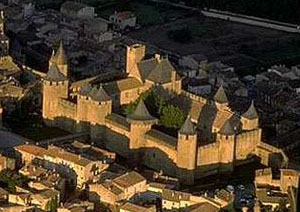
Siege of Carcassonne.
From 1st to 15th of August Carcassonneis
besieged. Its Viscount, Raymond-Roger
Trencavel, is seized during a truce and without their commander
the inhabitants surrender. The Crusaders expel the inhabitants
with a day's safe conduct, so that they can loot at leisure.
It is at this stage that Simon
de Montfort is appointed to hold Raymond-Roger's territories.
|
| 1209 |
August/September |
Château de Saissac abandoned by Bertrand
de Saissac |
| 1209 |
10th of November |
Death of Raymond-Roger Trencavel in mysterious circumstances,
in his own prison. |
| 1210 |
|
Siege of Bram.
When the castle at Bram
falls in 1210, 100 prisoners have their noses cropped, their
lips cut off and their eyes gauged out. One man is left with
one eye so that he can guide the others away. With a hand on
the shoulder of the one in front, and the one-eyed man at their
head, a file of blind prisoners winds its way to Lastours
(Cabaret), a visible demonstration of the ineffable mercy
of God's Army. |
| 1210 |
February |
Simon
de Montfort fails repeatedly to capture the Castles
of Lastours
(Cabaret) |
| 1210 |
Early June |
The "Montréal Meeting" is convened between
Peter II of Aragón and Languedoc lords. The lords were prepared
to swear allegiance to the king in return for his support. The
negotiation fell through. |
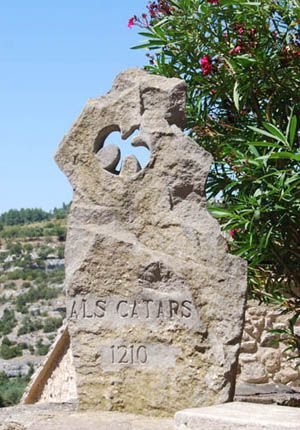
| 1210 |
June-July |
Siege of Minerve.
|
| 1210 |
22 July |
Capture of Minerve,
following a six-week siege, led by Simon de Montfort, Viscout
Aimeri de Narbonne, Guy de Lucy, Jean de Monteil, & Robert
de Mauvoisin. 140-180 Cathar men and women are burned alive
when they refuse to abjure their faith. |
| 1210 |
22 July |
The Seigneur de Ventajou offers his submission
at Minerve.
Simon de Montfort destroys the Château de Ventajo |
| 1210 |
22nd of August- November |
Siege of Termes,
which fell after a four-month siege.
Raymond de Termes imprisoned at Carcassonne and dies a few years
later. |
| 1210 |
End November |
Guillaume de Durfort is dispossed of his feudal
holdings including the château de Durfort. (In 1212, Guillaume
de Durfort lost his holdings at Fanjeaux (to Robert de Mauvoisin).
In 1215, a legal case confirms the Termenès and the Seigneurie
de Durfort now belongs to Alain de Roucy, a crusader and one
of the principal lieutenants of Simon de Montfort.) |
| 1210 |
End November ? |
Three day siege of Puivert.
Its lord, Bernard de Congost, and his family escape. |
| 1211 |
|
Council of Montpellier, at which Raymond
VI of Toulouse is excommunicated for the third time. |
| 1211 |
Early March |
Surrender of Cabaret, under diplomatic
rather than military pressure by Pierre Roger de Cabaret. |
| 1211 |
3rd of May |
Capture of Lavaur. Lavaur
falls after a siege, after which the French crusaders excel
even themselves in cruelty and disregard for the accepted rules
of war. Aimeric-de-Montréal and 90 knights are hanged. The chatelaine,
Geralda de Lavaur, is thrown alive into a well which is then
filled with stones until her screams can no longer be heard.
As in all other cases, Cathar Parfaites
decline to abjure their faith. 400 cathars are burned by the
crusaders, "with great joy" as de Cernay noted. (The crusaders
generally burned people alive with great joy - cum ingenti gaudio).
One Parfaits
allegedly renounced his faith. The rest sing as they are being
led to the pyres. |
| 1211 |
16th to 29th of June |
Siege of Toulouse. Simon
de Montfort besieges Toulouse, without success. |
| 1211 |
September |
Siege of Castelnaudary.
The tables turned, Simon
de Montfort is besieged in Castelnaudary
by the Count of Toulouse and his ally the Raymond
Roger Count of Foix. |
| 1212 |
|
The Childrens' Crusade to the Holy Land is launched.
More than 50,000 children would be sold into slavery at Marseilles. |
| 1212 |
11 April |
Siege and capitulation of Hautpoul by Izarn
d'Hautpoul. |
| 1212 |
16th July |
The battle of Las Navas de Tolosa. Turning
point of the Crusade against the Moors in Spain. |
| 1212 |
8th of September |
Surrender of Moissac. Simon
de Montfort captures cities of the Albi and the Quercy regions
which had rebelled against the occupation by the crusaders. |
| 1213 |
|
Councils of Orange and Lavaur. |
| 1213 |
27th of January |
Raymond
VI of Toulouse renders feudal homage to Peter II King of
Aragón. |
| 1213 |
July |
Raymond
VI of Toulouse recapturs Pujol. |
| 1213 |
September |
Battle of Muret. Simon
de Montfort is besieged in the Castle of Muret by Raymond
VI of Toulouse and Peter II of Aragón. Due to Peter's foolhardy
bravado he is killed in hand-to-hand fighting, and a battle
already won by the allies is converted into a route by de Montfort's
forces. Raymond
VI of Toulouse goes into exile, seeking refuge with his
Plantagenate relative King
John of England. |
| 1215 |
May |
Surrender of Toulouse to Simon
de Montfort |
| 1215 |
1st of June |
Prince Louis and Simon
de Montfort enter Toulouse |
| 1215 |
|
In Enland, King John seals Magna Carta under
duress. |
| 1215 |
24 August |
At John's request, Pope Innocent III declares
Magna Carta invalid. Innocent declared the Catholic Church to
be a state and, so, heresy is a crime against the state like
treason and should be punished accordingly.. |
| 1215 |
11-30, November |
Fourth Lateran Council. This Council
was the main even of Innocent
III's pontificate. Pope
Innocent expanded Gregory VII's claims to temporal as well
as spiritual matters, trying to impose a theocracy on the Christian
world. A practical application of these temporal claims was
the purported dispossession of Raymond
VI of Toulouse whose estate was allotted to Simon
de Montfort, who thus adopted the title Count of Toulouse. |
| 1216 |
May-24th of August |
Siege of Beaucaire. Raymondet, the son of Raymond
VI of Toulouse, the future Raymond
VII of Toulouse, lands in Marseille and besieges Beaucaire.
When de Montfort leaves Toulouse to intervene, the inhabitants
of Toulouse seize the opportunity to revolt (see next).
It declares that: "...Convicted heretics shall be handed
over for due punishment to their secular superiors, or the
latter's agents. ...If a temporal Lord neglects to fulfill
the demand of the Church that he shall purge his land of the
contamination of heresy, he shall be excommunicated by the
metropolitan and other bishops of the province. If he fails
to make amends within a year, it shall be reported to the
Supreme Pontiff, who shall pronounce his vassals absolved
from fealty to him and offer his land to Catholics. The latter
shall exterminate the heretics,
possess the land without dispute and preserve it in the true
faith... "
|
| 1216 |
16 July |
Death of Pope Innocent III |
| 1216 |
18 July |
Honorius III elected pope. |
| 1216 |
Early September to October |
Popular Uprising in Toulouse |
| 1216 |
22 December |
Pope Honorius III gives official approval for
the Order of Preachers (Dominicans), founded by St. Dominic.
The Dominicans become the main administrators of Inquisitorial
trials. |
| 1217 |
February-March |
Siege of Montgrenier. |
| 1217 |
22nd of May |
Surrender of Peyrepertuse. |
| 1217 |
12th of September |
Raymond
VI of Toulouse re-enters Toulouse. |
| 1217 |
13th September 1217 to 22 July 1218 |
Second Siege of Toulouse. Stung by the
humiliation of losing Toulouse, Simon
de Montfort besieges the city again. |
| 1218 |
25th of June |
During the siege of Toulouse a stone hurled
from a mangonel strikes Simon
de Montfort on the head and kills him, an event that is
still celebrated in the Languedoc. After his death his son Amaury
takes over the leadership of the crusade. |
| 1218 |
October 1218 to June 1219 |
Siege and capture of Marmande |
| 1219 |
16th of June - 1st of August |
Third Siege of Toulouse |
| 1220 |
July to March 1221 |
Second siege of Castelnaudary |
| 1220 |
22 November |
Holy Roman Emperor Frederick crowned
by Pope Honorius III in the expectation that Frederick would
participate in the Fifth Crusade. |
| 1221 |
|
Raymond
VI of Toulouse captures Montréal. |
| 1222 |
|
Raymond
VI of Toulouse builds a fortified village for refugees at
Cordes (Now called Cordes sur ciel) |
| 1222 |
August |
Death of Raymond
VI of Toulouse |
| 1223 |
|
Council of Sens, at which attempts are
made to end the crusade. Churchmen insist that it continue. |
| 1223 |
March |
Death of Raymond Roger of Foix. He is succeeded by
Roger Bernard II (the Great) Count of Foix (1223-1241) |
| 1223 |
July |
Death of Philip II (Philip Augustus),
King of France |
| 1223 |
|
Start of the reign of Louis
VIII (1223-1226). Defeated, Amaury de Montfort turns
to the King of France for help and bestows his rights on the
French King. Louis
VIII, appointed commander of the crusade by the pope, carries
out more atrocities in the Languedoc. His death reverses the
Crusaders' fortunes and Raymond
VII of Toulouse recovers part of his estate. |
| 1223 |
29 December |
Pope Honorius III gives formal approval for the
Franciscan Order. |
| 1224 |
February |
Raymond Trencavel II recovers the estates of
his father Raymond-Roger Trencavel who died at the hands
of the Crusaders at Carcassonne
in 1209. Amaury de Montfort returns to France |
| 1225 |
|
Raymond
VII of Toulouse is declared an enemy of the Church. |
| 1225 |
|
The Council of Bourges initiates a second
crusade. |
| 1226 |
|
Cathar Council of Pieusse
creates a Cathar bishopric in the Razés. |
| 1226 |
30th of January |
Led by the King of France, Louis
VIII, French crusaders arrive in the Languedoc. With the
exception of Toulouse, local resistance collapses. |
| 1226 |
July |
Carcassonne
surrenders to the French Crusaders. |
| 1226 |
9th of September |
The Crusaders take Avignon |
| 1226 |
3rd of November |
Death of Louis
VIII while returning to France. |
| 1226 |
|
Accession of Louis
IX (later Saint Louis), and since he is still a child, start
of the regency of Blanche
of Castile |
| 1227 |
18 March |
Pope Honorius III dies. |
| 1227 |
19 March |
Start of the Pontificate of Gregory IX (1227-1241) |
| 1227 |
|
Council of Narbonne endorses the excommunication
and anathema against Raymond
VII of Toulouse. |
| 1227 |
29 September |
Pope Gregory IX excommunicates German emperor
Frederick II |
| 1228 |
|
The Sixth Crusade Launched |
| 1228 |
|
Raymond
VII of Toulouse submits to Blanche
of Castile Regent for Louis IX of France. Raymond Trencavel II and other seigneurs are
stripped of their possessions and become faidits. Raymond Tranceval
seeks refuge in Aragón. |
| 1229 |
January |
Treaty of Meaux under which Raymond
VII of Toulouse pledges to exterminate "heresy", to marry
his daughter to the son of Louis
VIII, Alphonse de Poitiers (brother of Louis IX). The treaty
also specifies that the County of Toulouse would be consolidated
within the Kingdom of France if the marriage produces no heirs.
The establishment of the Inquisition
is often dated from this meeting, though it had already been
planned before this treaty. |
| 1229 |
|
Council of Toulouse. Devises procedures
to apply the Treaty of Meaux. |
| 1229 |
|
The Inquisition prohibits the reading of the
Bible except by churchmen |
| 1229 |
Spring |
Roger-Bernard de Foix makes his peace with the
Louis IX. |
| 1231 |
|
Pope Gregory IX issues Excommunicamus,
incorporating into canon law the 1224 constitution of Frederick
II. This explicitly permits the burning of heretics at the stake.
|
| 1232 |
|
Guilhabert de Castres, the most prominent Cathar
bishop administers the Consolamentum
in hundreds of Languedoc townships. He then establishes himself
in the Cathar stronghold at Montségur
(
Montsegùr)
- where he holds a Cathar Council. |
| 1233 |
13th April |
Gregory IX formally established the Inquistion,
and appoints the Dominicans
to administer it. |
| 1233 |
26 May |
Pope Gregory IX dispatches Inquisitors to Aragon, having
assigned the Inquisitorial process to theDominican Order the
previous year. In the Bull Declinante jam mundi, Archbishop
Esparrago and his suffragans are instructed to search for
and punish heretics in their dioceses.
The first permanent tribunal to deal with heresy is set up
in Toulouse.
|
| 1234 |
|
210 people are condemned to the stake by Inquisotors
at Moissac. |
| 1237-1241 |
|
Following a request from Raymond
VII of Toulouse, the widely despised Inquisition
agrees to suspend its activities in the county of Toulouse for
a four-year period. |
| 1237 |
|
At the Council of Lerida the Inquisition is
formally placed under the authority of the Dominicans and the
Franciscans. |
| 1239 |
29 May ??? |
183 Cathars are burned at Montwimer (Marne)
by Robert le Bougre in the presence of the Count of Champaigne. |
| 1240 |
7th of September - 11th of October |
Raymond Trencavel II returns from exile in
Aragón with an army and besieges Carcassonne
|
| 1240 |
16th of November |
Surrender of Peyrepertuse
to the French. |
| 1241 |
|
First Siege of Montségur.
To appease Louis IX, Raymond
VII of Toulouse, besieges Montségur
(
Montsegùr)
but without success. |
| 1241 |
May |
Death of Roger Bernard II (the Great) Count
of Foix 1223-1241 |
| 1241 |
22 August |
Pope Gregory IX dies |
| 1242 |
28 May |
Massacre of lnquisitors at Avignonet.
As part of an abortive uprising, two widely hated Inquisitors
were killed, along with their retinue, by soldiers from Montségur
(
Montsegùr)
(led by Pierre-Roger de Mirepoix). |
| 1242 |
20 May |
Royan. Henry
III, King of England lands on the Atlantic coast of the
Aquitaine. |
| 1242 |
July |
Taillebourg. Victory of Louis IX King
of France over Henry
III, King of England at Taillebourg. |
| 1243 |
January |
The Peace of Lorris by which Raymond
VII of Toulouse definitively surrendered to Louis IX. |
| 1243 |
Spring |
Council of Béziers:
Raymond
VII of Toulouse appeals for his excommunication to be lifted.
The Council decides to "cut off the head of the dragon" referring
to Montségur
(
Montsegùr)
. |
| 1243 |
May |
Siege of the Château
of Montségur. Montségur
(
Montsegùr)
is besieged by the French Crusaders begins. Inside, a military
garrison of around 200 knights and soldiers protected a further
200 Parfaits
and their families. |
| 1243 |
25 June |
Innocent IV is elected pope. |
| 1244 |
March |
Fall of the Château
of Montségur after a siege lasting 10 months.
Between the start of negotiations of the surrender and the final
rendition, some 25 ordinary believers opt to receive the Consolamentum,
knowing the implications. |
| 1244 |
16th of March |
Around 225 Parfaits,
including the 25 recent additions, were burnt alive on a huge
pyre at the foot of the pog of Montségur
(
Montsegùr)
(in a field now called the 'Prat dels Cremats (field of the
burnt). |
| 1247 |
7th of April |
Raymond Trencavel II submits in Béziers |
| 1248 |
|
Crusade to the Holy Land. Louis
IX (later Saint Louis) goes off on crusade , and is later
captured in Egypt. |
| 1248 |
??? |
Raymond
VII of Toulouse has eighty confessed heretics burned in
his presence without giving them a chance to recant. |
| 1248 |
|
Death of Raymond
VII of Toulouse, without a male heir. His estates pass to
his daughter, Jeanne, married to Alphonse de Poitiers, brother
of Louis IX. |
| 1252 |
15 May |
Torture to elicit confessions is authorized
by Pope Innocent IV in his Bull Ad exstirpanda. It would
be confirmed by Pope Alexander IV in 1259 and by Pope Clement
IV in 1265. In Ad exstirpanda Innocent IV wrote: "When
those adjudged guilty of heresy have been given up to the civil
power by the bishop or his representative, or the Inquisition,
the podestˆ or chief magistrate of the city shall take
them at once, and shall, within five days at the most, execute
the laws made against them. " He also ordered that this
Bull and corresponding regulations of Frederick II be entered
in every city among the municipal statutes under pain of excommunication,
a punishment also visited on those who failed to follow the
papal and imperial decrees. |
| 1254 |
7 December |
Death of Pope Innocent IV. |
| 1254 |
12 December |
Alexander IV elected pope. |
| 1255 |
|
Return of Louis
IX, Saint Louis |
| 1255 |
Spring |
Surrender of Quéribus After the fall
of the Château of Montségur
(
Montsegùr),
Cathar resistance had centred on another remote mountain stronghold,
this time in the Fenouillèdes, in the Roussillon, legally belonging
to the King of Aragón and so outside the jurisdiction of the
French crown. Another siege was planned. This time the Cathars
leave before the arrival of the French troops, fleeing presumably
to seek sanctuary elsewhere in Catalonia, Aragón or Piedemont. |
| 1256 |
??? |
In Ut negotium, Pope Alexander IV allows
Inquisitors to absolve one another of any "irregularities"
they commit while engaged in their work, ensuring that there
is no effective oversight of their activities. |
| 1258 |
11th of May |
Treaty of Corbeil. This treaty, concluded
between Louis
IX, Saint Louis and Jaume I of Aragón, ratified the French
seizure of Queribus
and the surrounding area in the Fenouillèdes. Aragón ceded all
lands north of the River Agly. Subsequently Louis IX and Philip
the Bold re-inforced or rebuilt Puilaurens,
Aguila, Queribus,
Peyrepertuse
and Termes
to form a line of defence for the new border. These five castles
are together known as the five sons of Carcassonne.
Many Cathars withdraw to even more remote places of safety such
as caves or forests. Others are sheltered by friends or flee
to Piedmont. Some die of exposure or starvation, or fall into
the hands of the Inquisitors. |
| 1259 |
30 November |
Pope Alexander IV confirms the policy of using
torture to elicit confessions, first authorized by Pope Innocent
IV in Ad exstirpanda. |
| 1261 |
25 May |
Pope Alexander IV dies |
| 1261 |
29 August |
Urban IV elected pope |
| 1264 |
2 October |
Pope Urban IV dies |
| 1265 |
5 February |
Clement IV elected pope. |
| 1267 |
|
Pope Clement IV creates a new Inquisition in
Rome. |
| 1268 |
|
"28 cart loads" of Cathars are burned alive
at Plaisance in Lombardy. |
| 1271 |
1 September |
Gregory X elected pope. |
| 1271 |
October |
Annexation of the county of Toulouse.
Following the death of Alphonse de Poitiers and Jeanne de Toulouse
the county of Toulouse is incorporated into the French Royal
Demesne. |
| 1278 |
|
Cathar persecutions continue elsewhere. 200
Patarins are burnt at the stake in Sermione. 200 Cathars are
burnt in Verona. |
| 1286 |
|
The consuls of Carcassonne complain to the pope,
the King of France, and the local bishop about the Inquisitor
Jean Garland, whom they alleged had been inflicting torture
in an utterly inhuman manner |
| 1321 |
|
Death of Guillem Bélibaste, Guilhem
Belibaste was the last known Parfait
in the Languedoc, burned alive at the château at Villerouge
Termenès. |
| 1328 |
|
510 Cathars are allegedly walled up alive in
the Lombrives cave, on orders from the Inquisitor Jacques
Fournier, who is later elected pope. This incident
seems at best no more than folklore. |