 |
Cathars and Cathar Beliefs in the Languedoc
|
 |
|
||||||||||||||||||||||||||||||||||||||||||||
|
|
|
|
|
|
|||||||||||||||||||||||||||||||||||||||
|
|
||||||||||||||||||||||||||||||||||||||||||||
|
|
Cathar Terminology
A source of confusion is the number of different names used for Catharism and its adherents. This is partly due to the different languages used - Roman Catholics tended to use Latin, people in the Languedoc used Occitan the local language, while modern studies often favour French or English terms. Another source of confusion is that some Catholic critics were themselves confused by what the Cathars were and where they had come from. Many names are derived from villages where Catharism flourished, developing into a local centre, not only in the Languedoc, but throughout Europe. Many catholic authorities imagined that all "heresies" were essentially the same, so Cathars could be lumped together with Waldensians (or Vaudois), Arians, Marcians and dozens of others, included many who might have been no more than disenchanted monks (or, later, friars) criticising their own Roman Catholic Church. Scholars are not unanimous in identifying the Cathars of the Languedoc and Italy with the Bogomils of the Balkans, nor with other earlier Gnostic Dualists - but realistically there is little doubt that there was a continuous chain of teaching from the earliest Christian times to the thirteenth Century Languedoc. For this reason I have included terms for Bogomils in this section.
The Good Men and Good Women
Cathars referred to their male elect as bons omes, The Occitan for "good men". In Latin the term is boni homines and in modern French bonnes hommes, also meaning "Good Men". Women members of the elect were bonas femnas, "good women". In Latin the term is bone femine and in modern French Bonnes Femmes, also meaning "Good Women". Together they were "good Christians", but good men and good women themselves frequently referred to each other as 'the friends of God'. Catholic writers often failed to distinguish between members of the elect and ordinary believers, referring to all as good men or good women.
Various other names were used for Gnostic Dualist sects that we would today call Cathars. A list of these names is given below:
Cathars and variations,
|
|||||||||||||||||||||||||||||||||||||||||||
|
|
Clement seems to be confirming that early Church practices were identical to Cathar ones - where Perfected adherents were those who had completed their training in gnosis, the secret knowledge of the Gnostics, which was deliberately kept from the mass of the faithful.
The idea is also present in the gospels. When a rich young man asks what more he must do to achieve eternal life, according to Matthew 19:21, Jesus answers "If thou wilt be perfect, go and sell that which thou hast, and give to the poor, and thou shalt have treasure in heaven: and come and follow Me" [my emphasis].
When administrating the Consolamentum, the Parfaits were sometimes known as Soul Collectors by other Cathars.
Ordinary believers were variously known as believers (credentes) and less involved listeners (auditores).
Their heresy (as Roman Catholics saw it) was "The Great Heresy".
|
|
 |
|
|
Devil and the cat worshippers kissing the cat’s backside. Jean Tinctor, Traittié du crisme de vauderie (Sermo contra sectam vaudensium), Bruges ca. 1470-1480 (Paris, BnF, Français 961, fol. 1r). Like Cathars, any group considered heretical were accused by the Catholic Church of worshipping cats. Here Waldensians are shown queuing up to kiss the rear end of a cat. |
|
 |
|
|
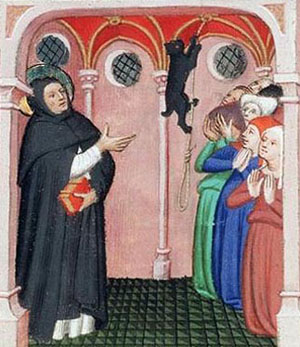
Dominic Guzmán (later Saint
Dominic) bravely seeing off a malodorous, black, catlike,
demonic apparition of terrific size with savage eyes and formidable
claws - which escapes up the bell-rope. This miracle supposedly
caused nine women to renounce their Cathar beliefs. |
|
 |
Alternative Names for Cathars
Patarenes and variants of the word: Patareni, Paterini, Patrini, Paterelli, Patalini. The word seems to have originally been used in the early eleventh century for a reforming part in the church of Milan, but was soon transferred to Cathars. It became the standard name in Dalmatia and was used extensively in Italy especially after the thirteenth century. In both places it was used indiscriminately for local Cathars and those from Bosnia.
Manichaeans: a reference to an ancient Dualist synthetic religion founded by Mani in the fourth century. Aurelius Augustinus, later St Augustine of Hippo (354 – 430) had been a Manichaean but he left when he realised that he was not going to advance in the hierarchy. He therefore transferred to the branch of the Christian Church that developed into the Roman Catholic Church - bringing some Manichaean ideas with him, but leaving detailed denunciations of others in his writings. When later scholars read his works and compared Manichaean beliefs with contemporary Cathar beliefs they deduced that Cathars were Manichaeans, and adopted the term to describe them. It is more than possible that they were wrong and that Manichaeans and Cathars shares a common Gnostic Dualist Christian ancestor sect.
More on the Manichaeans
Tixerands with variations Textores, Tisserands and Tisseyres. The reference of to Weavers and other cloth workers. Cathar Elders often earned their living by weaving, and it is likely that cloth merchants introduced Cathar ideas to western Europe - they travelled back and forth to the east. As Runciman explains it "Many of the missionaries were itinerant cloth merchants, whose trade was the chief trade that linked Eastern and Western Europe. It was their function to carry the woven silks of Byzantium and the East to the eager markets of the West. They were therefore ideally placed to be the channels of an Eastern faith. From them the residents cloth merchants learnt the doctrine and spread it to the actual weavers. Clothiers' shops were well suited to be centres of heresy, for it was perfectly natural for the women of the district to gather and gossip there" (Runciman, The Medieval Manichee, p 169)
Albigenses, Albigensians, Albigeois; The name Albigenses, given to them by the Roman Catholic Council of Tours (1163) was common towards the end of the twelfth century. It comes from the name of the town of Albi (Latin Albiga,) where the Roman Church imagined the heresy to be centred - hence the Albigensian Crusade. Roman Catholic works still favour the name Albigenses or Albigensians for what almost everyone else now calls Cathars. During the wars against the people of the Languedoc geographic names were often used to denote both Cathars and people from the area whether Cathars or not - possibly a deliberate blurring of the distinction between Cathars and Catholic victims of the Crusaders. As well as Albilensian, the words Toulousain and Provençal were used in this way.
Paulicians: a reference to an early Gnostic theologian regarded by the Roman Church as a heretic.
Publicans: and variants Publicani, Populicani: This term was used in France and especially in Champagne in the eleventh and twelfth centuries. It seems to have started life as a a Latinised version of Paulician, which was misunderstood as a reference to the "Publicans" of the New Testament. It is possible that the word Pauliciani had been picked up by western Crusaders passing through Constantinople and then applied to people back home with surprisingly similar beliefs. By some curious turns Publicani seems to have been distorted into Teleonarii and thence Deonarii to which there are a few references.
Piphles, and variants Piphiles and Pifli. This is thought to be yet another improbable corruption of the term Popliocani. It was used extensively in Flanders.
Bulgars: variations Bulgari, Bougres, Bugares and Buggers: originally denoting their real or supposed Bulgarian origins - but Catholic propaganda successfully caused the name to be associated with sodomy.
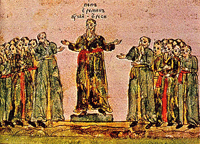
 Bogomils:
a reference to follows of Bogomil - a leader of a sect in the Balkans
with very similar Manichaean teachings. This term was used extensively
by Bulgarian writers and sometimes by Byzantine writers.
Bogomils:
a reference to follows of Bogomil - a leader of a sect in the Balkans
with very similar Manichaean teachings. This term was used extensively
by Bulgarian writers and sometimes by Byzantine writers.
Phundaites: The name is derived from the Greek word for a scrip, a reference to the document (presumably the John Gospel) that they were reputed to carry. The term is used only in the works of twelfth century Byzantine writers.
Kudgers: a late medieval term apparently for Bogomil believers and derived from a the name of the village of to Kotugeri near Vodena (modern Kaisariana in the Pella Prefecture, near Edessa in Greece).
Babuni: a name given to Gnostic Dualists in Serbia and Bosnia, up to the fourteenth century.
Concorricii: Cathars from Concoresso (In modern Italy).
Garatenses: a term applied to a school of Cathar believers founded by Bishop Garatus in Concoresso (In modern Italy). this is the term used in the famous Liber de Duobus Principiis.
Runcarii, with variants Rungarii, Roncaroli, Runkeler. The name was applied to a group of German Cathars in the thirteenth century and is thought to have been a geographical name. The variant Roncaroli was used by Frederick II in his law against heresy (Mansi, Concilia, v xxii, p 590)
 |
 |
|
Cathars were known as |
 |
|
Eastern (Uyghur) Manichaeans writing (with panel inscription in Sogdian). 8th or 9th century Manuscript from Gaochang, on the northern rim of the Taklamakan Desert in what is now Xinjiang, China |
 |
|
The (vaguely related) "Cathars" in Star Wars have a cat-like appearance, a curious echo of a Catholic etymological error. |
 |
|
|
Names of Cathar Rites & Ceremonies
For Cathar Ceremonies and practices click on the following links:
Consolamentum or Consolament, from the Occitan word for "Console" or "Comfort", a reference to the Holy Spirit, identified with the "Paraclete" or Consoler. The Catholic Church referred to this as "heretication".
Melhoramentum. A greeting by a Cathar Believer acknowledging Holy Spirit dwelling with the Parfait. Contemporary Catholics imagined that the Believer was "adoring" the Parfait.
Apareilementum or Aparelhament or Apparellamentum or Servissi (Service). A monthly Cathar rite involving a public and a solemn General Confession, identical to the earliest form of confession known in the Christian Church. It is given in the Occitan Cathar Ritual (Lyon Ritual). It seems to have been restricted to the Elect.
Convenenza or Convenientia from the Occitan words for "Coming Together", a sort of preliminary initiation
Endura. A form of suicide or voluntary euthanasia. The Occitan word translates as "fasting", literally "enduring".
|
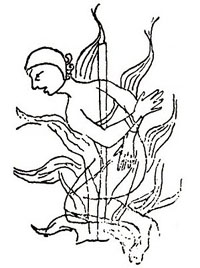
A modern recreation of the Cathar Ceremony of the Consolamentum |
 |
Further Information on Cathars and Cathar Castles
|
If you want to cite this website in a book or academic paper, you will need the following information: Author: James McDonald MA, MSc.
If you want to link to this site please see How to link to www.cathar.info
For media enquiries please e-mail james@cathar.info
|




| CATHAR BELIEFS | CATHAR WARS | CATHOLIC CHURCH | CATHAR INQUISITION | CATHAR CASTLES | CATHAR ORIGINS | CATHAR LEGACY | CATHAR TOURS | CATHAR BOOKS | WHO's
WHO |
CATHAR TIMELINE | MORE INFO |
CATHAR GLOSSARY | CATHAR NEWS |
|
|

|
| Follow
@Cathar_Info
|
| Tweet
|
 |
| :::: Link to www.cathar.info ::: © C&MH 2010-2016 ::: contact@cathar.info ::: Advertising ::: |