|
|
|
|
|
|
|
|
|
|
|
HOME
CATHAR
BELIEFS
Basic
Tenets
Implications
Cathar
Believers
Cathar
Elect
Afterlife,
Heaven
& Hell
Other
Beliefs
Cathar
Ceremonies
Cathar
Prayer
The
Cathar Hierarchy
CATHAR
WARS
Albigensian Crusade
Who
led the Crusade ?
Crusader
Coats of Arms
Defender
Coats of arms
Medieval
Warfare
CATHOLIC
CHURCH
Cistercians
Dominicans
Franciscans
Cathars
on Catholics
Catholics
on Cathars
Catholic
Propaganda
"Kill
Them All ... "
Waldensians
Troubadours
CATHAR
INQUISITION
Inquisition
Inquisition
documents
CATHAR
CASTLES
Cathar
Castles
Cathar
Castle Photos
CATHAR
ORIGINS
Early
Gnostic Dualism
Manichaeans
CATHAR
LEGACY
Geopolitics
Historical
Studies
Popular
Culture
Catholic
Inheritance
Protestant
Inheritance
Cathar
Vindications
Do
Cathars still exist ?
CATHAR
TOURS
WHO's
WHO
The
Catholic Side
The
"Cathar" Side
Counts
of Toulouse
The
Cross of Toulouse
CATHAR
TIMELINE
Detailed
Chronology
MORE
INFORMATION
CATHAR
TERMINOLOGY
A
Cathar Glossary
|
The Cathar Legacy
The influence of Catharism on the Catholic Church was marked in
the medieval period, and is still visible today. Here are
just a few examples.
In attempting to present itself in the same light as the popular
Parfaits,
the papacy created new preaching orders like the Dominicans
and Franciscans.
The Dominicans
in particular are a very obvious attempt to copy of the Parfaits.
When they were set up they travelled around the Languedoc countryside
in pairs, walking, dressing simply in sandals and plain habits,
avoiding the ostentation of other churchmen, and preaching poverty.
In this they were consciously and explicitly emulating Parfaits.
You can see them today, still wearing their black robes, almost
identical to the habit of the people they were responsible for exterminating.
Again, the first nunnery, set up by Dominic
Guzmán (Saint Dominic), was a copy of a convent for Cathar
Parfaites.
To emulate Cathar asceticism, celibacy was imposed on the Roman
Catholic clergy after centuries of lip service. New ecclesiastic
buildings were notable for their simplicity and lack of the usual
ostentation (the Cathedral at Albi
shown on the right is a spectacular example).
The doctrine of transubstantiation, first formally declared at
the Fourth Lateran Council in 1215, looks suspiciously like a way
of contradicting Cathar teaching on the impossibility of combining
earthly and spiritual elements. Again, the sacrament of extreme
unction appears to have evolved by way of competing with the deathbed
Consolamentum.
Marian devotion was developed by Dominic
Guzmán as a way of countering the role accorded to women
by the troubadours
and perhaps to a lesser extent by the Cathars.
There is a strong case that the Reformation was fuelled by the
preserved ideas of the Cathars and their fellow "heretics".
Certainly, many Cathar ideas can be found in modern Protestant doctrine.
Click on the following link for a summary of Cathar
ideas developed by Protestants . .
It can also be argued that the Roman Church itself is slowly catching
up with the Cathar Church, slowly abandoning its traditional teachings,
and embracing ever more Cathar ideas. Click on the following
link for a summary of Cathar
ideas adopted by Roman Catholics
This page
Cathar
Influence on modern Europe and world geopolitics
Cathar
Influence on Historical Studies
Cathar
Influence on modern Popular Culture
Cathar
Influence on the Catholic Church
Cathar
Influence on Protestant and other Churches
Cathar
ideas developed by Protestants.
Vindications
of Cathar claims
Catharism
Today. Do Cathars still exist ?
|
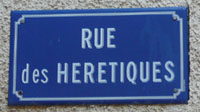
Persecuting Cathars, Jews, and other minorities,
and making them wear yellow "badges of infamy" was
a requirement of the Catholic Church imposed on the rulers
of the Languedoc.
|
 |
| |
|
The nascent Occitan indiependence movement
has adopted the Cross of Toulouse from the armorial bearings
of the medieval Counts
of Toulouse.
|
 |
| |
|
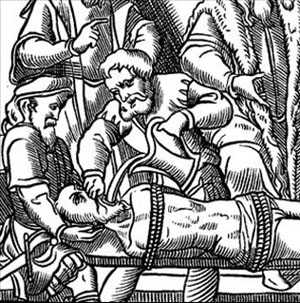
Medieval Inquisition
torture methods are still in use today.
|
 |
|
|
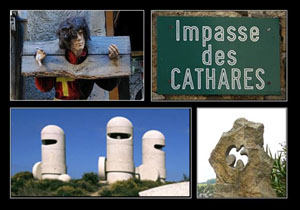
Reminders of the Cathar Period
|
 |
| |
|
Reminders of the Cathar Period
|
 |
| |
|
Reminders of the Cathar Period. The Cross
of Toulouse is still widely used throughout the Languedoc
|
 |
| |
|
The Counts
of Toulouse are popular
among medieval re-enactors
|
 |
| |
|
A monument to the Cathars.
Autoroute aire: Pech Loubat,
in the Aude on the A61 near Nîmes
|
 |
| |
| |
| |
| |
| |
|
| |
Cathar Influence on Modern Europe
and World Geopolitics
The annexation of the Languedoc was the first step in building
modern France. This was the result, conscious or not, of Pope
Innocent III's actions in calling for a crusade against fellow
Christians, and in his claim to be able to reassign feudal properties
over the heads of feudal suzerains.
This approach is consistent with
Innocent's views of himself, set midway between God and Man,
and given the whole world to rule over. During his reign,
Innocent managed to establish himself at the head of a single
international feudal hierarchy, claiming as vassals not just the
Holy Roman Emperor but the Kings of Aragon, Portugal, Hungary and
England.
Before Innocent
III, Europe had been a patchwork of feudal possessions, after
him it was destined to become a collection of much larger nation
states, an extended process that would see its fulfilment in the
nineteenth century with the unification of Italy and Germany.
The success of Catharism as an alternative belief system that appealed
to people more than Roman Catholicism also set a precedent. The
same criticisms of the Roman Church articulated by the Cathars were
echoed by other groups of "heretics" - the Waldensians
followed by Lollards, Hussites, Anabaptists, Huguenots, and Protestants.
The broad division of Europe into Protestant North and Catholic
South can therefore also be traced back directly to Cathar dissidents.
The tollerance and liberalism of modern democracy can also be traced
to the Languedoc of the Cathars, troubadours and medieval Counts
of Toulouse. A number of democratic countries including the
USA commemorate the Counts of Toulouse as instrumental in the development
of local democracy.
|
|
| |
Cathar Influence on Historical Studies
Historically, few historians in France and almost none outside
France have taken any interest in the Cathars. Even Voltaire devoted
only a chapter to them.
In the last century Cathar studies in universities around the
world have exploded, and there is now a wealth of material in most
European languages - both books and academic papers.

|
|
| |
Cathar Influence on Popular Culture
Cathars are widely recognised in popular culture, including books,
cartoon strips, films and music. The Singing Nun sang of
Dominic
Guzmán's role in attempting to induce Cathars to accept
the Catholic faith. Iron Maiden sang of the massacre at Montsegur.
Elements of the Cathar story appear in books like The Holy Blood
and the Holy Grail and the Da Vinci Code, and in films
such as the Raiders of the Lost Ark and Star Wars.
|
| |
|
The Singing Nun sang of Dominic
Guzmán's role in attempting to induce Cathars to
accept the Catholic faith. Iron Maiden sang of the massacre
at Montsegur.
|
 |
| |
|
"Kill
Them All ... " First articulated during the Cathar
wars, and still a popular idea among traditionalist Christians
|
 |
| |
|
The (vaguely related) "Cathars"
in Star Wars have a cat-like appearance, strange echo of a
Catholic etymological error.
|
 |
| |
|
| |
Influence of Catharism on the Catholic Church
The influence of Catharism on the Catholic Church was marked in
the medieval period, and is still visible today. Here are
just a few examples.
In attempting to present itself in the same light as the popular
Parfaits,
the papacy created new preaching orders like the Dominicans
and Franciscans.
Dominicans
in particular represent a very obvious - indeed explicit - attempt
to copy of the Parfaits. When they were set up they travelled
around the Languedoc countryside in pairs, walking, dressing simply
in sandals and plain habits, avoiding the ostentation of other churchmen,
and preaching poverty. Even the idea of preaching in the local
language in order to be understood - let alone entertaining - was
an innovation copied from Cathar practice. They were consciously
and explicitly emulating Parfaits.
You can see them today, still wearing their black robes, almost
identical to the habit of the people they were responsible for exterminating.
Again, the first nunnery, set up by Dominic
Guzmán (Saint Dominic), was a conscious copy of convents
for Cathar Parfaites
in Fanjeaux..
To emulate Cathar asceticism, celibacy was imposed on the Roman
Catholic clergy after centuries of lip service.
New ecclesiastic buildings were notable for their simplicity and
lack of the usual ostentation (the Cathedral at Albi
shown on the right is a spectacular example).
The doctrine of transubstantiation, first formally declared at
the Fourth Lateran Council in 1215, looks suspiciously like a way
of contradicting Cathar teaching on the impossibility of combining
earthly and spiritual elements. Again, the sacrament of extreme
unction appears to have evolved by way of competing with the deathbed
Consolamentum.
Marian devotion was developed by Dominic
Guzmán as a way of countering the role accorded to women
by the troubadours
and perhaps to a lesser extent by the Cathars.
It can also be argued that the Roman Church itself is slowly catching
up with the Cathar Church, slowly abandoning its traditional teachings,
and embracing ever more Cathar ideas.
From early days in its history the Church that developed into the
Roman Catholic Church adopted popular ideas from their Gnostic counterparts.
The idea of creating a canonical "New Testament" was one
such idea. The first version of the New Testament was collated by
a Gnostic called Marcion. The idea of Apostolic
Succession is a another example. And what is technically called
mitigated Dualism is a third. The idea of a God of Light locked
in cosmic battle with a God of Darkness is characteristically Manichaean
- ie Gnostic Dualist - idea. Mitigated Dualists taught that the
good god will win in the end. Catholics take care not to refer to
the evil principal as a god. Modern Catholic teaching on this point
is indistinguishable from Catharist belief in its mitigated Dualist
form, as long as Satan is denied the title of a god (though Satan
is clearly called a god in the New Testament - see 2 Corinthians
4:4).
Part of the reason for this convergence is the history of men like
St
Augustine. Augustine was a Manichaean
- a Gnostic Dualist - but he failed to progress in his chosen religion,
and so defected to a group that in time would evolve into the Orthodox
and later Catholic Churches. Having failed to progress in the Manichaean
hierarchy, he flourished in his new Church but never entirely shook
off his Gnostic Dualist theological training.
The writings of medieval Catholic polemicists reveal examples of
Cathar ideas that were then regarded as extravagant, but today seem
unremarkable. The explanation is that at some time over the last
seven hundred years the Catholic Church has shifted ground and adopted
the Cathar position.
Example: The Fall of Satan. Cathar ideas of Heaven
and Hell
included a Fall from heaven, during which a number of angels were
expelled from Heaven
and fell to earth. Here is an extract from Montana of Cremona,
a Professor at the University of Bologna who became a Dominican
- possibly an Inquisitor, though this is not known for sure. He
is listing distinctively heretical beliefs - "What Heretics
May Believe, or Rather, Concoct" around 1241-1244:
They also say and teach that this devil [Satan], puffed up by
the deception which he had practised in heaven, presumed to ascend
into heaven with his cohorts and there joined battle with the
archangel Michael and was defeated and driven out. They think
that the verse Apocalypse 12:7, "And there was a great battle
in heaven. Michael and his angels fought with the dragon, and
the dragon fought with his angels" is to be interpreted with
reference to this battle. This they take literally.
English translation from the preface to Book 1
of Monetae Cremonensis adversus Catharos et Valdenses libri
quinque I (Descriptio fidei haereticorum), ed. Thomas A Ricchini
(Rome, 1743). For a fuller text see Walter Wakefield & Austin
Evans, Heresies of The High Middle Ages (Columbia, 1991),
p309
Few Catholics today would find this story of the Fall of the Angels
remarkable, since it is now Catholic orthodoxy.
Example: The identification of Mary Magdelene with the Woman
taken in adultery. Many Christians take for granted the identification
of the woman taken in adultery (John 8:3) with Mary Magdelene. In
fact the bible, makes no such connection and there is no substantial
reason to link the two. Anyone not taught that they are the same
person will have no reason to link them, and this seems to have
been the position of medieval Catholic clerics. Here is one, a Cistercian
chronicler writing around about the Cathars of the Languedoc in
1213-1216:
Further, in their secret meetings they said that Christ who was
born in the earthly and visible Bethlehem and crucified at Jerusalem
was evil, and that Mary Magdelene was his concubine - and that
she was the woman taken in adultery who is referred to in the
scriptures.
Historia
Albigensis - Pierre des Vaux de Cernay (WA &
MD Sibly's translation into English (Boydell, 2002) at {11} p
11).
Leaving aside the the author's main point in this text, he clearly
reveals that Catholics in his day did not identify Mary with the
woman taken in adultery. In other words, on this particular point,
modern Catholics hold the same views as medieval Cathars, not medieval
Catholics.
Since the Enlightenment, Catholic ideas have moved more quickly.
The Catholic Church no longer condemns the Cathar principles of
toleration, nor the equality
of women as it once did; and its attachment to feudalism
has been quietly dropped in favour of a vague attachment to democracy
since the late twentieth century.
The Cathars' absolute condemnation of capital punishment, was abhorrent
to medieval Catholic chroniclers and was still abhorrent to Catholic
apologists when Hilaire Belloc wrote his tract against the Albigensian
heresy in 1938 (Hilaire
Belloc, The Albigensian Attack, Chapter Five of The Great
Heresies). But the Cathar position has since then gradually
become more acceptable, and the was finally adopted by the Roman
Catholic Church at the end of the 20th century. The Roman
Church - or at least a Pope - condemned capital punishment unreservedly,
just as the medieval Cathars did.
So too for the position on war. Catholic priests are no longer
allowed to fight in wars at they did officially up to the nineteenth
century and unofficially until the twentieth. Senior Churchmen,
including popes like Julius II, were happy to don armour and fight
in wars. During the Cathar Crusades, Catholic abbots and bishops
took roles as military leaders, as they continued to do for centuries
afterwards. No Cathar
Parfait and Parfaite fought in the Crusade
against the Cathars of the Languedoc, even to defend themselves.
The position of the Catholic Church in the twenty first century
is becoming noticeably more pacifist, though it is not yet as pacifist
as the medieval Cathar Church.
Some Catholics are now vegetarians
without knowing that their Church would once have condemned them
to death for it.
Many lay Catholics own and read bibles, another Cathar practice
that was once a capital crime under the Catholic Church.
Many Catholics - most in the west - practice contraception. Up
until the 1960's the Vatican regarded all contraceptive methods,
including the "rhythm method", as mortal sins. Since then
the rhythm method has not been sinful, another small step
in the the direction of Cathar teaching which preferred contraception
to conception. In practice well over 90% of western Catholic couples
practice other forms of contraception despite the clear teaching
of their Church.
Some Catholics now support euthanasia,
and suicide
is no longer regarded with the horror it once was. Not so
long ago the Catholic Church was insisting that suicides be buried
in unconsecrated ground at cross-roads, with a stake through their
heart. Now the Church almost always spares the residual stigma of
suicide by the fact or the pretence that the balance of the suicide's
mind was disturbed at the time of death. In effect, the Cathar position,
finding no doctrinal objection to euthanasia
or suicide,
is gradually becoming more acceptable to educated western Catholics.
Many Catholics now favour the restoration of women to the positions
of authority they held in the very earliest Church and in the medieval
Cathar Church - preaching, teaching and administering sacred rites.
Sexual
equality a hot topic in the west and it is not impossible that
within the present century the Catholic Church will return to the
position held by the Early Church and by the medieval Cathar Church.
|
| |
|
Figure on the Basilica at Carcassonne
Wilful blindness was often used to characterise "heresy"
|
|
 |
| |
|
After the Cathar period the Catholic Church
adopted an architectural style with plain exteriors - as at
Lavaur and here at Albi.
Cathedrals from this period often resemble fortresses, since
the Church was still unpopular and in danger of attack from
local citizens who disliked bishops and Inquisitors alike.
|
 |
| |
|
Devil and the cat worshippers kissing the
cat’s backside Jean Tinctor, Traittié du crisme
de vauderie (Sermo contra sectam vaudensium), Bruges ca. 1470-1480
(Paris, BnF, Français 961, fol. 1r)
|
 |
| |
|
Dominicans
copied many aspects of Cathar practice, including the wearing
of black outer robes
|
 |
| |
| |
|
A Church in Transition:
Catechism of the Catholic Church on capital punishment,
2267: "The traditional teaching of the Church does
not exclude, presupposing full ascertainment of the
identity and responsibility of the offender, recourse
to the death penalty..."
On the other hand: in his 1995 encyclical letter "Evangelium
Vitae" ("The Gospel of Life" ), Pope
Jean-Paul II presented the Catholic Church's reasons
for opposing capital punishment. In his January 1999
visit to St. Louis, Missouri, he called for the end
of the U.S. death penalty saying, "the dignity
of human life must never be taken away even in the case
of someone who has done great evil."
|
|
| |
|
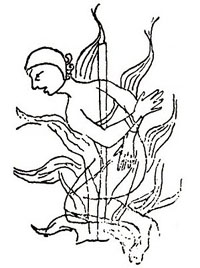
Around 1250 Alphonse de Poitiers wrote to
Pope Innocent IV asking him to issue a bull against heresy.
This document is known in the form of a draft, on the back
of which is a sketch showing a man being burned at the stake.
Alphonse's draft letter is held in the French
National Archives, in a dossier called "Grands documents
de l'histoire de France; Florilège", No
notice 00000192, Fonds MUS, Cote AE/II/257 (Cote origine J428/1):
described as "Projet de texte rédigé pour
Alphonse de Poitiers, comte de Toulouse, afin d'obtenir du
pape Innocent IV une bulle sur les poursuites contre les hérétiques.
Au verso figure le dessin d'un hérétique livré
aux flammes. Document non daté, en latin."
|
 |
| |
| |
|
|
|
|
|
| |
Influence of Catharism on Protestant Churches
Cathar teachings shared by the Waldensians
became defining features of Protestant belief. Many of these teachings
follow from the rejection of Roman Catholic "tradition" in favour
of scripture. Examples include the rejection of a priesthood,
the rejection of graven images and the idolatry associated with
them, rejection of the cults of saints and relics, denial of Purgatory,
and a rejection of the Roman Church's sacraments.
Protestants, like Cathars, rejected the medieval Roman doctrine
of transubstantiation and infant baptism.
Like Cathars and Waldensians,
Protestant Churches encourage laymen to read the scriptures for
themselves. Most accept women as ministers, and most affirm the
dignity of labour. Churchmen themselves are increasingly working
for a living rather than living off tithes. Protestant theology
is that of mitigated dualism, embracing predestination and rejecting
the Catholic position on Free Will. Protestants, like Cathars,
reject the medieval Roman Catholic notion of Purgatory, along
with the practice of praying for the dead, and the entire system
of indulgences. In the last century, mainstream Protestant Churches
moved closer still to the beliefs of the Cathars. Contraception
is not merely permitted but positively encouraged by Protestant
theologians. Many Protestants are Universalists, believing in
the eventual redemption of all. Even belief in re-incarnation
is now increasingly common among mainstream Christians.
Proto-Protestants, such as Anabaptists, and later non-conformists
like the Quakers adopted even more Cathar and Waldensian ideas.
They refused to swear oaths - even commercial and legal oaths.
They refused to sit in judgement. They practised poverty as well
as preaching it. They refused to kill - even in war. Along with
a priesthood they rejected special vestments, church buildings,
relics, and the hierarchy of Archbishops, Metropolitans, Primates,
Popes and Patriarchs. In all of this they were emulating medieval
Cathars.
Among minority sects one can find yet more Cathar ideas still
flourishing today. Pentecostalists still celebrate baptism
by fire rather than water. The so-called House Church movement
rejects the idea of church buildings. And Jehovah's Witness still
believe the Roman Church to be the Church of Satan. Catharism
may have been exterminated long ago, but every single one of its
teachings is still flourishing today.
Click on the following link to read an on-line copy of a book
published by the American Tract Society in 1866, giving a Protestant
account of the the persecution of proto-Protestants, Vaudois and
Cathars: W. Carlos Martyn,
A History of the Huguenots
|
|
| |
A Vindication of Cathar Claims
Both Catholics and Cathars believed that they alone represented
the one true version of Christianity. Consequently, both sects
needed to explain the existence of the other, its beliefs, practices
and doctrine. Catholics and Cathars were fond of pointing
out each others' misreading of scripture, their failure to follow
orthodoxy (as evidenced by early Christian tradition) and what each
saw as the other's perverse fabrications.
Cathar charges against the Roman Church have been largely vindicated,
while Catholic charges against the Cathars look increasing unsustainable.
In many respects the Cathar position is now accepted by historians
and objective observers as correct, or at least more correct than
the corresponding position of the Roman Church. Catholics and Cathars
disagreed about the Identity
and Nature of God. For example, Cathars rejected as an innovation
the Catholic concept, which is now generally acknowledged to date
from the fourth century.
Cathars claimed (and footnotes in modern Catholic bibles confirm
it) that the earliest Christians knew no Priesthood
in the Roman Catholic sense of the word. Cathars were also correct
in claiming that the Roman Church had adopted the doctrine of Apostolic
Succession, if not from the Cathars directly then at least from
other early Gnostics. Cathar teachings reflect Apostolic
Practices in other ways - ascetic lifestyles, an equal sharing
of authority among the teachers, travelling in pairs, living in
poverty, everyone working for their living, women teachers as well
as men.
No historian doubts that Cathar practices followed Biblical
Injunctions more closely than Roman Catholic ones. Cathars rejected
graven images; practised poverty as well as preaching it; practised
pacifism and refused to kill; declined to lie, swear oaths or to
sit in judgement over others. On the question of baptism
the Cathars adopted the earliest Christian practice, while the Roman
Church adapted existing Jewish practice. (According to the bible
Jesus replaced the Jewish practice of baptising in water with baptism
by the Holy Sprit.) In other areas Cathar theology is now accepted
as predating the innovations of the Orthodox and Roman Churches.
In place of the medieval Sacraments,
we find early Christian ceremonies such as the Consolamentum,
early Christian Prayers
notably the Pater,
early Christian public confession (Apareilementum),
the early Christian Agape, with a communal meal involving the blessing
of bread without any idea of transubstantiation.
Scholars agree with the Cathars in noting that the Catholic Church
forged key texts, falsified documents and mistranslated important
passages to match their own ideas. Catholic forgeries
and mistranslations omitted or disguised passages in the scriptures,
and wrote women out of the story.
Examples of other areas where the Cathar position has been vindicated
include the existence of distinctive Gnostic
passages in the New Testament, recognition that the concept
of Purgatory was unknown before the Middle Ages, and assorted Other
Teachings. Those sympathetic to Catharism, are also fond of
pointing out that in the whole of history of Christianity no sect
has a better verifiable claim to the ideals of Martyrdom
than the Cathars.
Without doubt, the Cathars had a stronger claim than the Roman
Church to represent the teachings and practises of the Early Christian
Church. Its tradition represented ancient practices abandoned or
amended by the Orthodox Church and then further amended by the Roman
Church. The truth seems to that, in the bosom of medieval society,
Cathars represented the last witness to the earliest Christian Church.
Cathars themselves were aware of this, and told their persecutors
so. They even seem to have known the route by which their tradition
came to western Europe.
|
Here is an extract from one of the most authoritative
historians of the twentieth century, Sir Steven Runciman,
an expert on the Middle Ages. He is addressing the question
of Catholics trying to explain why the Cathar Consolamentum
seemed so familiar:
"... the resemblance of the whole wording of
the ceremony tempted certain orthodox writers to see
in it a travesty of Catholic Church ceremonies. In
this they entirely misunderstood the position. Any
similarity between the ceremonies of the Cathars and
those of the Catholic Church was due not to conscious
mockery on the part of the former sect but to their
common origin. The services of the Early Christian
Church up to the fifth century show almost all the
characteristics to be found in Cathar services. The
ritual feast of the Cathars is, if we equate the Perfect
with the early Christian priest, exactly the same
as the Early Christian Communion Feast. The Kiss of
Peace terminated Early Christian services as it did
those of the Cathars. The Apparelliamentum of the
Cathars was couched in almost the same terms as the
General Confession of the Early Christians, indeed
the Confiteor that still survives in the Catholic
Church. The Consolamentum itself in its two aspects
was closely akin to the adult baptism administered
by the Early Church to the dying and to the ordination
or initiation into its ministry. The very details
of the service are similar. In the Early Church the
catechumen was tested by a long and stern probationary
period. His initiation ceremony began with his reception
of the Symbol and the Pater Noster. They were recited
to him with a homily by the Presbyter who conducted
the service and he had to repeat them. The Melioramentum
that followed was not unlike the Confessional ceremony
held by Early Christians on Holy Thursday or Good
Friday. Finally, the actual ordination was identical,
consisting of the laying on of hands and of the Gospel
upon the catechumen's head.
Such similarity cannot be fortuitous. Obviously the
Cathar Church had preserved, only slightly amended
to suit its doctrines of the time, the services extant
in the Christian Church during the first four centuries
of its life."
Sir Steven Runciman, The Medieval Manichee
( Cambridge University Press, 1999), p 164.
A little later (p 173) He says:
"... it was the Gnostics that kept these ceremonies
in their pure form; for the orthodox, with growing
wealth and power, and, at last, with the patronage
of Imperial Rome, began to enrich their services with
pomp and splendour, till they lost their old simplicity.
In the course of the centuries this led to a strange
anomaly.
To the Early Christians baptism, the reception into
the Church, was a species of initiation ceremony.
There were many sympathisers who might be called Christians
but who had not been received into the Church and
were not received into the Church till their death
beds - for example, the Emperor Constantine It was
only when the practice arose of giving baptism sooner
in the Christian's life, in order that even dying
infants should have the advantage of membership of
the Church, that every Christian sympathiser became
by his baptism as an infant an initiate; and gradually,
with this cheapening of initiation, the ceremony of
Confirmation rose in importance. By the end of the
fifth century there was no spiritual aristocracy in
Christendom, other than the official hierarchy of
the Church. The Gnostic sects, however, by the stress
they laid on their gnosis, retained the older practice.
Thus when polemical churchmen in the Middle Ages denounced
the heretics for maintaining a class of the Elect
or Perfect they were denouncing an Early Christian
practice, and the heretic initiation service that
they viewed with so much horror was almost word for
word the ceremony with which Early Christians were
admitted to the Church."
Runciman's terminology is in some cases slightly different
from that used on this website. Corresponding terms,
with links are:
Consolamentum
(the same)
Perfect - Parfait
/ Parfaite
Pater
Noster (the same = "Our Father")
Apparelliamentum - Apareilementum
Melioramentum - Melhoramentum
|
|
| |
|
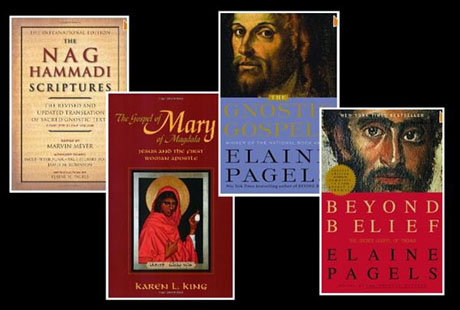
many Gnostic gospels are known from ancient
times, all of them sought out and destroyed by mainstream
Christians. Since the twentieth century some examples have
been discovered, having been hidden, often in desert conditions.
They do not always match the Catholic accusations made against
them, but they do often reflect Medieval Cathar teachings.
|
 |
| |
|
| |
|
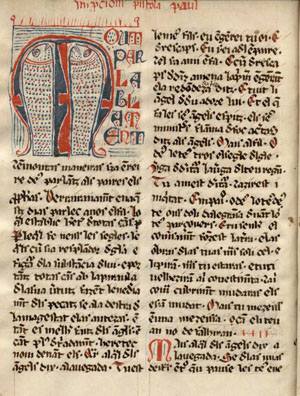
First page of Paul's Epistle to the Hebrews
- Cathar Bible in Occitan, from Lyon
|
 |
| |
| |
|
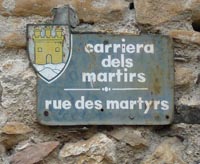
Commemorative Road Sign at Minerve
where 140 - 180 Cathars were burned alive for disagreeing
with Catholic theology.
|
 |
| |
| |
Here is an extract from a letter of 1143
or 1144 from Eberwin, Prior of the Premonstratensian Abbey
of Steinfeld, writing to Bernard
of Clairvaux (Saint Bernard):
|
"Indeed, those who were burned told us during their
defence that this heresy has lain concealed from the time
of the martyrs even to our own day, and has persisted thus
in Greece and certain other lands."
|
Sancti Bernardi....epistolae, ep 472 (Everwini
Steinfeldensis praeposti ad S. Bernardum) - Migne Patrologia
latina, CLXXXII, 676-80. English translation from Wakefield
& Evans, Heresies of the High Middle Ages (Columbia
University Press, 1991), p 132.
|
| |
|
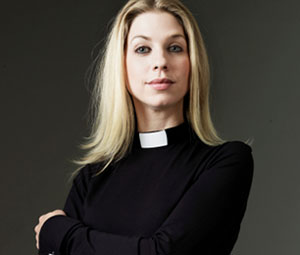
Mainstream Churches are currently re-introducing
women leaders, a practice of the early Church retained by
the Cathars.
|
 |
|
The diet of Parfaits was much stricter than
that of Catholic monks. The strictest Catholic monks used
identical diet to Cathar Parfaits everyday diet, but only
for a limited number of fast days each year. No meat, no eggs,
no milk or cheese, etc.
|
 |
| |
|
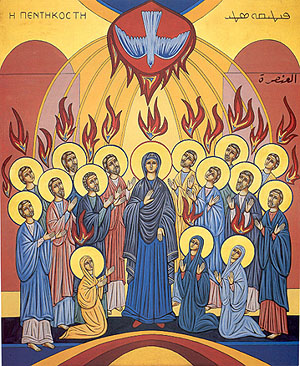
Cathar baptism (The Consolamentum) was identical
to the mainstream Christian idea of Pentecost - The Holy Spirit
descending to dwell within the new initiates who become apostles.
|
 |
| |
| |
| |
| |
| |
| |
| |
| |
| |
| |
| |
| |
| |
| |
| |
| |
| |
|
| |
Baptism
The Jewish practice was to baptise with water - by total submission
in cold running water. This was the way that John the Baptist
is recorded as having baptised Jesus in the River Jordan.
According the New Testament Jesus later did away with this traditional
practice, and instituted Baptism of the Spirit. At Pentecost the
Holy Spirit, visible as tongues of fire, descended onto the heads
of the disciples.
For reasons that are not altogether clear, the mainstream Church
retained the old Jewish practice. The Orthodox Church still baptises
by total immersion in running water, but the schismatic Roman
Church deviated from this practice and now baptises in the familiar
manner. A further innovation was to baptise infants, who could
not possibly understand or consent to the ceremony.
For the Cathars, infant baptism with water was not merely unscriptural,
it was an appanage of the bad god Jehovah, and had been expressly
rejected by Christ.
Various modern Christian sects take a range views about the question
of baptism, from Baptists who practice full immersion in water,
to Penecostalists who believe that the Holy Spirit descends on
them in the form of tongues of flame - sadly invisible to the
rest of us.
|
Baptism of the Spirit. At Pentecost the Holy
Spirit, visible as tongues of fire, descended onto the heads
of the disciples. Note the prominent role of Mary.
Present were about one hundred and twenty
followers of Christ (Acts 1:15)
Their reception of Baptism in the Holy Spirit in the Upper
Room is recounted in Acts 2:1–6
Peter stated that this event was the beginning
of a continual outpouring that would be available to all believers
from that point on (Acts 2:39)
|
 |
| |
|
Pfarrkirche St. Peter in Tapfheim, Donau-Ries
, Bavaria, Germany
|
 |
| |
|
Pfarrkirche St. Vitus und Katharina,
Rehling, Aichach-Friedberg, Bavaria, Germany
|
 |
| |
|
|
Laying on of Hands - once the central part
of Christian baptism, as it remained for the Cathars.
|
 |
| |
|
Baptism of the Spirit. At Pentecost the Holy
Spirit, visible as tongues of fire, descended onto the heads
of the disciples.
|
 |
| |
|
Baptism of the Spirit. At Pentecost the Holy
Spirit, visible as tongues of fire, descended onto the heads
of the disciples.
In the Middle Ages, cathedrals and great
churches throughout Western Europe were fitted with a "Holy
Ghost hole"; a small circular opening in the roof that
symbolised the entrance of Holy Spirit into the midst of the
assembled worshippers. At Pentecost, these Holy Ghost holes
would be decorated with red flowers representing tongues of
fire. Sometimes a dove was lowered through into the church
along with burning straw, while the story of the Pentecost
was read. Holy Ghost holes can still be seen today in European
churches, including Canterbury Cathedral
(Pentecost represented at St. Therese of
Lisieux Church in Montauk, New York.)
|
 |
| |
|
| |
Other Sacraments
As Cathars and Catholics alike well knew, in the early thirteenth
century the Roman Church had invented its official list of seven
Sacraments within living memory.
Here is a passage from Hugh of Poitiers a monk from the monastery
of Sainte Madaleine in Vézelay written in 1167 when The Catholic
Church had developed a concept of their being seven sacraments,
but there was no agreement as to what they were. A group of Cathars
(called Deonarii or Publicans) had been investigated at Vézelay:
They were held for some sixty days or more, and were
frequently brought before the gathering and questioned - now with
threats and again with soft words - about the Catholic faith. At
length, after the vain expenditure of much effort, with the advice
and assistance of the archbishops of Lyon and Narbonne, the Bishop
of Nevers, several abbots, and many other learned men, they were
adjudged guilty of the charge that, while paying lip service to
the unity of the Divine Essence, they rejected absolutely all the
holy sacraments of the Universal Church: specifically, the baptism
of children, the Eucharist, the seal of the life-giving Cross, sprinkling
with holy water, the building of churches, good works in tithes
and offerings, the marital relations of husband and wife, the monastic
life, and all the functions of clergy and priests.
Luc d'Achery's edition of Hugh of Poitiers' Historia
Vizeliacensis monasterii, published in Bouquet et al (Eds)
Recueil Des historiens Des Gaules et de la France (24 vols, Paris,
1738 - 1904) XII, 343-44. English translation from Wakefield &
Evans, Heresies of the High Middle Ages, 41. p 248
The Seven Sacraments as they are now defined all had questionable
scriptural authority, and generally the Cathars claimed to represent
an older tradition than the Catholic Church.
Confession. The earliest known form of Christian confession
was a group activity, involving the public admission of sin. It
was identical to the Cathar Apareilementum,
quite different from the Medieval or modern Catholic practice.
Confirmation and Ordination. Various Catholic theologians
recognised elements of the Consolamentum
in their own Sacraments. "Is it not curious" says one of them
in the nineteenth century
"to remark that the essential rite of the Consolamentum
is in effect nothing but the most ancient form of Christian ordination?".
The same applied to confirmation, since the Consolamentum
represented an ancient usage "when the ceremonies of Confirmation
and Ordination had yet to be distinguished".
Marriage. The Cathars did not recognise marriage, claiming
that although it was mentioned in the New Testament it was not sanctioned
by it. The Catholic position (reflected in the words of the marriage
service) is that marriage was instigated by God and that Jesus himself
was a guest at a wedding. While true, the fact that the God of the
Old Testament instituted Jewish (polygamous) marriage could have
carried no weight for the Cathars.
Extreme Unction. Extreme Unction was an innovation of the
Roman Church in the Middle Ages. It has been suggested, but not
proved, that it was developed as a conscious response to the Consolamentum
administered to dying Cathars, popular because it ensured a place
in heaven.
The Eucharist. The Catholic doctrine of transubstantiation
was formally propounded in 1215 based on contemporary philosophical
notions that were later discredited. The Cathar practise of blessing
bread before meals by contrast is identical to the practice of the
earliest Christians at communal meals called agapes (abandoned by
mainstream churches in the second or third centuries when their
own agapes degenerated into disreputable occasions)
|
|
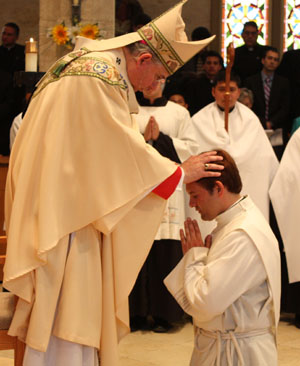
The Laying on of hands during an ordination
reproduces the practice of baptism in the early Church and
in the Cathar Church.
|
 |
|
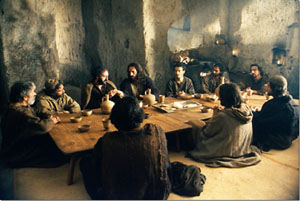
This scene could be the Last Supper or a
Cathar Meal at which bread was blessed.
|
 |
| |
|
This scene is an early Christian Agape but
could equally well represent a Cathar meal. Note that the
meal consists of bread and fish.
(Painting from Early Christian catacombs - "Catacombe
di Priscilla")
|
 |
| |
|
This is a Catholic Mass or Eucharist - resembling
neither early Christian nor medieval Cathar practice, since
neither the earliest Christians nor the Cathars recognised
a Christian priesthood qualified to make sacrifices.
|
 |
|
|
The Identity and Nature of God
Identity of God.
Cathar teachers and others associated with them pointed out the
cruelty, rapacity and irascibility of the Jewish tribal mountain
god described in the Old Testament. Anyone who read the it
could see for themselves that he was indeed unjust, partisan, jealous,
cruel, irrational and occasionally positively vicious. This
was such an easy point to prove in a literate society that it must
have contributed to the fact that the best Catholic preachers consistently
lost in open debate with Cathar Parfaits.
(Such embarrassment led the Roman Church Church to prohibit the
circulation of the Old Testament among laymen. For ordinary
people to read a bible, or even to possess one, would soon become
a capital offence, and many proto-Protestants would be burned alive
for it.)
The Trinity.
Some Cathars seem to have accepted the Trinity, but others did
not. They recognised the Father as the good god, Jesus Christ as
a divine phantom and the Holy Ghost as a created being inferior
to God. They saw the Catholic Trinity, nowhere mentioned in the
original version of the bible, as a blasphemous invention.
It is a matter of fact that the doctrine of the Trinity was developed
in the fourth century - it was refined by a series of Church Councils
starting with the Council of Nicea in 325. (Incidentally it is known
that a bogus passage was inserted into orthodox bibles to explicitly
confirm the doctrine of the Trinity, In the Authorized Version,
the First Epistle of John 5:7 refers to the Holy Trinity: "For there
are three that bear record in heaven, the Father, the Word, and
the Holy Ghost: and these three are one". These words come from
the Vulgate, but are not in any early Greek text.
Satan.
Catholic theologians tend to regard Dualist religions as un-Christian.
This is arguable for the pure form of Dualism which posits two co-equal
and opposite gods, but the Cathars of the Languedoc were initially
"mitigated Dualists". They believed that the God of Darkness, the
god of this world, was lesser than and subordinate to the Good God.
Eventually the Good God, leading the armies of Light, would triumph
over the lesser, evil God and his army of demons. If we identify
the God of Darkness as Satan, then this is orthodox Catholic doctrine.
The fact is that mainstream Christian Church, from which the Roman
Church would later split off, adopted Manichaean
ideas during the Dark Ages. In short, the Roman Church is itself
a mitigated Dualist religion.
|
|
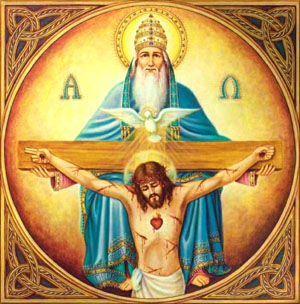
A representation of The Catholic Trinity
(with God the Father wearing a papal tiara)
|
 |
|
|
|
The Fall of Lucifer - A characteristically
Gnostic Dualist idea now absorbed into mainstream Christianity.
|
 |
|
| |
Apostolic Practices
Both Catholics and Cathars claimed that their ceremonies had
been preserved from apostolic times.
Church historians now accept the validity of many Cathar claims,
in particular the claim that their ceremonies and practices predated
Catholic ones eg the Consolamentum,
public confession, blessing bread without any suggestion of transubstantiation,
spiritual succession, the rejection of baptism
in water and of any priesthood, recognition of Gnostic passages
in the New Testament, and so on.
|
|
|
Apostolic Succession
Many Churches, including the Roman Catholic Church, claim to be
"Apostolic". What they mean be this is that they derive their claims
to authority from From Jesus himself through at least one of the
twelve Apostles. This authority is handed on from generation to
generation, generally from bishop to bishop. According to the theory,
the twelve apostles passed on their authority to bishops, their
successors. These successor bishops handed on their authority to
their successors, and so on. (This is why at least one existing
bishop is needed to consecrate a new bishop. In practice several
bishops often take part to ensure that their can be no possibility
of questioning a valid chain). In theory any modern bishop claiming
apostolic succession could trace his authority back to at least
one apostle, through a chain of predecessors.
Medieval Catholic theologians noted that the Cathars claimed a
similar succession for the Parfaits.
Only Parfaits could create new Parfaits (through the Consolamentum),
and since the first Parfaits were the apostles, initiated by Jesus
into the secret inner knowledge, any Cathar Parfait had a claim
to authority that paralleled that of Catholic bishops. Catholics
always had an explanation for non-Catholic practices that were similar
to their own. They were obviously perversions of the true Catholic
doctrine. The Cathars had simply copied and perverted the theory
of apostolic succession.
The evidence shows almost exactly the opposite. The theory of apostolic
succession was first recorded by a Gnostic sect in the third century.
The idea seemed such a good one that it was picked up by other strands
of Christianity - including the one that gave rise to the Roman
Catholic Church. The unfortunate lacunae between the apostles and
the contemporary third century bishops could easily be filled by
the invention of suitable chains of predecessor bishops, and so
it was. (Genuine contemporary continuous lists of bishops from this
period are unknown, except for a line of bishops of Jerusalem who,
unfortunately for the Roman Catholic case, were practising Jews).
Although it is something of a simplification, one might reasonably
claim that the Roman Catholic Church stole the idea of apostolic
succession from the Cathars, rather than the converse.
|
|
|
|
Gnosis
There are numerous references to gnosis in the New Testament,
but we never notice them in English versions because they are translated
away as mere knowledge rather than secret knowledge.
Gnostic messages are are also explained away by theologians, sometimes
by making them say the opposite of what they really say in the biblical
text. For example, why did Jesus speak in parables?
We are frequently told that he did so in order that all the simple
people should understand his message. Anyone who reads the
texts themselves can see that the truth is exactly the opposite.
According to Jesus himself in all the synoptic gospels, he
spoke in parables so that certain people would not understand
him (Luke 8:9-10, Matthew 13:10-13 or Mark 4:10-12).
Although there are others, this passage alone (if accurately recorded
in the canonical gospels) proves conclusively that at least part
of Jesus's message was a Gnostic.
The Church Father Clement of Alexandria is known to have suppressed
gospel material that did not suit him. As he explained in a letter,
referring to the Secret Gospel of Mark:
During Peter’s stay in Rome he wrote an account of the
Lord’s doings, not however declaring all of them, nor yet
hinting at the secret ones, but selecting those he thought most
useful for increasing the faith of those who were being instructed.
But when Peter died as a martyr, Mark came over to Alexandria,
bringing his own notes and those of Peter, from which he transferred
to his former book the things suitable to whatever makes for progress
towards gnosis. Thus he composed a more spiritual gospel for the
use of those who were being perfected…
(Morton Smith, The Secret Gospel ( London, 1974)). Note
not only the use of the word gnosis but the use of the
word perfected (cf Parfaits).
There are of course, a whole library of Gnostic gospels, once thought
"lost" (ie suppressed by the mainstream Church), but preserved in
the desert and rediscovered in the twentieth century. According
to these gospels too, Jesus was a Gnostic teacher.
|
|
|
|
Biblical Injunctions
Poverty.
Injunctions about poverty were ignored by the Roman Church in
the Middle Ages, in strong contrast to the Cathars. While the
clergy lived in great luxury on extorted taxes, Cathar Parfaits
led ascetic lives and worked for their living. The contrast was
so marked, and the scandal so great, that various Catholic organisations
were created at this time consciously to emulate the lifestyle
of the Parfaits (notably Dominic
Guzmán's Dominicans
and the Third Order of the Catholic Paupers).
Killing.
The Commandment "Thou shalt not kill" was interpreted by Cathars
as applying to all living creatures. The only exceptions seem
to have been suicide (by starving to death) and presumably the
killing of fish (not proper animals). For Roman Catholics there
were sufficient exceptions to render the Commandment meaningless.
The Church for example permitted the killing of foetuses less
that 40 days old if male, 80 day if female, and positively encouraged
the killing of infidels, pagans, heretics, blasphemers, atheists,
criminals, deformed children, apostates, enemy soldiers, vandals
who damaged Church property, and animals. Catholic commentators
seem unaware of the irony of Christian Churchmen condemning to
death a poor country girl when she refused to kill a chicken,
her sole crime being to obey the commandment "Thou shalt not kill".
|
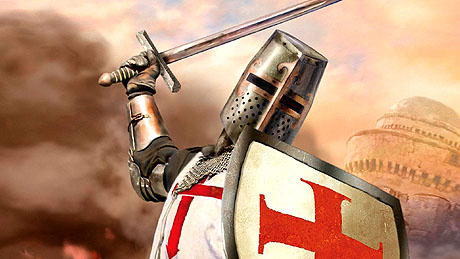
Knights Templars were Catholic monks as
well as knights.
|
 |
Swearing Oaths
The New Testament is clear about prohibiting the swearing of
all oaths. But I say unto you, Swear not at all; ... But let your
communication be, Yea, yea; Ney, ney; for whatever is more than
these cometh of evil. (Matthew 5:34-37) This was adhered to strictly
by the Cathars and ignored by the Roman Catholic Church. Pope
Innocent III confirmed that those who took Jesus' teaching
on this matter literally were heretics, and that they deserved
to die. (Much later the Quakers would adopt the same position
as the Cathars, and would also be burned alive for it).
Giving Judgement.
Jesus is reported to have taught that we should not judge others:
"Judge not, that ye be not judged" (Matthew 7:1 c/f Luke 6:37).
Cathars therefore refused to sit in judgement. Other Christian judges
have had no qualms about judging others. Mainstream Churches even
have their own ecclesiastical courts - in which, in the past, they
have prosecuted and condemned Cathars, Quakers and others for following
New Testament injunctions.
|
|
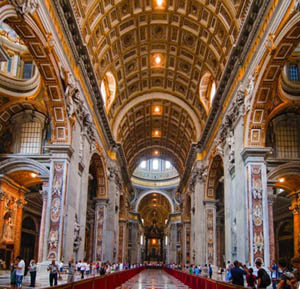
Saint Peter's Basilica, Rome. Like earliest
Christians, Cathars met in private houses, not palaces dedicated
to what they considered Rex Mundi.
|
 |
|
Swearing an oath on a bible - which contains
an injunction not to swear oaths, as the Carthars pointed
out.
|
 |
| |
|
Bishops sat as judges. Friars acted as Prosecutors
as well as Judges.
(Detail from Cristiano Banti (1824-1904), Galileo before the
Inquisition, 1857, Carpi (MO), Private collection)
|
 |
|
|
|
Prayers
The Pater, or Lord's Prayer, is used by all Christians. According
to the New Testament is the only prayer explicitly authorised
by Jesus. Even here, there was scope for disagreement. Cathar
and Catholic practice differed in two reprects. In both cases
Cathars were correct in asserting that their practice was very
ancient, and in one case their position is demonstrably truer
to the original than the Catholic practice.
The Lord's Prayer - 1. We are all accustomed to
hearing the line give us this day our daily bread.
But the the meaning the Greek word translated as daily
is unknown. Daily is just a guess. The Cathars claimed
that they had preserved the correct meaning from earlier times.
They said give us this day our supersubstancial
bread, which arguably makes much more sense. The words
in question (panis superstantialis or panem supersubstancialem)
were interpreted as referring not of the material but of the spiritual
sustenance.
The Lord's Prayer - 2. We are all accustomed to
hearing the closing line For thine is the power, the power
and the glory for ever and ever. But the Roman Church
did not use this formula in the Middle Ages, which it claimed
was an unwarranted addition to the text. Cathars were attacked
for this innovation. As we know from its familiarity to
us, it was later added to the Catholic form of the prayer, a tacit
admission perhaps that the Cathars had it right after all.
Incientally, both Cathars and Catholics taught that only initiates
had the right to address the good Good as Father, and thus only
they were permitted to recite the Lord's Prayer.
|
|
The Lord's prayer in the original Kione (Greek)
with the word ἐπιούσιον
meaning "supersubstancial" not "daily",
and the doxology in brackets.
|
|
Πάτερ ἡμῶν
ὁ ἐντοῖς οὐρανοῖς·
ἁγιασθήτω τὸ
ὄνομάσου·
ἐλθέτω ἡ βασιλεία
σου·
γενηθήτω τὸ
θέλημά σου, ὡς
ἐν οὐρανῷ καὶ
ἐπὶ τῆς γῆς·
τὸν ἄρτον ἡμῶν
τὸν ἐπιούσιον
δὸς ἡμῖν σήμερον·
καὶ ἄφες ἡμῖν
τὰ ὀφειλήματα
ἡμῶν,
ὡς καὶ ἡμεῖς
ἀφίεμεν τοῖς
ὀφειλέταις
ἡμῶν·
καὶ μὴ εἰσενέγκῃς
ἡμᾶς εἰς πειρασμόν,
ἀλλὰ ῥῦσαι
ἡμᾶς ἀπὸ τοῦ
πονηροῦ.
[Ὅτι σοῦ ἐστιν
ἡ βασιλεία καὶ
ἡ δύναμις καὶ
ἡ δόξα εἰς τοὺς
αἰῶνας. ἀμήν.]
|
| |
| |
|
|
|
Priesthood
The justification for a Roman Catholic priesthood rests on certain
passages in the New Testament, but the key words in the original
Greek do not accurately translate as "priest".
In these critical New Testament passages, certain followers are
referred to as presbyters. The Greek word presbyter
means elder, and references in the New Testament to presbyters
are not to priests but to community elders. Nevertheless, the early
forerunner of the Roman Catholic Church soon changed its presbyters
into priests, borrowing much of the significance from pagan religions
where priests were holy men who enjoyed a special relationship with
God and made sacrifices to him. A priesthood was thus created without
any biblical justification, a fact which may have contributed to
the priesthood's reluctance to allow people to read the bible. When
people did read the bible for themselves, and failed to find the
word sacerdos (priest), only presbyter (elder), the
result was widespread anger. The lack of biblical justification
for a priesthood was one of the main complaints of Church dissidents
and reformers, and it is for this reason that Presbyterian sects
have rejected a priesthood in favour of lay leaders called Elders.
Other Churches suspicious of an official priesthood call their officers
Ministers or Pastors.
The New Testament does not mention priests except in the sense
that all believers are priests (1 Peter 2:9 and 2:5, Revelations
1:6, 5:10, and 20:6) and believers were regarded as priests only
in the sense that all Jews had been regarded as priests in the Old
Testament (Exodus 19:6). Nowhere in the New Testament is the ministry
of Jesus' followers described as a priesthood. Neither is any follower
referred to as a priest, except in the general sense that all followers
were priests. It was presumably because of these passage that the
Waldensians
advocated a priesthood of all believers. (These passages are studiously
ignored by most denominations).
The Cathars for their part held that there should be no priesthood,
arguing that there was no priesthood in the original version of
the New Testament scriptures.
|
|
Modern mainstream Christian priests wearing
distinctive priestly clothing. Cathar leaders were not priests
and dressed in ordinary clothes.
|
 |
| |
|
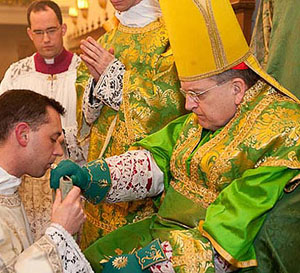
Kissing a bishop's ring is one of many imperial
practices transferred from imperial rulers to Church officials.
|
 |
|
|
|
Forgeries and Mistranslations
Forgery.
It is now clear that characteristically Catholic teachings were
founded on fabrications and forgeries. The Eastern Church has been
calling the Western Church the "home of forgeries" for
over a thousand years.
A few examples are the teachings supported by bogus documents,
such as the Donation of Constantine and the Symachian Forgeries.
It is accepted that various passages were inserted into the bible
(such as an explicit reference to the Trinity, since removed again),
and even tampering with the creeds (still a point of contention
with the Orthodox Church).
Popes were less keen on forgeries that
they had not themselves authorised. Innocent III built many
of his own novel claims on forgeries, but was less understanding
of other forgeries.
This extract is from Boudinhon, Auguste.
"Forgery, Forger." The Catholic Encyclopedia.
Vol. 6. New York: Robert Appleton Company, 1909.
|
Substitution of false documents and tampering with genuine
ones was quite a trade in the Middle Ages. In the chapter
Dura vi, "De crimine falsi", written in 1198,
(pars decisa), Innocent III relates that he had discovered
and imprisoned forgers who had prepared a number of false
Bulls, bearing forged signatures either of his predecessor
or of himself. To obviate abuses, he orders under pain of
excommunication or suspension that pontifical Bulls be received
only from the hands of the pope or of the officials charged
to deliver them. He orders bishops to investigate suspicious
letters, and to make known, to all those having forged letters,
that they are bound to destroy them, or to hand them over
within twenty days, under pain of excommunication. The same
pope legislated severely against forgery and the use of
forged documents. In the chapter Ad falsariorum, vii, "De
crimine falsi", written in 1201, forgers of Apostolic
Letters, whether the actual criminals or their aiders and
abetters, are alike excommunicated, and if clerics, are
ordered to be degraded and given over to the secular arm.
|
Mistranslations
Comparison of Catholic translations of the bible with non-Catholic
bibles reveal a number of differences. Comparison with the Hebrew
or Greek originals show that Catholic versions contain mistranslations
apparently made to bolster a particular belief. So it is that "secret
knowledge" becomes ordinary "knowledge", Sophia ceases to be a person
and becomes "wisdom" with a small w, all Christs except one loose
their titles and become merely "anointed ones", the apostles' wives
become "helpers", and so on.
|
|
The Donation of Constantine is a forged Roman
imperial decree by which the emperor Constantine I supposedly
transferred authority over Rome and the western part of the
Roman Empire to the Pope. Composed probably in the 8th century,
it was used by many popes including Pope Innocent III in support
of claims of political authority by the papacy. Lorenzo Valla,
exposed the forgery in 1439–1440, but the Catholic Church
disputed his research for many centuries.
|
 |
|
| |
Cathar Martyrdom
Historically, Western Christians have always abandoned their faith
en masse whenever they have been put under pressure to do
so. From early Christians during the reign of Diocletian
to priests during the French Revolution, believers have preferred
to abandon their faith rather than loose their lives. Throughout
the Middles Ages the masses were fed fanciful tales of heroic martyrdom,
but no amount of propaganda could conceal the fact that even Christian
armies (including monks and priests) would generally recant under
pressure. Anyone who had already been on crusade to the Holy Land
would have firsthand knowledge of colleagues who had converted to
Islam when captured and pressed by their Moslem captors.
Western Christendom was therefore surprised to find that Cathar
Parfaits
consistently opted to be burned alive rather than renounce their
faith when faced with greater pressure than Catholics faced at Moslem
hands. The pattern was established early on. When some of
the "new heretics" were burned alive in Cologne a full
century before the siege of Montségur,
the way they met their deaths immediately made an impression. Eberwin,
a prior at the Premonstratensian Abbey of Steinfeld, wrote to Bernard, Abbot of Clairvaux
(St Bernard). He reported that the heretics were
"... thrown into the fire and burned. What is more marvellous,
they met and bore the agony of the fire not only with patience
but even with joy. At this point, Holy Father, were I with you,
I should like you to explain whence comes to those limbs of the
devil constancy such as is hardly to be found even in men most
devoted to the faith of Christ."
The quotation is from Sancti Bernardi epistolae,
letter 472 (Everwini Steinfeldensis praepositi ad S. Bernardum)
cited by Walter L Wakefield & Austin P Evans Heresies of
the High Middle Ages, (Columbia, 1991) p. 129.
By the siege of the Château of Montsegur
( Montségur,
  Montsegùr) Europe had seen a century of Cathar martyrs.
During that time it had become become ever more important to the
Catholic Church to be able to produce converted Parfaits
who could be paraded in public to admit the error of their former
ways. The Languedoc had seen thirty-five years of war and
a well established Inquisition
with a formidable range of persuasive tools and techniques. Thousands
had been burned alive rather than renounce their faith - often hundreds
at a time.
Montsegùr) Europe had seen a century of Cathar martyrs.
During that time it had become become ever more important to the
Catholic Church to be able to produce converted Parfaits
who could be paraded in public to admit the error of their former
ways. The Languedoc had seen thirty-five years of war and
a well established Inquisition
with a formidable range of persuasive tools and techniques. Thousands
had been burned alive rather than renounce their faith - often hundreds
at a time.
|
Persecuted Cathars saw themselves and Inquisitors
as fulfilling this prophesy:
|
[Jesus said:] "As for yourselves, beware; for they
will hand you over to councils; and you will be beaten in
synagogues; and you will stand before governors and kings
because of me, as a testimony to them. And the good news
must first be proclaimed to all nations. When they bring
you to trial and hand you over, do not worry beforehand
about what you are to say; but say whatever is given you
at that time, for it is not you who speak, but the holy
spirit. Brother will betray brother to death, and a father
his child, and children will rise against parents and have
them put to death; and you will be hated by all because
of my name. But the one who endures to the end will be saved.
(Mark 13:9-13)
|
|
Commemorative Road Sign at Minerve
where 140 - 180 Cathars were burned alive for disagreeing
with Catholic theology.
|
 |
The rendition of the Chateau at Montsegur
(
Montségur,
Montsegùr) offered what must have looked like one final
opportunity to win mass Parfait
converts. When the terms of surrender were negotiated, the
Church was willing to offer life and freedom not only to all members
of the garrison, but also to any Cathar prepared to abandon his
or her faith. Surely one of the two hundred Parfaits
trapped at Montsegur
would weaken. In the event this did not happen. As elsewhere,
not a single one renounced their faith. More astonishing yet, around
twenty five people in the Castle, including members of the garrison,
chose to take the Consolamentum
between the formal surrender and the final rendition, so becoming
Parfaits,
forfeiting their freedom and ensuring themselves a most appalling
death.
|
There are no contemporary representation
of the burning of Cathars
so illustrations are often modern
|
 |
On 16th March ,1244, the besieged refugees at the Château
of Montsegur
(
Montségur,
Montsegùr) who refused to abjure the Cathar faith were
burned en masse at the foot of the pog. Some 225 Parfaits
were burned alive. After all this warfare, torture and bloodshed,
the Roman Church had not only failed to win Parfait converts but
had done exactly the opposite. Catholic churchmen contented themselves
with the pious conviction that the Cathar heretics had passed directly
from the fires of this world to the eternal fires of hell.
|
Cathar victims also saw themselves as fulfilling
the following prophesy:
|
|
[Jesus said:] "They will put you out of the synagogues.
Indeed, an hour is coming when those who kill you will think
that by doing so they are offering worship to God. And they
will do this because they have not known the Father or me."
John 16:2-3
|
Sources differ on the the number of victims. The Chronique de
Guillaume de Puylaurens, gives the number as 200; the
Chronique de l'Abbaye de Berdoues, states 205; The Chronique
de St-Paul de Narbonne 215; and Gerard de Frachet 224. These
chronicles do not attempt to list all the victims, so historians
have had to piece together a partial list, mainly from Inquisition
records.
As far as I am aware, sixty-three individuals have so far been
identified by name. Click on the following link for the
names of some of those
who died at Montsegur  The names of those who received the Consolamentum
on the night of 13th March 1244 are marked with a ‡.
The names of those who received the Consolamentum
on the night of 13th March 1244 are marked with a ‡.
|
|
Memorial at Les
Casses where 60 Cathars were burned alive
|
 |
| |
|
Burning Heretics
|
 |
| |
|
Montsegur
|
 |
| |
|
Commemorative Road Sign at Minerve
where 140 - 180 Cathars were burned alive for disagreeing
with Catholic theology.
|
|
| |
|
Dame Guiraude being murdered by the Crusaders
at Lavaur
|
 |
| |
|
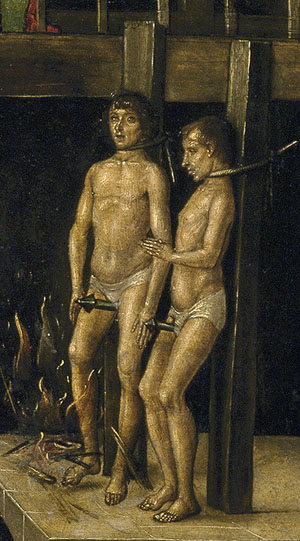
Auto Da Fe Presided Over By Saint Dominic
Of Guzmán (1475); Pedro Berruguete (around 1450-1504)
commissioned by Torquemada, Oil on wood . 60 5/8 x 36 1/4
(154 x 92 cm).
Now in the Museo del Prado, Madrid.
Detail - Cathars being burned
|
 |
|
|
|
Do Cathars Still Exist Today?
It depends what you mean. If you mean "Are there people living
today who claim to be Cathars ?", then the answer is Yes.
If you mean "Are there people who live like Cathars, and believe
what the Cathars believed ?", then the answer is also Yes.
But neither of these answers tells the whole story. For example,
quite a few of the people calling themselves Cathars will tell you
that they are reincarnated Cathar Parfaits.
But a central Cathar belief was that on their deaths Parfaits were
released from the cycle of rebirth. Which means that either
these modern Cathars hold to a belief system that they know to be
wrong, or that they are impostors who have not troubled to do their
homework.
A more interesting question is whether any Cathars living today
can claim a continuous chain of succession from the Parfaits of
the thirteenth century. The reason that this is significant
is that the Cathars themselves claimed a continual chain of descent,
each Parfait having joined the inner circle of the Elect
by being given the Consolamentum
by an existing Parfait.
There therefore existed a continuous chain of succession from any
Parfait all the way back to the original biblical Pentecost.
(If this looks suspiciously like the doctrine of Apostolic Succession
claimed by Catholic and other mainstream bishops, it is worth bearing
in mind that the mainstream Church is known to have copied the idea
from a Gnostic sect in the fourth century, and then fabricated lines
of apostolic succession for the missing centuries).
After the depredations of the Inquisition
in the fourteenth century, the chain of succession was restored
in the Languedoc by two brothers who travelled to Piedmont to receive
the Consolamentum
from a Parfait there. But this line was apparently exterminated
with the burning of Guilhem
Belibaste in 1321. The Italian line was exterminated
by the Roman Church soon after, and in the fifteenth century the
Balkan line was suppressed, or absorbed, by Islam, which shares
the characteristically Gnostic belief that it was a divine phantom,
not a man, who was crucified when the authorities thought they were
executing Jesus (c/f Koran 4:157: "they slew him not nor crucified
him, but it appeared so unto them").
Did a secret succession survive from any of these traditions, or
from any of the more remote Eastern ones? Perhaps.
No one seems to know for sure. But even if not, all of their
principal beliefs are to be found in one or another Christian sect.
Even the idea that the Roman Catholic Church is mistakenly worshipping
the Evil God is still current (Jehovah's Witnesses for example believe
this).
Click on the following internal link for more information on Cathar
ideas and practices still current in modern mainstream Christian
Churches
Click on the following internal link for more information on Cathar
ideas and practices still current in Churches other than Roman Catholic
Churches
Click on the following internal link for more information on Cathar
ideas and practices now current in the Roman Catholic Church
Click on the following external links to go to websites run by
modern Cathar, Gnostic and Dualist Churches
- A network of organisations in the French Gnostic Tradition
http://www.gnostique.net

- L'Eglise du Plérôme. (Ecclesia Pleromatis). A Church
of Christian Gnosis in the French Gnostic Tradition.
www.plerome.org
- The North American Fellowship of Cathars (linked with movements
in France, Bulgaria, Bosnia and the Ukraine).
www.cathari.org
|
|
|
|
|
|
|
|
Further Information on Cathars and Cathar Castles
|
|
|
|
|
|
|
If you want to cite this website in a book
or academic paper, you will need the following information:
Author: James McDonald MA, MSc.
Title: Cathars and Cathar Beliefs in the Languedoc
url: http://www.cathar.info
Date last modified: 8 February 2017
If you want to link to this site please see
How
to link to www.cathar.info
For media enquiries please e-mail james@cathar.info
|
|
|
|
|
|
|
|
|
|
|
 |
|
|
|
 |
|
|
|
|
|
|
|
|
|
|
|
|
|
|








.jpg)