|
|
Bogomilism
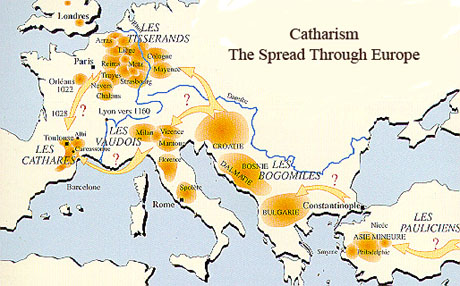
Bogomilism was a Dualist sect founded in the First Bulgarian Empire
by a priest called Bogomil during the reign of Tsar Peter I in the
10th century. It arose in what is today the region of Macedonia
in opposition to the Bulgarian state and the church. This helped
the movement spread quickly in the Balkans, gradually expanding
throughout the Byzantine Empire and later reaching Kievan Rus, Bosnia,
Dalmatia, Rascia, Italy, France, the Languedoc and Aragon.
Bogomils called for a return to early Christianity, rejecting the
ecclesiastical hierarchy, and their primary political tendencies
were resistance to the state and church authorities. They were Dualists,
believing the world was created by the Abrahamic God - an evil demiurge
- not the God of Light.. They did not use the cross or build churches,
preferring to perform rituals outdoors.
The term Bogomil in free translation means "dear to God".
It is impossible to ascertain whether the name was taken from the
reputed founder of that movement, the priest Bogomil, or whether
he assumed that name after it had been given to the sect itself.
The word is an Old Church Slavonic calque of Massaliani, the Syriac
name of the sect corresponding to the Greek Euchites. Bogomils are
identified with the Messalians in Slavonic documents from the 13th
century.
Members are referred to as Babuni in Church Slavonic documents,
which originally meant "superstitious person" and may
be derived from a place name. Toponyms which retain the word include
the river Babuna and the mountain Babuna in the region of Azot today
in central Republic of Macedonia - not far from "the Bogomila
Waterfall" and village "Bogomila", suggesting that
the movement was once active in the region.
Much of their literature has been lost or destroyed by the mainstream
Christian Churches. The earliest description of the Bogomils is
in a letter from Patriarch Theophylact of Bulgaria to Tsar Peter
of Bulgaria, and the main source of doctrinal information is the
work of Euthymius Zigabenus, who says that they believe that God
created man's soul but matter was the invention of Satan, God's
older son, who in seducing Eve lost his creative power.
Concerning the Bogomils, something can be gathered from the polemic
against the the Bogomils written in Slavonic by Cosmas the Priest,
a 10th-century Bulgarian official. Old Slavonic lists of forbidden
books of the 15th and 16th century alsoprovide a clue to this literature.
Something may also be inferred from the doctrines of the varieties
of Bogomilism which spread in Medieval Kievan Rus' after the 11th
century.
Paulicians
Paulician Christian dualism originated in Armenia in the mid-7th
century, when Constantine of Mananalis, basing his message solely
on the New Testament, began to teach that there were two gods: the
good God who had made men's souls, and the evil God who had created
the entire physical universe including the human body. His followers,
who became known as Paulicians, were not marked by extreme deviance
in lifestyle compared to contemporaries, despite their belief that
the world was evil, and were renowned as good fighting men.
In 970 the emperor John I Tzimiskes transplanted no less than 200,000
Armenian Paulicians to Europe and settled them in the neighbourhood
of Philippopolis (today's Plovdiv in Thrace).
Under Turkish rule, the Armenian Paulicians lived in relative safety
in their ancient stronghold near Philippopolis, and further northward.
Linguistically, they were assimilated into the Bulgarians, by whom
they were called pavlikiani. In 1650, the Roman Catholic Church
gathered them into its fold. No less than fourteen villages near
Nicopolis, in Moesia, embraced Catholicism, as well as the villages
around Philippopolis. A colony of Paulicians in the Wallachian village
of Cioplea near Bucharest also followed the example of their brethren
across the Danube.
Bogomilism was apparently influenced by the Paulicians who had
been driven out of Armenia.
In spite of all measures of repression, Bogomilism remained popular
until the fall of the Second Bulgarian Empire in the end of the
14th century.
The Slavonic sources are unanimous on the point that Bogomil's
teaching was Manichaean. A Synodikon from the year 1210 adds the
names of his pupils or "apostles", Mihail, Todur, Dobri,
Stefan, Vasilie and Peter. Bogomil missionaries carried their doctrines
far and wide. In 1004, scarcely 25 years after the introduction
of Christianity into Kievan Rus, we hear of a priest Adrian teaching
the same doctrines as the Bogomils. He was imprisoned by Leontius,
Bishop of Kiev. In 1125, the Church in the south of Rus had to combat
another Bogomil named Dmitri.
The Church in Bulgaria also tried to extirpate Bogomilism. Efforts
were made to secure their conversion; and for the converts the new
city of Alexiopolis was built, opposite Philippopolis. When the
Crusaders took Constantinople (1204), they found some Paulicians,
whom the historian Geoffrey of Villehardouin calls Popelicans.
The Legend of Saint Gerard discloses that followers of Bulgarian
Bogomilism were present during the early 11th century in Ahtum's
realm, which comprised present day Banat.
Bogomils spread westwards and settled in Serbia, where they were
to be known as Babuni. At the end of the 12th century Serbian Grand
Prince Stefan Nemanja and the Serbian council deemed Bogomilism
a heresy, and expelled them from the country. Large numbers took
refuge in Bosnia and Dalmatia where they were known under the name
of Patarenes (Patareni).
Threatened by the pope with dispossession for his acceptance of
Bogomilism, 1199 Bosnian ruler Ban Kulin accepted Catholicism. During
his reign, Bogomilism began to attract followers in Bosnia, ( Bosnian
principalities may have adopted Bogomilism in order to offset the
influences of its Catholic and Orthodox neighbours). In addition
to Kulin, the prince of Herzegovina and the Roman Bishop of Bosnia
followed him in his beliefs. Altars and crosses were removed, the
distinction between clergy and laity disappeared. A fixed amount
of believers’ income was set aside for alms and the support
of itinerant evangelists.
In 1203, Pope Innocent III, with the aid of the King of Hungary,
forced an agreement of Ban Kulin to acknowledge Papal authority
and religion, though in practice this was ignored. On the death
of Kulin in 1216 a mission was sent to convert Bosnia to Rome but
failed. In 1234, the Catholic Bishop of Bosnia was removed by Pope
Gregory IX for allowing heretical practices. In addition, Pope Gregory
called on the Hungarian king to lead a crusade against the Bogomils.
However, Bosnian nobles were able to expel the Hungarians.
Following Pope Nicholas IV's Bull Prae cunctis in 1291,
a Franciscans
led Inquisition
was imposed on Bosnia. Bogomilism was eradicated in Bulgaria and
Byzantium in the 13th century, but survived in Bosnia and Herzegovina
until the Ottoman Empire gained control of the region in 1463.
From Bosnia, their influence extended into Italy (Piedmont). The
Hungarians undertook many crusades against the heretics in Bosnia,
but towards the close of the 15th century, the conquest of that
country by the Turks put an end to their persecution.
Few or no remnants of Bogomilism have survived in Bosnia. The
Ritual in Slavonic written by the Bosnian Radoslav, and published
in vol. xv. of the Starine of the South Slavonic Academy at Agram,
shows great resemblance to the Cathar ritual published by Cunitz,
1853.
In the 18th century, the Paulician people from around Nicopolis
were persecuted by the Turks, presumably on religious grounds, and
a good part of them fled across the Danube and settled in the Banat
region that was part of the Austrian Empire at the time, and became
known as Banat Bulgarians. There are still over ten thousand Banat
Bulgarians in Banat today in the villages of Dudestii Vechi, Vinga,
Brestea and also in the city of Timisoara, with a few in Arad; however,
they no longer practice Bogomolism, having converted to Roman Catholicism.
There are also a few villages of Paulicians in the Serbian part
of Banat, especially the villages of Ivanovo and Belo Blato, near
Pancevo.
The existence of older Christian heresies in the Bulgarian lands
(Manichaeism and Paulicianism), which were Dualistic, influenced
the Bogomil movement. Manichaeism’s origin is related to Zoroastrianism;
that is why Bogomilism is sometimes indirectly connected to Zoroastrianism.
They regarded every material being to be the work of Satan. They
also opposed established forms of government and church. Bogomils
were both Adoptionists as well as Dualists . They accepted the teaching
of Paul of Samosata, though at a later period the name of Paul was
believed to be that of the Apostle. They apparently did not accept
the docetic teaching of some sects.
The Bogomils taught that God had two sons, the elder Satanail and
the younger Michael. The elder son rebelled against the father and
became the evil spirit. After his fall he created the lower heavens
and the earth and tried in vain to create man; in the end he had
to appeal to God for the Spirit. After creation Adam was allowed
to till the ground on condition that he sold himself and his posterity
to the owner of the earth. Then Michael was sent in the form of
a man; he became identified with Jesus, and was "elected"
by God after the baptism
in the Jordan. When the Holy Ghost (again Michael) appeared in the
shape of the dove, Jesus received power to break the covenant in
the form of a clay tablet (hierographon) held by Satanail from Adam.
He had now become the angel Michael in a human form; as such he
vanquished Satanail, and deprived him of the termination -il = God,
in which his power resided. Satanail was thus transformed into Satan.
Through his machinations the crucifixion took place, and Satan was
the originator of the whole Orthodox community with its churches,
vestments, ceremonies, sacraments and fasts, with its monks and
priests. This world being the work of Satan, the perfect must eschew
any and every excess of its pleasure.
They held the "Lord's Prayer" in high respect as the
most potent weapon against Satan, and had a number of conjurations
against "evil spirits". Each community had its own twelve
"apostles", and women could be raised to the rank of "elect".
The Bogomils wore garments like mendicant friars and were known
as keen missionaries, traveling far and wide to propagate their
doctrines. Healing the sick and exorcising the evil spirit, they
traversed different countries and spread their apocryphal literature
along with some of the books of the Old Testament, deeply influencing
the religious spirit of the nations, and preparing them for the
Reformation. They accepted the four Gospels, fourteen Epistles of
Paul, the three Epistles of John, James, Jude, and an Epistle to
the Laodiceans, which they professed to have. They sowed the seeds
of a rich, popular religious literature in the East as well as the
West. The Historiated Bible, the Letter from Heaven,
the Wanderings through Heaven and Hell, the numerous Adam
and Cross legends, the religious poems of the "Kaleki perehozhie"
and other similar productions owe their dissemination to a large
extent to the activity of the Bogomils of Bulgaria, and their successors
in other lands.
For Bogomils "the Logos was not the Second Person of the Blessed
Trinity, the Eternal Word incarnate, but merely the spoken word
of God, shown in the oral teaching of Christ". Although Bogomils
regarded themselves as "Trinitarian", anathemas against
Bogomils (circa 1027) charge Bogomils with rejection of the Trinity.
Its followers refused to pay taxes, to work in serfdom, or to fight
in conquering wars. They ignored the feudal social system, which
was interpreted by their enemies as suggesting disorder if not the
destruction of the state and church.
Karp Strigolnik, who in the 14th century preached the doctrine
in Novgorod, explained that St. Paul had taught that simpleminded
men should instruct one another; therefore they elected their "teachers"
from among themselves to be their spiritual guides, and had no special
priests. There is a tradition that the Bogomils taught that prayers
were to be said in private houses, not in separate buildings such
as churches. Ordination was conferred by the congregation and not
by any specially appointed minister. The congregation were the "elect",
and each member could obtain the perfection of Christ and become
a Christ or "Chlist". Marriage was not a sacrament. Bogomils
refused to fast on Mondays and Fridays, and they rejected monasticism.
They declared Christ to be the Son of God only through grace like
other prophets, and that the bread and wine of the eucharist were
not physically transformed into flesh and blood; that the last judgment
would be executed by God and not by Jesus; that the images and the
cross were idols and the veneration of saints and relics idolatry.
In the 12th century Bogomils were already known in the West as
"Cathars" or in other places as "Bulgari", i.e.
Bulgarians. In 1207 the Bulgarorum heresis is mentioned. In 1223
the Albigenses are declared to be the local Bougres, and in the
same period mention is made of the "Pope of the Albigenses
who resided within the confines of Bulgaria" (a reference to
Nicetas, Bogomil bishop). The Cathars and Patarenes, the Waldenses,
the Anabaptists, and in Russia the Strigolniki, Molokani and Doukhobors,
have all at different times been either identified with the Bogomils
or closely connected with them.
A French and consequently an English word emerged based on mistaken
perceptions of the Bogomils by the Catholic Church. The words "bouguer"
and "bugger" emerged, by way of the word "bougre"
in French, from "Bulgarus (Lat)" (Bulgarian). "Buggery"
first appears in English in 1330 with the sense "abominable
heresy". "Bugger" in a sexual sense is not recorded
until 1555.
|
The Secret Book is a Macedonian feature film combining
the detective, thriller and conspiracy fiction genres, based
on a fictional story of the quest for the original Slavic
language "Secret Book", written by the Bogomils
in Bulgaria and carried to Western Europe during the Middle
Ages
|
Considerable scholarly debate has arisen about the relationship
between Dualist heresies that arose in different places and at different
times across medieval Europe, questioning whether it was indeed
a single movement or belief system which was spread from one region
to the next, or if multiple heretical movements arose independently
in different parts of Europe. Adding to the confusion is the fact
that medieval sources, including the papal Inquisition, would often
assume that contemporary Dualistic heresies were directly connected
to previous heretical movements in different regions. Inquistors
often described 13th century Cathars as surviving Manichean dualists
from previous centuries (by the same logic, Inquisitors who encountered
pagan religions in the fringes of Europe would accuse them of worshiping
"Apollo and Mercury").
|
| |
 |
| |
| |
 |
| |
| |
|
In Foucault's Pendulum, a novel by
Umberto Eco, the plot concerning a widespread secret and mystic
conspiracy has its ground in the disappearance of the Bogomils
after the fall of the Second Bulgarian Empire under the rule
of the Ottoman Empire.
|
|

|
| |
|
Bogomil Cove is a 970 m wide cove indenting
for 770 m the west coast of Rugged Island off the west coast
of Byers Peninsula of Livingston Island in the South Shetland
Islands, Antarctica. It is entered north of Kokalyane Point
and southof Ugain Point. The cove is named after the Bulgarian
religious reformer Pop (Priest) Bogomil (10th Century AD).
Bogomil Cove is located at 62°37'56"S 61°17'30"W,
Coordinates: 62°37'56"S 61°17'30"W.
|
 |
| |
| |
| |
| |
| |
|
|
|
Saint Augustine
Manichaean Ideas and Christianity
Manichaean ideas undoubtedly had a major effect on the development
of Christianity.
In particular Gnostic Christians held similar Dualist ideas. The
Pauline line of Christianity that developed into what we now call
the Orthodox and Catholic Churches was also influenced. It absorbed
a number of characteristic Manichaean ideas that are not generally
recognised as such. A few examples are the God of Light locked in
battle with the "god of this world", along with their
armies of light and darkness respectively, with human beings as
combatants on either side.
Augustine of Hippo (354-430 AD) Augustine was a "hearer"
of Manichaeism for nine years, but he failed to make any progress
in the hierarchy of his chosen faith. Soon after Christian persecution
of his faith started in earnest he dropped it and adopted Christianity,
becoming a critic of his earlier faith. According to his Confessions
of St. Augustine, he converted to Christianity from Manichaeism
in the year 387, possibly sensing greater opportunities given his
failure to progress, and the ascendancy of the Christian Church.
The Emperor Theodosius I, prompted by Christians, had issued a decree
in 382 AD imposing the death penalty for Manicheans, and in 391
he was to declare Christianity to be the only legitimate religion
in the Roman Empire.
.Despite his hostility it is apparent that Manichaean ways of thinking
had an influence on the development of Augustine's ideas, even after
his conversion to Christianity. Some of his Manichaean ideas that
were later considered mainstream (but were not mainstream before
his time) include the polarised nature of good and evil (Good/Bad;
Light/Dark; Heaven
/ Hell;
Immaterial/Material; eternal/corruptible); the separation of people
into elect, hearers, and sinners; the hostility to the flesh and
a horror of sexual activity. His novel idea of Origin Sin, by which
sin became a sexually transmitted disease, owes much to his fundamentally
Manichaean outlook.
Augustine's writings documented some Manichaean beliefs and when
later Christians encountered Dualist ideas they tended to assume
that they represented a survival or re-emergence of Manichaeism,
and thus heresy. This is unfortunate, not only for the Dualist who
were persecuted as heretics, but also for modern scholars. Whenever
medieval Christian chroniclers recorded the discovery of Manicheans
it is generally impossible to determine whether they really were
Manicheans or whether they were other Dualists branded as Manicheans
and with Manichaean beliefs falsely imputed to them.
Intriguingly there are also links with the Essenes. Comparisons
between Manichaean myths and the Book of Enoch reveal that they
both recognised the same "King of Glory", also referred
to in other Dead Sea Scrolls.
|
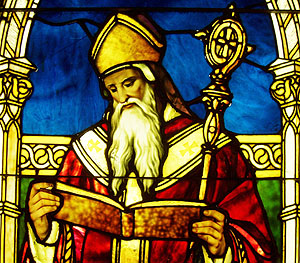
Saint
Augustine of Hippo - an ex Manichaean
Sometimes called the "Father of the Inquisition",
debating about death of living creatures with the Manichaeans
(Augustine, La Cité de Dieu, Books I-X (translation
from the Latin by Raoul de Presles), Paris, Maître François
(illuminator); c. 1475-1480. Volume II: Nantes, BM, fr. 8
Fol. 25r, Book 1, 20)
|
 |
| |
| |
|
|
Augustine sacrificing to an idol of the Manichaeans
Unknown artist, circa 1480-1500,
now in the Rijksmuseum, Amsterdam, Netherlands
|
 |
| |
|
Saint Augustine of Hippo, an ex Manichaean,
trampling other Manichaeans
underfoot
|
 |
|
|
|
Manichaeism and Catharism.
It has been extensively argued that the Bogomils, Paulicians, and
the Cathars were deeply influenced by Manichaeism. Scholars hold
varying opinions on this as the evidence is ambiguous - or in the
case of Medieval Christian Chroniclers, unreliable. On balance the
majority view is that all three groups were inheritors of the Manichaean
tradition, a view based largely on the amount of detail that accords.
One example they held identical views in interpreting the
word superstantial which occurs in the Lord's Prayer.
Another is the close resemblance to Manichaean principles of Church
organisation. On the other hand their religious cosmology from
what we know does not appear to match.
Regardless of its historical accuracy the charge of Manichaeism
was levelled at Cathars by contemporary Catholic opponents, who
routinely tried to match contemporary heresies with those recorded
by the Church Fathers such as St
Augustine.
Manichaeism continued to spread with extraordinary speed through
both the east and west. It reached Rome through the apostle Psattiq
by AD 280, who was also in Egypt in 244 and 251. It was flourishing
in the Fayum area of Egypt in AD 290. Manichaean monasteries existed
in Rome in 312 AD during the time of the Christian Pope Miltiades.
The spread and success of Manichaeism were seen as a threat to
other religions, and it was persecuted in Hellenistic, Christian,
Zoroastrian, and Buddhist cultures.
In 291, persecution arose in the Persian empire with the murder
of the apostle Sisin by Bahram II, and the slaughter of many Manichaeans.
In AD 296, Diocletian decreed against the Manichaeans: "We
order that their organizers and leaders be subject to the final
penalties and condemned to the fire with their abominable scriptures",
resulting in many martyrdoms in Egypt and North Africa. By AD 354,
Hilary of Poitiers wrote that the Manichaean faith was a significant
force in southern Gaul. In AD 381 Christians requested Theodosius
I to strip Manichaeans of their civil rights. He issued a decree
of death for Manichaean monks in AD 382.
Augustine
(AD 354–430) converted to Christianity from Manichaeism, in
the year 387. This was shortly after the Roman Emperor Theodosius
I had issued a decree of death for Manichaeans in AD 382 and shortly
before he declared Christianity to be the only legitimate religion
for the Roman Empire in 391. According to his Confessions, after
nine or ten years of adhering to the Manichaean faith as a member
of the group of "hearers", Augustine
became a Christian and ant adversary of Manichaeism (which he expressed
in writing against his Manichaean opponent Faustus of Mileve), seeing
their beliefs that knowledge was the key to salvation as too passive
and not able to effect any change in one's life.
I still thought that it is not we who sin but some other nature
that sins within us. It flattered my pride to think that I incurred
no guilt and, when I did wrong, not to confess it... I preferred
to excuse myself and blame this unknown thing which was in me
but was not part of me. The truth, of course, was that it was
all my own self, and my own impiety had divided me against myself.
My sin was all the more incurable because I did not think myself
a sinner. (Confessions, Book V, Section 10)
Some modern scholars have suggested that Manichaean ways of thinking
influenced the development of some of St
Augustine's ideas, such as the nature of good and evil, the
idea of hell, the separation of groups into elect, hearers, and
sinners, and the hostility to the flesh and sexual activity.
How Manichaeism may have influenced Christianity continues to be
debated. Manichaeism may have influenced the Bogomils, Paulicians,
and Cathars.
|
|