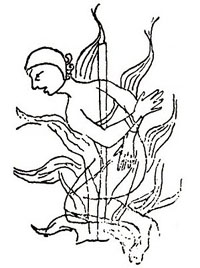


The following text is an English translation of an extract from Bernard GUI'sPractica inquisitionis heretice pravitatis or "Conduct of the Inquisition into Heretical Wickedness". Gui was Inquisitor in Toulouse from 1307 to 1323. Here he describes the the supposed "heresy" of the Beguines.
This translation is by David Burr. Other extracts concerning the examination of suspected Cathars are cited elsewhere on this website.
|
|
|
|
|
2. The following deals with the errors or erroneous opinions of the present-day Beguins and where they got them: |
|
|
|
Thus, in various places in the province of Narbonne and in some places in the province of Toulouse, from the year of our Lord 1317 on, the Beguins - as are commonly called those of both sexes who refer to themselves poor brothers of penance of the third order of Saint Francis, wearing brown or greyish habits with or without a cloak - were publicly exposed and confessed in court to holding many errors and erroneous opinions, exalting themselves in opposition to the Roman Church and apostolic seat, as well as against the apostolic power of the lord pope and prelates of the Roman church. Through lawful questioning and through depositions and confessions by many of their own number who chose to be burned and die rather recant as was canonically required, it has been discovered that they took their pestiferous errors and opinions partly from the books and other writings of Brother Peter John Olivi, born in Sérignon near Béziers. |
|
|
|
That is, they took these errors from his commentary on the Apocalypse, which they have both in Latin and in a vernacular translation; from some treatises on poverty, begging and dispensations that the Beguins say and believe he wrote; and from certain other writings they attribute to him, all of which they have in vernacular translations. They say and believe that the aforesaid Brother Peter John had knowledge through revelation given him by God, especially in his commentary on the Apocalypse. They also derive the aforesaid errors and opinions from oral tradition, teachings which they say he imparted to his close associates and to the Beguins during his lifetime, and which were then recited to others by those who originally received them. They respect these traditions as if it were authentic and genuine documents. |
|
|
|
These Beguins of both sexes also received their instruction in part from Brother Peter John's accomplices and followers. Moreover, some Beguins, seduced by their own imaginations, added a few things themselves like a people blinded, becoming masters of error rather than disciples of truth. Many of the things given a general application in Olivi's writings or in those of his followers, these Beguins, according to their depraved understanding, apply specifically to themselves to those they call their persecutors. Thus they stumble from one error into another, going from bad to worse. |
|
|
|
Indeed, it should be recognised that the aforesaid commentary on the Apocalypse was diligently examined by eight masters of theology at Avignon in the year of our Lord 1319 and found to contain many articles considered heretical, as well as many others containing falsity, intolerable error, temerity, or prediction of uncertain future events. Their judgement was drawn up in a public document and validated with their seals. One who has seen it, read through it, and held it in his hands bears witness to the truth here. |
|
|
|
Nevertheless, attention should be called to the fact that among the Beguins are found some who know, accept and believe many or all of the errors listed below. These are more steeped and hardened in them. Others can say less about these errors yet are sometimes found to be worse in holding and believing them than are others. Still others have heard or remember less and yield to valid reason and saner counsel. Others obstinately persist and refuse to recant, choosing to die rather than abjure their errors, saying that in this matter they defend the gospel truth, the life of Christ, and evangelical and apostolic poverty. Some of them, however, want to avoid being enmeshed in error or erroneous opinion and attempt to protect themselves from it. |
|
|
|
3. The following deals with their way of life: The aforesaid Beguins, who live in villages and small towns, have little dwellings in which some of them live together. Their own term for these dwellings is "houses of poverty." In these houses, on feast days and Sundays, those who reside in them, other Beguins who dwell privately in their own houses, and intimates or friends of the Beguins all come together to read or hear read the aforesaid books or works from which they suck poison, although certain other things are read there such as the commandments, the articles of faith, legends of the saints, and the Summa of Vices and Virtues, in order to clothe the school of the Devil in an appearance of goodness and make it seem to imitate the school of Christ in some ways. Nevertheless, the precepts of God and articles of faith should be preached and expounded publicly by rectors and pastors of the church and by teachers and preachers of God's word, not in secret by simple laypersons. |
|
|
|
It should also be recognized that there are some among them who beg publicly from door to door because, as they say, they have accepted evangelical poverty. And there are others who do not beg publicly but gain income by working with their hands, and observe a life of poverty. There are, however, some simpler Beguins of both sexes who do not know explicitly the articles or errors listed below, but are ignorant of them. Yet of these, there are some who commonly consider unmerited and unjust the condemnation of Beguins carried out by prelates and Inquisitors of heretical depravity from the year of our Lord 1318 on in many places in the province of Narbonne (that is, at Narbonne, Capestang and Béziers, around Lodève, in the diocese of Agde, and around Lunel in the diocese of Maguelonne), at Marseilles, and in Catalonia. They feel that the condemned were just and good people. |
|
|
|
4. Concerning the outward signs by which they can be recognized to some extent: It should also be recognized that, as Augustine says in Against Fausus, "men cannot be bound together in either a true or false religion unless they are joined by common participation in some signs or visible sacraments." Thus the Beguins observe certain special practices of this sort, and display certain modes of behaviour in speech and other areas through which they can be recognized by others. Their way of giving or returning a salutation is as follows: When they come to or enter a house or meet one another on a journey or in the street, they say, "Blessed by Jesus Christ," or "blessed be the name of Lord Jesus Christ." Again, when they pray in church or elsewhere they commonly sit hooded and bent over with their faces turned toward the opposite wall or a similar location, and rarely seem to kneel with hands joined as others do. Also, at the midday meal, after the food has been blessed, the Gloria in excelsis Deo is said kneeling by those who know it. At the evening meal those who know it say the Salva, Regina, also kneeling. |
|
|
|
5. The following deals with the erroneous, schismatic, temerarious or false articles or the aforesaid Beguins and their followers: In the first, place, those commonly called Beguins -although they call themselves Poor Brothers of Penitence of the Third Order of Saint Francis - believe and affirm that Lord Jesus Christ (insofar as he was man) and his disciples as well owned nothing either individually or in common, because they were perfectly poor in this world. Again, they say that having nothing individually or in common constitutes perfect evangelical poverty. Again, they say that having something in common diminishes the perfection of evangelical poverty. Again, that the apostles could not have owned anything individually or in common without diminution of their perfection or without sin. Again, they say it is heretical to believe and assert anything to the contrary. |
|
|
|
Again, they say the rule of Saint Francis is that life of Jesus Christ which Jesus observed in this world and which he handed down to his apostles, imposing its observation on them. Again, that in his rule Saint Francis handed down the aforesaid evangelical poverty to the brothers of his order, so that professors of the aforesaid rule can have nothing either individually or in common beyond the limited use necessary to life, which always smacks of the indigence of poverty and has nothing superfluous. Again, they say that Blessed Francis was, after Christ and his mother (and, some add, the apostles), the highest and most eminent observer of the evangelical life and rule, as well as its renewer in this sixth period of the church which they say we are now witnessing. Again, they say that the aforesaid rule of Saint Francis is the gospel of Christ or one and the same with the gospel of Christ. |
|
|
|
Again, they say that whoever impugns or contradicts the rule of Saint Francis in any way impugns and contradicts the gospel of Christ, and consequently errs and becomes a heretic if he perseveres in this behaviour. Again, they say that neither the pope nor anyone else can change anything in the gospel of Christ, nor can they add or subtract anything. Thus neither can they change anything in the aforesaid rule of Saint Francis, nor can they add or subtract anything concerning vows, or the evangelical counsels or precepts contained in them. Again, they consequently say that the pope cannot annul or change the rule of Saint Francis or abolish the order of Saint Francis, which they call the evangelical order, from the number of existing orders. Again, they make precisely the same assertion concerning the third state or order of Saint Francis, or his third rule. Again, they say that neither a pope nor a general council can annul or legislate the contrary of what has been confirmed, legislated or ordered by a previous pope or general council. On this basis they commonly believe and say that the aforesaid two rules of Saint Francis - and, some of them add, any others confirmed by Roman pontiffs - cannot be annulled by any succeeding pope or general council. |
|
|
|
Again, they say that if the pope changes something in the rule of Saint Francis, adds something to it, or subtracts something from it (especially concerning the vow of poverty), or if he annuls the aforesaid rule, he acts against the gospel of Christ and neither a Friar Minor nor anyone else is required to obey him in the matter, however much he may command it or excommunicate those not obeying him, because such excommunication would be unjust and not binding. Again, they say that the pope cannot dispense anyone from a vow of poverty made to God, even if that vow was simple and not solemn, for a person who vows poverty is bound forever to observe it, since anyone dispensed from such a vow would descend from a higher to a lower grade of virtue and from a higher to lower perfection, and papal power, as they say, is only for building up, not for tearing down. Again, they say that the pope cannot issue a constitution or decretal dispensing or allowing the Brothers Minor to store in common granaries or cellars that wheat or wine which will be necessary for their future use, for that would be a violation of Saint Francis' evangelical rule and thus also of the Christ's Gospel. |
|
|
|
Again, they say that Pope John XXII, in issuing a certain constitution beginning Quorumdam, which dispenses or concedes to the Brothers Minor that they may store wheat and wine for the future in granaries or cellars at the discretion of their leaders, acted against evangelical poverty and hence, as they say, against the gospel of Christ. Thus they say that he has become a heretic and consequently lost the papal power to bind, loose and do other things (granting that he perseveres in this course of action), and that the prelates created by him since he issued the constitution have no ecclesiastical jurisdiction or power. Again, that all the prelates and others who consented to the issue of said constitution or now knowingly consent to it by this very act have become heretics if they pertinaciously continue to do so and have lost all ecclesiastical jurisdiction. Again, they say that the Brothers Minor who asked for the constitution, or who now consent to it and accept it, or who make use of it, have by their action become heretics. |
|
|
|
Again, they say that the pope cannot, with divine approval make it legitimate for a Friar Minor to transfer to some other religious order in which that brother will, like others in the order, hold wealth in common, even if the transfer is effected with papal permission. For, as they say, that would entail descending from a greater and higher state or grade of perfection and virtue to a lesser and inferior one, which would involve tearing down and not building up, and the pope's power was granted to him only for building up, not tearing down. Again, they say that if some Friar Minor, whatever sort of papal license he might have, should transfer to another religious order, he is still perpetually obliged to observe the vow of poverty made by him earlier in accepting the rule of Saint Francis. That is, he cannot possess anything either individually or in common beyond what is consistent with poverty. |
|
|
|
Again, they say that if some Friar Minor should become a bishop or cardinal or even pope, he would still be perpetually obliged to observe the vow of poverty made by him earlier in accepting the rule of Saint Francis, and thus he should occupy himself only with the administration of spiritual matters and let all temporal affairs be governed and administered by competent proctors. Again, they say that the pope cannot make dispensation concerning the size and quality of Franciscan habits in contradiction to the rule of Saint Francis, allowing the introduction of superfluity. The brothers should not obey him in this matter or in any other that is contrary to the perfection of Saint Francis' rule. Again, they say that the state of the order of the Friars Minor, which vows and promises evangelical poverty, is the highest state in the church of God, and the state of prelates cannot equal its perfection, although those prelates who belong to the order of Friar Minor and thus have promised evangelical poverty (which they are perpetually obliged to observe) attain to that same perfection if they observe the vow they made earlier. |
|
|
|
Again, they say that those four Friars Minor who, in the year of our Lord 1318, were burned at Marseilles by the Inquisitor of heretical depravity (himself a member of the order of Friars Minor), were condemned as heretics because, as the beguins say, they wished to observe the aforesaid rule of Saint Francis, preserving its purity, truth and poverty, and did not want to consent to relaxation of the rule, or accept the dispensation issued by the aforesaid pope on these matters, or obey him or others on this point. They say that these brothers were condemned unjustly because they defended the truth of the evangelical rule. Thus they say that the brothers were not heretics, but rather Catholics and glorious martyrs. They ask for their prayers and intercession before God. Again, many of them say that they consider them to be of no less merit before God than the martyrs Saint Laurence and Saint Vincent. Again, some say that Christ was again spiritually crucified in these four Friars Minor, as in the four arms of the cross, and that the poverty and life of Christ was condemned in them. |
|
|
|
Again, they say that the aforementioned Lord Pope commanded or consented or still consents that the aforesaid four Friars Minor should have been condemned as heretics by the Inquisitor. Through this he has become a heretic himself, the greatest one of all, since as head of the church he should defend evangelical perfection. Thus, as they say, he lost papal power, nor do they believe him to be pope or to be obeyed by the faithful, for from that moment he vacated the papacy. |
|
|
|
Again, they say that all those who are commonly called beguins (but call themselves poor brothers of penitence of the third order of Saint Francis) who have been condemned as heretics during the last three years (that is, from the year 1318 on) through the judgement of prelates and Inquisitors of heretical depravity in the province of Narbonne (that is, at Narbonne, Capestang, and Béziers, around Lodève, in the diocese of Agde, and around Lunel in the diocese of Maguelonne), who believed the aforesaid four Friars Minor were holy martyrs and believed, maintained and felt the same as they about evangelical poverty and papal power (that is, that he lost it and became a heretic), and also believed that the prelates and Inquisitors who persecuted the said brothers became heretics through that activity, and that the doctrine of Brother Peter John Olivi was completely true and catholic, and that the carnal church (that is, the Roman Church) was Babylon the great whore which was to be destroyed and cast out just as the synagogue of the Jews was when the primitive church began; these beguins, I say, even though they believed and defended all that, were, they say, unjustly condemned for defending the truth, and were not heretics but rather Catholics. They say they are, before God, glorious martyrs. Again, they say that the church of God will still recognise that these four Friars Minor and the said beguins condemned as heretics are holy martyrs, and there will be a solemn feast day in the church for them just as for the great martyrs. |
|
|
|
Again, they say that the prelates and Inquisitors who judged and condemned them as heretics - and indeed all those who consented or now consent knowingly to their condemnations - have by this action become heretics (if they persevere in it), and by this action have lost the ecclesiastical power to bind, loose and administer the ecclesiastical sacraments. Nor should they be obeyed by faithful Christians. Again, they say that each and every one of the aforesaid who, they say, became heretics for the aforesaid reasons are not the church or the church of God, nor are they among the number of the faithful. They are, rather, outside the church of God if they persevere in this activity. Again, that all those who do not wish to believe or refuse to believe these same articles the four Friars Minor and beguins condemned as heretics believed, and indeed all those who do not believe the condemned heretics were glorious martyrs, these, I say, they assert to be not of the church of God, but outside the church. |
|
|
|
Again, they say that all those who hold and believe what the beguins or poor brothers of the third order believe and maintain concerning all the aforesaid, and who believe as they who were condemned as heretics believed and maintained, are the church of God and live within the church of God. This number can even include other faithful not of the third order, be they clerics, members of religious orders, or laity, as long as they believe and maintain as the beguins do on the aforesaid issues. Again, many beguins and beguines, along with those who believe in them, secretly gather the burnt bones and ashes of the aforesaid burned who were condemned as heretics, so that they can preserve them as relics. They are kissed and venerated just as relics of the saints are, through the devotion and reverence they hold for them, as was uncovered and discovered through inquisition and through confessions as well as depositions obtained during the judicial process from certain beguins who had such things with them and had seen and knew about others who had them or had once had them. We ourselves, in the process of inquiry, have touched and seen relics of this sort found among them, and are thus can offer direct witness concerning them. Again, some beguins have recorded in written form the names of the aforesaid condemned and the days on which they were martyred (as they assert), just as the church of God is accustomed to do with its saints and genuine martyrs; and they have recorded their names on their calendars and invoked them in heir litanies. |
|
|
|
Again, they say the pope cannot dispense anyone from the vow of virginity or chastity, even if that vow was simple and not solemn, no matter how much good might follow to the community through such a dispensation, for example the return of peace to some province or kingdom, or conversion of a people to the faith of Christ; for the person who was dispensed would descend from a higher and greater to a lesser grade of perfection. Again, they add on this score that even if all women in the world were dead except one who had vowed chastity or virginity to God, and the human race would disappear unless that woman were married, the pope could not provide a dispensation, and the woman would not be required to obey the pope if he demanded marriage. If she obeyed she would sin mortally, and if she disobeyed and were excommunicated by the pope the excommunication would be unjust and invalid. If she suffered death on this account she would be a martyr. Again, some of them say that if a person who had made such a vow entered into matrimony, even with papal dispensation, that marriage would not be true or legitimate, and the offspring produced through it would be not legitimate but adulterine. |
|
|
|
Again, they say that prelates and members of religious orders whose clothing is too abundant or too costly violate gospel perfection and Christ's precept, according instead with the precept of Antichrist. Such clerics who go around in pompous fashion are of the family of Antichrist. Again, they say that beguins or poor of the third order are not required to swear before prelates and Inquisitors except concerning the faith or the articles of faith, even though they are summoned to answer to them concerning the sect and heresy of the beguins. Again, they add and say that they should not be interrogated by prelates or Inquisitors concerning anything except the articles of faith, commandments or sacraments; and if they are interrogated on other matters they are not required to respond, since they are, as they say, laity and simple people. In reality, however, they are astute, cunning and crafty. |
|
|
|
Again, they say they are not required to take oaths, nor should they be made to reveal under oath the names of their fellow believers, accomplices and associates, because, as they say, this would violate the command to love one's neighbour and would on the contrary injure one's neighbour Again, they say if they should be excommunicated on this account, simply because during a judicial process they refuse to swear simply and absolutely to tell the truth concerning anything except the articles of faith, commandments or sacraments, and because they refuse to respond to anything else under oath and to reveal their accomplices, such an excommunication is unjust, is not binding on them, and they take it lightly. |
|
|
|
Again, they say the pope cannot forbid the beguins on pain of excommunication to live by begging, even though they might be capable of working at a trade for their livelihood and even though they do not labour at the gospel, since it is not fitting for them to teach or preach. For, they say, their perfection would thereby be diminished, and thus they are not required to obey the pope on this matter, nor is his sentence binding on them. If, they say, they should be condemned to death on these grounds, they would be glorious martyrs. |
|
|
|
Again, they say all the teachings and writings of Brother Peter John Olivi of the Franciscan Order are true and catholic. They believe in these teaching, say they were revealed to Brother Peter John by God, and claim that while still alive he told his close associates that such was the case. Again, they commonly refer to Brother Peter John as an uncanonized holy father. Again, they say he was such a great doctor that there was no one greater from the apostles and evangelists on, and some add that he was greater in both sanctity and teachings. Again, some of them say there has been no doctor except Saint Paul and the aforesaid Brother Peter John whose teaching have not been refuted in some particular by the church, but the entire teaching of Saint Paul and Brother Peter John is to be accepted in its totality by the church, and not one letter of it is to be rejected. |
|
|
|
Again, some of them say that Brother Peter John spoke the truth when he said that Christ was still living when, hanging on the cross, his side was pierced by the lance, for his soul was still really in his body at that point, but because he was so greatly weakened he seemed dead to onlookers. The Evangelist John referred to him as dead by then because he appeared to be such, and the Evangelist Matthew wrote that he was still alive because he was truly such, but the church erased this passage from the gospel of Matthew so he and John would not seem to differ. |
|
|
|
Again, they say Brother Peter John was spiritually designated by that angel of whom it is written in Apocalypse 10 that his face was like the sun, and that he had an open book in his hand; because, as they say, the truth of Christ and understanding of the Apocalypse was opened in a singular way to him among doctors. Moreover, in his commentary on the Apocalypse, which they have translated into the vulgar tongue, they interpret the aforesaid passage in that way. Again, they say the writings and teachings of Brother Peter John are more necessary to the church of God now than any other writing by any other doctor or saint except the writings of the apostles and evangelists, because, as they say, he interprets more fully and clearly malice of Antichrist and his disciples, that is, the Pharisees, whom they identify with contemporary church leaders, monks and Brothers. Again, they say that if God had not provided the church with Brother Peter John or someone like him, the whole world would be blind or heretical. Again, they say that those who do not accept the teachings and writings of Brother Peter John are blind, because they do not see the truth of Jesus Christ; and those who reprove and condemn his doctrine are heretics. Again, they say Brother Peter John is the light which God sent into the world, and thus those who do not see this light walk in darkness. |
|
|
|
Again, they say that if the pope were to condemn the teachings or writings of Brother Peter John, he would become a heretic by doing so, because he would be condemning the life and teachings of Christ. Again, they say that if the pope should condemn his teachings and writings, they would not consider it really condemned, and if he were to excommunicate them on that account they would not consider themselves excommunicated, nor would they obey him, nor would they surrender Olivi's books. Again, the books of Brother Peter John possessed by these Beguins were translated from Latin into the vulgar tongue by some of his followers. They include his Apocalypse commentary; a certain small treatise on poverty; another rather small one on mendicancy; another on the seven malign spirits; and certain other writings, all of which they attribute to Olivi whether they were written by him or by someone else on the basis of his teachings and tradition (for they reflect the same dogma). They read these books in the vulgar tongue to themselves, their intimates and their friends within their conventicles and in the little dwellings they call "houses of poverty." They use these pestiferous teachings to instruct themselves and, if they can, others. |
|
|
|
Again, informed or rather deformed by the teachings they derive from Peter John's Apocalypse commentary, they say the carnal church (by which they mean the Roman church as it exists, not only in the city of Rome, but throughout the whole area under Roman jurisdiction) is Babylon, the great whore of whom John spoke in the Apocalypse. Thus they apply these passages to the Roman Church and attribute to the church all the evil things written there, such as that it is drunk with the blood of the martyrs of Jesus Christ. And they interpret this as referring to the blood of the four Brothers Minor condemned and burned as heretics at Marseilles, and the blood of the Beguins of the third order condemned and burned as heretics in the province of Narbonne in recent years, as mentioned earlier, for they assert that these people were martyrs of Jesus Christ. Again, they the church has drunk the wine of its fornication with all the kings of the earth, that is, the kings, princes and great ecclesiastical leaders who seek the pomp of this world. |
|
|
|
Again, they distinguish between two churches, the carnal church which they say is the Roman church which contains the multitude of reprobate, and the spiritual church which contains those people they describe as spiritual and evangelical, who emulate the life of Christ and the apostles. They say the latter is their church. Some of them, though, say there is only one church which they call a great, carnal whore because of the reprobate in it, but spiritual and a virgin without spot or stain because of the elect, whom they call evangelical people, and by the latter they refer to themselves, who say they accept, defend and die for evangelical poverty. Again, they claim that the carnal church, by which the mean the Roman church, is to be destroyed prior to the preaching of Antichrist by a war waged against it by Frederick, the present king of Sicily, and his accomplices, the ten kings signified by the ten horns of the beast in the Apocalypse. And they believe certain other erroneous and insane fables about King Frederick warring against the king of France and King Robert. |
|
|
|
Again, they claim that at the end of the sixth period of church history - that is, the present period which began with Saint Francis - the carnal church, Babylon, the great whore is to be rejected by Christ just as the synagogue of the Jews was rejected because it crucified Christ, for the carnal church is crucifying and persecuting Christ's life by persecuting those brothers in the Franciscan order called the poor and spiritual. They apply this to the persecution of those in both the first and third orders in the provinces of Provence and Narbonne. Again, they teach that just as, when the synagogue of the Jews was rejected by Christ, a few people were elected through which the primitive church was founded, so in the present sixth period of the church, once the carnal Roman church has been rejected and destroyed, there will remain a few elect, poor spiritual individuals, the majority of which will be of either the first or third order of Saint Francis, and through these will be founded, in the seventh and last period which begins with the death of Antichrist, a spiritual church which will be humble and benign. |
|
|
|
Again, they claim that all religious orders will be destroyed during the persecution of Antichrist except that of Saint Francis, and they divide the latter into three parts. One consists of those they call the community, a second of those in Italy called the Fraticelli, and a third of those called spirituals who observe the rule of Saint Francis in its spiritual purity, along with the brothers in the third order adhering to these spirituals. The first two parts, they say, will be destroyed and the third will remain, just as God has promised. |
|
|
|
Again, some of them claim that on those elect spiritual and evangelical individuals through whom a spiritual and benign church will be founded in the seventh and last period, the Holy Spirit will be poured out in greater or at least in equal abundance as on the apostles, the disciples of Jesus Christ, on the day of Pentecost during the time of the primitive church. And they say the Holy Spirit will descend on them like a fiery flame in a furnace, and they take this to mean that, not only will their souls be filled with the Holy Spirit, but the Holy Spirit will live in their bodies as well. |
|
|
|
Again, they claim that there is a double Antichrist, one spiritual or mystical and the other the real, greater Antichrist. The first one prepares the way for the second. And they say the first Antichrist is the present pope under whom they are being persecuted and condemned. Again, they have determined the time within which the greater Antichrist - whom they consider already born - should come, begin to preach, and finish his career. Some say it will all have happened by 1325; others say by 1330; and still others say by 1335. Again, they claim that when Antichrist is dead those spiritual individuals mentioned above, whom they call evangelicals and through whom the church will be founded, will preach to the twelve tribes of Israel and will convert twelve thousand from each tribe, thus making a combined group of 144,000. These will make up the militia signed by the angel having the sign of the living God, whom they interpret as the blessed Francis, who had the stigmata of the wounds of Christ. This signed militia will battle with Antichrist and be killed by him before the coming of Elijah and Enoch. |
|
|
|
Again, spreading more fables they claim that when the carnal church is destroyed there will be a great war and great slaughter of the Christian people, and a great multitude that defended the carnal church will be destroyed in the war; that, with almost all the men dead, the remaining Christian women will be in such need of men that they will embrace trees. On this subject they offer a great many other fables which can be read in the aforesaid commentary in the vulgar tongue. Again, they say that after the destruction of the carnal church the Saracens will come and occupy Christian lands, entering the kingdom of France through Narbonne, and will abuse Christian women, taking many of them captive. They say all this was revealed to Brother Peter John in Narbonne. Again, they say that both in the time of persecution by Antichrist and in that of the aforesaid war carnal Christians will be so afflicted that, despairing, they will say, "If Christ were God, he would not permit Christians to suffer so much and such intense evil." Thus despairing, they will apostatise from the faith and die. But God will hide the elect spiritual individuals so that they cannot be found by Antichrist and his ministers. Then the church will be reduced to the same size as the primitive church when it was first founded, so that scarcely twelve will remain by whom the church will be founded and upon whom the Holy Spirit will be poured out in equal or greater abundance than on the apostles in the primitive church, as was said above. |
|
|
|
Again, they say that after Antichrist's death these spiritual individuals will convert the entire world to the faith of Christ; and the whole world will be so good and benign that there will be no malice or sin in people of that period, except perhaps for venial sins in a few of them; and all things will be common as far as use is concerned; and there will be no one who offends anyone else or encourages another to sin. For there will be the greatest love among them, and there will be one flock and one pastor. According to some of them this period and condition will last for one hundred years. Then, as love fails, malice will creep back in and slowly increase until Christ is, as it were, compelled to come in universal judgement because of it. |
|
|
|
Again, these insane heretics seriously and ignominiously rail against the Lord Pope, the vicar of Jesus Christ, calling him the mystical Antichrist, precursor of the greater Antichrist, preparing the way for his life. Again, they call him a rapacious wolf to be avoided by the faithful; a one-eyed or blind prophet; Caiaphus the high priest who condemned Christ; and Herod, jokingly mocked Christ. He is such because, as they say, he condemned Christ's life and derided Christ in his poor. Again, they say he is the wild boar of the forest and the singular wild beast ruining and destroying the wall or enclosure of the church of God (1Ps. 79:14) so that dogs and swine may enter, that is, men who tear up and trample down the perfection of the evangelical life. And they say he causes more evil in the church than did all the preceding heretics, because in the time of these other heretics the church remained in its integrity, but not it seems not the church of God but the synagogue of the devil. They say that in his time the carnal church will be destroyed. He alone, along with two cardinals, will escape into hiding and die of sadness and grief. |
|
|
|
These are the insane and heretical claims made by that aforesaid pestiferous sect, the Beguins. All these things, and many more which it would take too long to narrate, I have heard from their own mouths while inquiring into them. In reading their books we have confirmed that many of these claims are contained there as well; and they are even more copiously contained in their confessions received in judicial processes against them. They have, however, been pulled together presented in a single document here so that they can kept more readily at hand. |
|
|
|
Inquiry was conducted against them in the province of Narbonne from the year of our Lord 1318 on, and in the province of Toulouse at Pamiers during the year 1321 and thereafter. |
|
|
|
6. The following deals with the way Beguins are to be examined and questioned: It should be recognized and kept in mind that some of these Beguins have studied and know more than others about the preceding articles, having been more fully instructed or trained in them; for it is their custom to move gradually from bad to worse, conveying their doctrine little by little rather than all at once. Thus in the process of investigation a skillful Inquisitor may inquire about all these things, a few, or only one, putting all others aside, as seems expedient to him, in view of the quality or condition of the person being examined and the demands of the Inquisitorial office. Thus a list of questions to be asked is presented below, based on the errors they have been found to hold; yet it should not be assumed that every one of them ought to be asked to each and every person being interrogated. Instead, those should be asked which the individual Inquisitor considers fitting, so that the manner and style of investigation can be fitted to the specific case at hand. Thus by suitably posed questions and the answers arising from them the truth will more subtly and more easily be discovered, while deceit will more quickly be detected when the interrogated does not respond clearly and properly to the question, seeking to avoid a direct answer by hiding behind a shelter of words. All of these things are learned more fully through experience. |
|
|
|
7. Questions especially relevant to contemporary Beguines: First the examinee should be asked when, where and by what minister he was received and professed in this order. Again, ask whether he was examined in the faith by the bishop of that place or by one of his deputies, for Lord Pope John XXII has decreed and ordained that any other sort of examination is invalid, empty and worthless. Again, ask with whom he associated after that, and where. |
|
|
|
Again, if the examinee is not a Beguin but a greater believer in them and friendly with them, and is suspected of sharing their errors, ask when he began to believe in them and associate with them on a familiar basis. Again, the examinee should be asked whether he has heard some of them teach and assert that Christ and the apostles had nothing either individually or in common; if he has heard it said that to hold and believe the opposite is heretical; if he has heard it claimed that to have things in common diminishes the perfection of evangelical poverty; if he has heard it said or claimed, and if he himself believed and believes, that the rule of Saint Francis is one and the same with the gospel of Christ or is the gospel of Christ; if he believed or believes that, just as the pope cannot change anything in the gospel or add or subtract anything from it, so he cannot change anything in the rule of Saint Francis, nor can he add to it or subtract from it insofar as the evangelical vows or counsels are concerned, or insofar as the precepts contained in it are concerned; if he believed, or believes, or even has heard it claimed that the pope cannot suppress either the Franciscan Order founded on the first rule or the third order founded on the third rule, removing either or both from the number of religious orders, as has sometimes occurred with other orders. |
|
|
|
Again, ask if he has heard it claimed, or has believed or now believes that the pope cannot promulgate a decree in which he dispenses or concedes to the Brothers Minor that they may store wheat and wine for their common future needs, for their own use, according to the decision of their own leaders. Ask if he has heard it said, or has believed or now believes that the Lord Pope John XXII, in making promulgating that decretal which begins Quorumdam, in which he is said to have dispensed or conceded to the Brothers Minor that can have common stores of grain and wine in the aforesaid manner, acted against evangelical poverty or against the gospel of Christ. Again, ask if he has heard it said, or has believed or now believes that the Lord Pope should not not be obeyed by any Brother Minor in the matter of the aforesaid dispensation or in any other case where he has changed something in the rule, even though the pope has ordered by virtue of obedience and under penalty of excommunication that it should be held and observed by all the friars. Again, ask if he has heard it said, or has believed or now believes that the Lord Pope John XXII, in promulgating the aforesaid decree and dispensation, by that very fact became a heretic and lost the papal power of binding and loosing. |
|
|
|
Again, ask if he has heard it said, or has believed or now believes that the pope cannot give a Brother Minor permission to transfer to another order in which he will hold possessions in common just like other members of that order, but rather that he will always be required to observe the vow of poverty he made according to the rule of Saint Francis, and thus can never hold anything either individually or in common. Again, ask if he has heard it said, or has believed or now believes that a Brother Minor, once he has been made a bishop or cardinal, is still required to observe the vow of poverty made by him according to the rule of Saint Francis. Again, ask if he has heard it said, or has believed or now believes that the pope cannot dispense anyone from a vow of chastity or virginity in some specific case, even if the vow was a simple one and not solemnise, and even if some great benefit to the community would follow from the dispensation; and that any marriage later contracted by a person so dispensed would be invalid. Again, ask if he has heard it said, or has believed or now believes that the pope cannot dispense anyone from a vow of simple poverty. |
|
|
|
Again, ask if he is aware that some Brothers Minor were condemned as heretics at Marseilles by an Inquisitor of heretical depravity belonging to their own order, and whether he knows the reason why they were condemned. Again, ask if he believed or believes they were Catholics. and holy martyrs, or if he knew other people who thought them holy martyrs, or if he heard it said or believed himself that those who condemned them as heretics acted unjustly and by doing so became themselves heretics and persecutors of evangelical poverty. Again, ask if he has heard it said, or has believed or now believes that the pope became a heretic and lost his papal power if he consented to those four Brothers Minor being condemned as heretics at Marseilles. |
|
|
|
Again, ask if he knew that some beguins, male and female, who call themselves Poor of the Third Order of Saint Francis, were during these past years condemned by judgement of bishops and Inquisitors of heretical depravity in the province of Narbonne and elsewhere. Again, does he know in which areas or towns of the province they were condemned. Again, how many beguins has he heard were condemned?Again, does he know the reasons why they were condemned as heretics? Again, did he or does he believe that the beguins condemned as heretics were Catholics. and holy martyrs, and that they suffered death for the sake of the truth? Again, does he know or has he heard any people who believe, or think or say that these condemned heretics were holy martyrs or saved?Again, did he or does he believe that those who condemned them as heretics by that act became heretics themselves? Again, ask if he kept bones, ashes or other things belonging to those who were condemned and burned as relics, through devotion and reverence for them. Again, from whom did he receive them and what did he then do with them? Did he kiss them? Again, does he know any other people who kept bones or ashes as relics? Again, did he think that the lord pope became a heretic and lost his papal power if he consented to the aforesaid beguins being condemned as heretics? Again, ask if he believed or believes that the beguins condemned as heretics and those who believed as they did made up the church of God or were a part of it, while those who condemned them or consented to their condemnation were not. Again, ask if he is aware that the days on which these condemned beguins died are recorded by some in calendars or included in litanies, just as is done with other saints, or if he knows that their names are invoked and their aid sought in litanies. |
|
|
|
Again, ask if he has heard it claimed among beguins that bishops, monks, friars or clerics who have superfluous or excessively valuable clothing violated Christ's gospel and follow the command of Antichrist or are of his family; or that Christ's poverty singularly shines forth in the ragged clothing of poor beguins. Again, ask if he has heard it claimed among beguins that in the modern time the church of God and faith of Christ has remained only in the humble community of poor beguins of the third order, and in other humble people who do not persecute these poor beguins or the evangelical rule of poverty. Again, ask if they have heard it said among beguins that it is of greater perfection for beguins to live by begging than by working, or by the labour of their hands, and that the pope cannot inhibit them from doing so or, by a sentence of excommunication, compel them not to beg in public if they can live decently by the labour of their hands, since they do not labour in preaching the gospel, for it is not fitting for them to preach. |
|
|
|
Again, concerning the teachings or writings of Brother Peter John Olivi of the order of Brothers Minor, if he has heard it read in the vulgar tongue, or if he has read it to himself or others, and where, and how many times, and who was involved. Again, which of Brother Peter John's books did he hear read or did he read: the Apocalypse commentary, the treatise on poverty, the one on mendicancy, or some other work? Again, does he consider or believe the writings or teachings of Brother Peter John to be true and catholic? Again, has he heard it said by the beguins or by some of them that his writings or teachings are more necessary to the church of God than are those of any other doctor or saint except the apostles and evangelists, or that he is the greatest doctor in the church since the apostles and evangelists? Again, has he heard it said or exposited among the beguins that Brother Peter John is the angel of whom it is said in the Apocalypse that "his face was like the sun and he had an open book in his hand," according to the spiritual meaning of the passage, because, as the beguins claim, in his commentary on the Apocalypse the truth of Christ and the meaning of that book was revealed in a unique way? Again, ask him if he has heard it said among the beguins that the pope cannot condemn the teachings or writings of Brother Peter John since they were revealed by God, as they claim; that if he were to condemn them he would be condemning the life of Christ; that the beguins would not consider them condemned, nor would they obey the pope on this matter; and that they would not consider themselves excommunicated by him on this account. Again, ask what he believes or believed concerning the preceding claims about the teachings or writings of Brother Peter John. |
|
|
|
Again, ask what he has heard recited among the beguins concerning what Brother Peter John predicted and taught to associates and beguins during his lifetime about the situation of the church and other things. Again, ask what he remembers having read or heard read in the aforementioned commentary . Did he read or hear read that there are seven periods of the church and that at the end of the sixth, which that commentary says began with Saint Francis or with his rule, the age of the Roman church is scheduled to end just as the age of the synagogue ended with the advent of Christ?; that in the beginning of the seventh period, which they say will begin with the death of Antichrist, another, new church will come into being and succeed to the first, church, the Roman church, now rejected and condemned?Again, ask if he has heard it exposited and explained in that commentary that the Roman church is Babylon, the great whore of which the Apocalypse writes, and that it is the city of the devil which will finally be condemned and rejected by Christ, just as the synagogue of the Jews was condemned and rejected. Again, ask if he has heard it read or exposited that the primacy currently enjoyed by the carnal church, namely the Roman church, will be transferred to the new Jerusalem, which they interpret as a certain new church to come at the end of the sixth period and at the beginning of the seventh. |
|
|
|
Again, ask if he has heard it read or exposited that the sixth period, begun in the time of Saint Francis, will more perfectly observe the evangelical rule of poverty and the counsel of patience than any other preceding period. Again, ask if he has heard it exposited that the rule of Saint Francis is truly and precisely that evangelical life which Christ observed himself and imposed on his apostles, and that the pope has no power over it. Again, ask if he has heard it exposited that the rule of Saint Francis must be wickedly attacked and condemned by the proud, carnal church, just as Christ was condemned by the Jewish synagogue. Again, ask if he has heard it said or exposited in the aforesaid commentary that the blessed Francis was, after Christ and his mother, the greatest observer of the evangelical life and rule; that he was, under Christ, the original and principal founder, initiator and exemplifier of the sixth period of the church and of the evangelical rule; that the state or rule of Saint Francis will, like Christ, be crucified around the end of the sixth period; that Blessed Francis will then bodily rise again in glory so that, just as he was assimilated to Christ in a singular way both in his life and in being given the stigmata of the cross, so he will be assimilated to Christ by a bodily resurrection. |
|
|
|
Again, ask if he has heard it exposited that the persecution or punishment now directed at those who pertinaciously cling to the beguin sect is, as it were, another crucifixion of the life of Christ, another piercing of his hands, feet and side. Again, ask if he has heard expositions regarding the wild boar, the mystical Antichrist, assimilated to Caiaphas condemning Christ and Herod mocking him; and regarding the wild boar, the great Antichrist, assimilated to Nero and Simon Magus. Again, ask if he has heard it exposited that the evangelical state is the state of those poor individuals who, as they claim, are persecuted and punished by the Roman church because they do not obey, but instead rebel against the apostolic power and against the expositions and declarations promulgated by the apostolic seat concerning the rule of Saint Francis. |
|
|
|
Again, ask if he has heard it exposited that in the thirteenth centenary year after the passion and resurrection of Christ, the Saracens and other infidels are to be converted by the order of Saint Francis, though with many martyrs among the Brothers Minor; and that in the thirteenth centenary year after the birth of Christ Saint Francis and his evangelical order appeared; and that in the thirteenth century after the death and ascension of Christ this evangelical order will be exalted on the cross and its glory will rise up over the whole earth; and that in the time when the evangelical life and rule is being attacked and condemned - which they claim will occur under the mystical Antichrist (whom they identify as a pope) and be completed under the great Antichrist - then Christ, his servant Francis and the evangelical crowd of his disciples will descend spiritually to oppose all the world's error and malice; and that, just as the apostolic order preached to the whole world at the beginning, so the evangelical order of Saint Francis will preach to the whole world and convert it between the times of the mystical and great Antichrists; and that the beast ascending from the earth in the Apocalypse refers to a pseudopope with his pseudoprophets, who will not directly execute people as will the beast ascending from the sea of the worldly laity, who will kill the saints (which the beguins exposit as meaning themselves); and that the sixth head of the dragon is, according to their exposition, the mystical Antichrist, a pope, while the seventh head is the great Antichrist, who has a powerful king allied with him. |
|
|
|
Again, ask what else he has heard said among the beguins about the time of Antichrist and the year he is to arrive; and what else he has heard of the many things said against the Roman church, its leaders, monks, friars and priests; and what else he has heard of the many temerarious predictions about the future contained in the aforementioned commentary. |
|
|
|
8. Teaching or instruction on dealing with the cunning and malice of those who, when required to confess the truth in judicial process, do not wish to do so. |
|
|
|
Since, however, many beguins - those who call themselves poor brothers of penitence and of the third order of Saint Francis - want to cover up and conceal their errors with sly cunning, they refuse to swear that they will tell the truth concerning themselves and their accomplices, living or dead, even though such is customary and in fact legally required. Some swear, but want to do so, not simply and absolutely, but under protest, conditionally and with certain expressed reservations, namely that they do not intend to swear or obligate themselves through oath to say anything which will offend God or result in injury or harm to their neighbours. They say, however, that it offends God when the Roman church, its leaders and its Inquisitors persecute, damn and condemn the beguins, their sect, since they, as they claim, observe and defend the life of Christ and evangelical poverty. (That is, they observe it as they understand and exposit it, and that understanding is clear from what has been said above.) Again, they say it would offend God if they were to abjure those beliefs which we Inquisitors and church leaders judge to be erroneous and to contain heresy, for they say they are not such, but are instead in accordance with evangelical truth. Thus they call good bad and bad good, turning light into darkness and darkness into light. |
|
|
|
Again, they say they believe it would cause their neighbours. harm and injury if they reveal their accomplices and fellow believers to the Inquisitors, for that would lead to their neighbours. suffering persecution by the inquisition and sustaining harm. Like a people blinded, they fail to see that it does not offend God when error is revealed and truth discovered, or when one on the crooked path of error is brought back to the straight path of truth and abjures that error. Nor do they see that, rather than harming their neighbours., it benefits them when the erring are led back to the way and light of truth, lest they be further corrupted and lest, by their pestilential contagion, they lead many others astray, like blind leaders dragging them into the ditch. |
|
|
|
Thus, in order to oppose their malice and cunning, care should be taken during judicial proceedings that they be forced to swear simply and absolutely, without any conditions or reservations, that they will tell the whole truth and nothing but the truth concerning themselves, their accomplices, believers, benefactors, receivers and defenders, according to the Inquisitor's interpretation, without artifice or deceit, whether they are confessing about themselves or others, whether they are responding to questions or offering affirmations or denials, throughout the entire inquiry. Otherwise they will commit perjury and incur its penalty. |
|
|
|
And thus one should be cautious lest they take the oath under condition, with reservation, or under protest; and it should be explained to them that it is not an offence against God, nor is God offended as they believe and say, when in judicial process truth is sought while error and heresy is uncovered. And in all this the judgement of the Inquisitor, not their false opinion, must determine what is to be done. Again, it should be made plain to them that their neighbours. will not be harmed, nor will they suffer any damage or injury as they say, for it redounds to their good and to the salvation of their souls when those who are infected and implicated in error are detected so that they can be corrected and converted from error to the way of truth, lest they become more corrupted themselves and infect or corrupt others with their error. |
|
|
|
If, however, they pertinaciously refuse to swear except with the preceding condition and reservation - refuse, that is, when they are ordered by the court to swear precisely that they will tell the whole truth and nothing but the truth - then, once their have been admonished according to canonical procedure, a written sentence of excommunication should be pronounced against the one who, required to swear, has refused, unless that person takes the oath immediately or at least within the time which the presiding judge, through kindness or equity, may have set (even though when ordered to swear precisely and simply he legally be required to comply immediately, without any delay). The sentence of excommunication, once composed, written and promulgated, should be inserted in the process. |
|
|
|
If someone incurs a sentence of excommunication and pertinaciously endures it for several days with his heart hardened, then he should be called back into judgement and asked if he considers himself to be excommunicated. If he replies that he does not consider himself excommunicated, nor does he consider himself bound by the sentence, then it will be evident that by that very fact he holds the keys of the church in contempt, and that is one article of error and heresy. Anyone persevering in it is to be considered a heretic. Thus this response should be inserted in the process, and the person should be proceeded against as the law requires. He should be admonished that he should retreat from the aforesaid error and abjure it or else from that moment on he will be judged a heretic, condemned as such, and as such will be handed over to the judgement of a secular court. |
|
|
|
It should be noted, however, that to prove his malice, so that his error should appear more clearly and the process against him be justified, another, new sentence of excommunication may be levelled against him in writing, as against one who is contumacious in a matter of faith. He is to be considered such because one who pertinaciously refuses to swear simply and precisely that he will respond concerning those things which pertain to the faith, and who pertinaciously refuses to abjure clear error and heresy, is shown to be practising evasion no less contumaciously than would be the case if, cited in other circumstances, he stayed away entirely. Once the sentence is bevelled against him he should be informed, and the notice should be in writing. If the person, having been excommunicated in a matter of faith, remains so with heart hardened for over a year, then by law he can and should be condemned as a heretic. |
|
|
|
Moreover, witnesses - if they are any - can be heard against such an individual. He himself can be constrained in various ways including limitation of food and being held in chains. He can even, on the recommendation of qualified persons, be put to the question in order to get at the truth, as the nature of the business at hand and the condition of the person may require. |
|
|
|
9. The form of the first sentence can be as follows. Since you, So-and-So of Such-and-Such-a-Place, were arrested or cited as suspect, reported denounced accused of holding the errors and erroneous opinions of the Beguins, who call themselves poor brothers of the third order of Saint Francis - errors which they hold and teach contrary to right faith, the state of the holy Roman and universal church, and apostolic authority - and you have been brought before us, So-and-So the Inquisitor, then required and admonished by us several times according to legal form to swear that you will tell the whole truth and nothing but the truth both concerning yourself and concerning your accomplices, believers and benefactors, alive and dead, as it relates to the matter of heresy and especially the errors and erroneous opinions of certain beguins who extoll themselves in opposition to the faith, the Roman church, the apostolic seat and the power of the pope and other leaders of the Roman church, and you refuse to swear simply and absolutely, but will only do so with certain conditions, reservations and under protest - conditions, reservations and protests which are entirely foreign to law and reason - I the aforesaid Inquisitor So-and-so order and admonish you once, twice and thrice, according to legal form, under pain of excommunication, to swear before us on the gospel of God in judicial process, simply and absolutely, without condition or reservation contrary to law and reason, to tell the whole truth and nothing but the truth concerning yourself and your accomplices, believers, benefactors and defenders, living or dead. Acting as a witness, tell whatever you know, knew, saw, believe or believed concerning heresy, and especially concerning the errors and erroneous or schismatic opinions held by you and other beguins of the third order of Saint Francis, and concerning anything else pertaining to the matter of heretical depravity. And out of mercy and grace I give you as a first term from this hour until the sixth hour of this same day, and as a second term from the sixth hour until the ninth, and as a third and final term from the ninth hour until vespers, or until completorium of this day. And unless by that final time you swear in the manner indicated, the legally required admonitions having been delivered, by the apostolic authority I bear through the office of inquisition by this same written document I excommunicate you and pass sentence of excommunication upon you, and I offer a copy of it to you should you wish to have it and request it. This sentence was given in such-a-year, on such-a-day, and in such- a-place, with the following people present, etc. 10. The form of the other sentence of excommunication against one who is contumacious could be as follows: We, the Inquisitor So-and-so, by the apostolic authority we bear by virtue of the office of inquisition concerning heretical depravity, order and admonish once, twice and thrice according to legal form, that you, so-and-so from such-and-such-a-place, swear simply and precisely to tell the whole truth and nothing but the truth about yourself and your accomplices regarding the errors and erroneous opinions of the beguins of the third order, and regarding certain other things touching the faith and relevant to the office of the Inquisitor of heretical depravity; again, that you humbly request the benefit of absolution from the sentence of excommunication laid on you by us in writing, which you have incurred which binds you still; and that you return unity with the church, acknowledge your error and abjure all heresy in our presence, so that, having sworn to observe the mandates of the church and our demands, you may deserve to be reconciled with the unity of the church. And we cite you to appear and do all this on the third day from this present one, assigning you the first day as a first term, the second as a second, and the third as the third and last. After that point you will respond concerning the faith and those things of which you are suspected, denounced, accused, telling the whole truth in judicial process about whatever you have done or know others to have done against the faith. Otherwise, if you have failed by completorium of that day to do each and every one of the aforementioned things, all of which you are legally required to do, by the apostolic authority held by us through the office of inquisition, we lay on you the bond of excommunication as one contumacious in matters of faith, because you are evasive and contemptuously refuse to be obedient in these things, and we declare to you that, if you pertinaciously endure this excommunication for a year, we will proceed against you as a heretic. And we offer to you a copy of the excommunication now be placed upon you, should you wish to have it and request it from us. This sentence was given in such-a-year, on such-a- day, and in such-a-place, with the following people present, etc. |
|
|
|
11. Advice concerning the guile and deceit of those who, not wanting to reply clearly and lucidly, do so ambiguously and obscurely. There are some malicious and crafty people among the beguins who, in order to veil the truth, shield their accomplices and prevent their error and falsity from being discovered, respond so ambiguously, obscurely, generally and confusingly to questions that the clear truth cannot be gathered from their replies. Thus, asked what they believe about some statement or statements proposed to them, they reply, "I believe about this what the holy church of God believes," and they do not wish to speak more explicitly or respond in any other way. In this case, to exclude the ruse they use (or rather abuse) in referring in this way to the church of God, they should diligently, subtly and perspicaciously be asked what they mean by "the church of God," whether they mean the church of God as they understand it; for, as is clear from the errors presented above, they use the phrase "church of God" misleadingly. For they say they themselves and their accomplices are the church of God or are of the church of God. But those who believe differently than they and persecute them they do not consider to be the church of God or part of it. |
|
|
|
In such matters industry and skill is necessary on the Inquisitor's part. Moreover, such people should be forced or compelled to respond clearly and explicitly concerning what has heretofore been said generally, equivocally or confusingly, through sentence of excommunication, as is described in the preceding section. |
|
|
|
12. A description of the passing of Brother Peter John Olivi, which the beguin men and women venerate and often read or hear read. |
|
|
|
It should be noted in passing here that the beguin men and women in their conventicles frequently and willingly read or have read to them a certain small work entitled The Passing of the Holy Father, in which is found the following: |
|
|
|
In the name of our Lord Jesus Christ who is eternally blessed, in the year of his incarnation 1297, on Wednesay, March 14 , at the sixth hour, in the city of Narbonne, the most holy father and distinguished doctor Peter John Olivi migrated from this world in the fiftieth year of his life and the thirtieth since his entry into the order of Brothers Minor. He was born in the village of Sérignan, which lies a thousand paces from the sea in the diocese of Béziers, and his most holy body rests in sanctity in the church of the Brothers Minor at Narbonne, in the middle of the choir. The most admirable and perfect progress of this holy man's conversion and the glorious end of his sojourn are more fittingly venerated in holy silence than exposed to the baying attack of vicious dogs. There is one thing, however, that I think should not be passed over. The venerable father, toward the end of his passing, after he had received holy unction and with the entire convent of Brothers Minor of Narbonne standing about, said he had received all of his knowledge had been infused in him by God, and that in the church at Paris at the third hour he had suddenly be illumined by the Lord Jesus Christ. |
|
|
|
This is contained in the aforementioned little book which the beguin men and women read and cause to be read in their conventicles with great devotion through reverence for him, and they believe without reservation that all these things are true. Nevertheless, his body was removed from there, carried elsewhere and hidden in the year 1318. Many wonder where it is, and different people say different things. |
|
|
|
|
|
|
|
GUI's approach to the equivocation of suspects brought before him is interesting to contrast with the Roman Church's approach to the same question when Roman Catholics. in England were suspected of treason in Tudor times. Routine, rehearsed equivocation was so widely practised by Jesuits that it gave us the word Jesuitical to denote extreme equivocation. GUI's work goes under a number of names such as The Inquisitors' Manual and the Inquisitors' Guide. It has been translated by Janet Shirley and is available
through Amazon. |
|


Click on the following link for more source
documents concerning Cathar Belief