 |
Cathars and Cathar Beliefs in the Languedoc
|
 |
|
||||||||||||||||||||||||||||||||||||||||||||||||||||||||||||||||||||||||||||||||||
|
|
|
|
|
|
|||||||||||||||||||||||||||||||||||||||||||||||||||||||||||||||||||||||||||||
|
|
||||||||||||||||||||||||||||||||||||||||||||||||||||||||||||||||||||||||||||||||||
|
|
Who's Who In The Cathar War
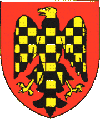
The Catholic Side: Crusade Leaders and their Allies The "Cathar" Side: Opponents and Victims of the Crusade. Heraldry of the Cross of Toulouse
The following are the chief personalities during the Wars against the Cathars:
Crusade Leaders and their Allies
Pope Innocent III: Called the crusade in 1208. Click here for more on Pope Innocent III Arnaud Amaury: Cistercian Abbot of Cîteaux. Military commander of the crusade in its early stages. Click here for more on Arnaud Amaury. Bernard of Clairvaux (Saint Bernard): Cistercian
Abbot who had tried to combat "heresy" in Toulouse and
the Languedoc by preaching against it in the century before the
Crusade. Click here for more on Bernard
of Clairvaux Simon de Montfort: Titular Earlof Leicester, and
lord of Montfort. Took over leadership of the Cathar Crusade
after the initial victories at Béziers
and Carcassonne.
Click here for more on Simon
de Montfort Amaury de Montfort: Earl of Leicester. Took
over leadership of the Cathar Crusade after the death of his father
Simon. Click here for more on Amaury
de Montfort Dominic Guzmán (Saint Dominic): A preacher
who set up the religious order ("The Dominicans")
which established and ran the first papal Inquisition.
Click here for more on Dominic
Guzmán Bernard Gui: A Dominican
Inquisitor who left a useful manual for identifying and punishing
Cathars and other supposed "heretics". Click here for
more on Bernard
Gui Philippe Augustus: King of France. Requested by Pope Innocent III to lead a crusade against the Cathars of the Languedoc. Eventually allowed his vassals and later still his son to join the Crusade. Click here for more on Philippe Augustus Louis VIII: King of France. Joined the Cathar Crusade and later led it. Click here for more on Louis VIII Blanche of Castile: (1188-1252). Regent of France (1226-36) during the infancy of her son Louis IX, King of France. Click here for more on Blanche of Castile Louis IX: King of France, also known as Saint Louis, a Crusader King. Click here for more on Louis IX Guy and Pierre Des Vaux-de-Cernay. A Crusading Cistercian
Abbot (Guy) and his nephew (Peter), a monk who left an invaluable
record of the Crusaders actions and their beliefs. Click on the
following link for more on Pierre
Des Vaux-de-Cernay and his Historia
Albigensis Fulk (or Folquet) de Marseille: A troubadour who
later became Bishop of Toulouse. Click here for more on Fulk
de Marsielle Jacques Fournier, Bishop of Pamiers: (c 1280 -
1342) Famous for his Inquitation records which survived in the Vatican
Archives after he was elected Pope as Benedict XII. Click here for
more on Jacques
Fournier
Opponents and Victims of the Crusade.
Peter II: (1174-1213) King of Aragon (1196-1213). Close relative and ally of the Counts of Toulouse. Recognised as the greatest Crusader in Christendom at the time, but opposed to the Crusade against his own vassals. Click here for more on Peter II: Raymond VI: (1156-1222), Count
of Toulouse (1196-1222). Click here for more on Raymond
VI
Raymond VII: (1197-1249), Count of Toulouse
(1222-1249). Click here for more on Raymond
VII Raymond-Roger Trencavel: (1184-12093). Viscount of
Carcassonne.
Relative of the Counts
of Toulouse. Click here for more on Raymond-Roger
Trencavel Raymond Trencavel II: (1204-126). Viscount of
Carcassonne. Son of Raymond-Roger. Click here for more
on Raymond
Trencavel II Raymond Roger: Count of Foix (1188-1223). Click here
for more on Raymond
Roger Roger Bernard II: Count of Foix (1223-1241). Click
here for more on Roger
Bernard II Roger IV: Count of Foix (1241-1265). Click here for
more on Roger
IV Savaric de Mauléon: ( Count of Comminges: Vassal and ally of the Counts
of Toulouse. Click here for more on Count
of Comminges Viscount of Béarn: Vassal and ally of the
Counts
of Toulouse. Click here for more on Viscount
of Béarn Esclarmonde of Foix:
Parfaite.
Click here for more on Esclarmonde
of Foix Guilhem Belibaste: (c 1280 - 1323) The last known
Cathar Parfait
in the Languedoc, burned at the stake in 1323. Click here for more
on Guilhem
Belibaste
Click on the following link for the Fransiscan friar Bernard
Delicieux Click on the following link for the
heraldry of the Crusade leaders, and other nobles |
|
||||||||||||||||||||||||||||||||||||||||||||||||||||||||||||||||||||||||||||||||
|
|
|
|||||||||||||||||||||||||||||||||||||||||||||||||||||||||||||||||||||||||||||||||
Arnaud Amaury (Latin: Arnaldus Amalricus,
|
||||||||||||||||||||||||||||||||||||||||||||||||||||||||||||||||||||||||||||||||||
 Arnald Amalric or Arnold Aimery), Abbot of Cîteaux
 |
|
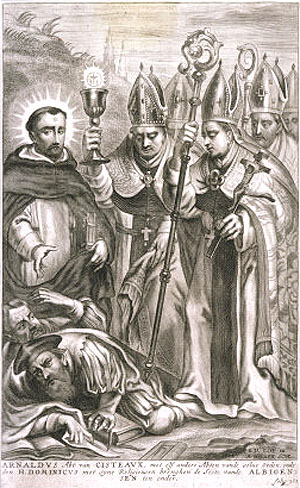
Arnaud
Amaury, other Cistercian abbots and St-Dominic.
(with a halo) crush helpless Cathars underfoot - a sanitised
version of the persecution of the Cathars. |
 |
|
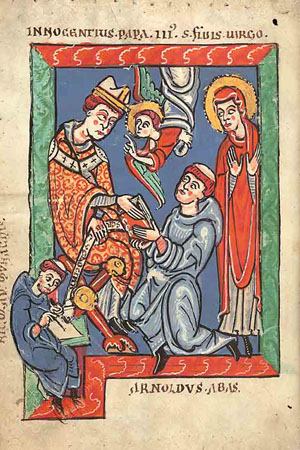
Pope
Innocent III with Cistercian
abbot Arnaud
Amaury |
 |
|
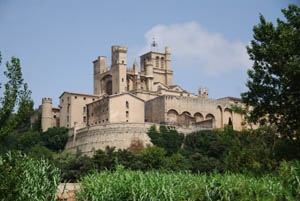
Béziers where the Abbot-Comander Arnaud Amaury reported having killied 20,000 without regard to age, sex or rank, having given the order "Kill Them All, God will know his own" |
|
|
|
Simon IV de Montfort (1160 - 25th June, 1218)
Simon de Montfort succeeded his father as Baron de Montfort in 1181. In 1190 he married Alix de Montmorency, the daughter of Bouchard III de Montmorency.
In 1191 Simon's brother, Guy de Montfort, left on the Third Crusade in the retinue of King Philip II of France. In 1199, while taking part in a tournament at Ecry-sur-Aisne, Simon heard Fulk of Neuilly preaching the Fourth Crusade. Along with Count Thibaud (Theobald) de Champagne, he took the cross as did his brother Guy. The crusade was diverted by a Cardinal to the Christian city of Zara on the Adriatic Sea. The city was sacked and plundered in 1202. Simon did not participate in the sacking, and soon he left the Crusade, continuing to the Holy Land. (His fellow Crusaders went on to sack the city of Constantinople).
At the time of the Cathar Crusade, Simon had already built a reputation. He was a rare commodity within the Catholic fold. He was not only a fearsome warrior, but also a good tactician and strategist. Further, he had distinguished himself in the Fourth Crusade by refusing to attack his fellow Christians in Byzantium.
In 1209 he found himself among the army assembled under the Abbot of Cîteaux to attack the Cathars of the Languedoc. After the initial victories at Béziers and Carcassonne the nobles looked for one of their number to take over the leadership. None of them was prepared to take on what appeared to be an impossible task, especially as it involved a feudal dispossession that many considered not only illegal but also a dangerous precendent. As Simon had distinguished himself once again in battle he was offered the leadership and effectively ordered to accept it. Simon had no choice. He accepted and over the following nine years confirmed his reputation for tactical brilliance.
|

 The Church awarded Simon territory
conquered from Raymond VI of Toulouse. Simon became known
and feared for his cruelty and for his "treachery, harshness,
and bad faith." In fairness he was often acting in obedience
to Church orders, as in 1210 when he burned 140 Cathars
alive in the village of Minerve.
He was a man of extreme Catholic orthodoxy, committed to the Dominican
Order and to the suppression of what he believed to be heresy.
The Church awarded Simon territory
conquered from Raymond VI of Toulouse. Simon became known
and feared for his cruelty and for his "treachery, harshness,
and bad faith." In fairness he was often acting in obedience
to Church orders, as in 1210 when he burned 140 Cathars
alive in the village of Minerve.
He was a man of extreme Catholic orthodoxy, committed to the Dominican
Order and to the suppression of what he believed to be heresy.
He led the Crusader army at Termes 1210, Lavaur 1211, Toulouse 1211, and Castelnau 1211. In 1213 his Crusader army defeated Peter II King of Aragon at the Muret. The southern armies were now crushed, but Simon carried on the campaign as a war of conquest, being appointed lord over all the newly acquired territory with Raymond VI's titles as Count of Toulouse and Duke of Narbonne (1215).
 From 6 June 1216 to 24 August 1216
he besieged Beaucaire,
which had been taken by his son Raymondet (later Raymond
VII of Toulouse). Responding to rumours that Raymond VI was on his way to Toulouse
in September 1216, Simon abandoned the siege
of Beaucaire, and sacked the city of Toulouse.
Raymond returned to take possession of Toulouse
a year later in October 1217 and Simon again hastened to the city,
this time to besiege it.
From 6 June 1216 to 24 August 1216
he besieged Beaucaire,
which had been taken by his son Raymondet (later Raymond
VII of Toulouse). Responding to rumours that Raymond VI was on his way to Toulouse
in September 1216, Simon abandoned the siege
of Beaucaire, and sacked the city of Toulouse.
Raymond returned to take possession of Toulouse
a year later in October 1217 and Simon again hastened to the city,
this time to besiege it.
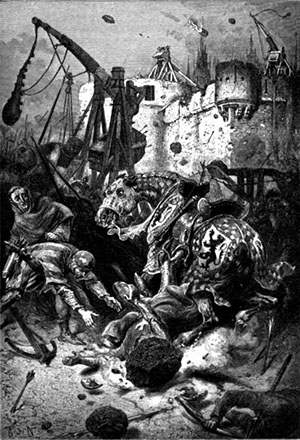
After maintaining the siege for nine months Simon was killed on 25 June 1218. His head was smashed by a stone from a mangonel operated by the women of Toulouse - "donas e tozas e mulhers" (noblewomen, little girls and men's wives). He was initially buried in the Cathedral of Saint-Nazaire at Carcassonne but his body was soon removed to his home in France.
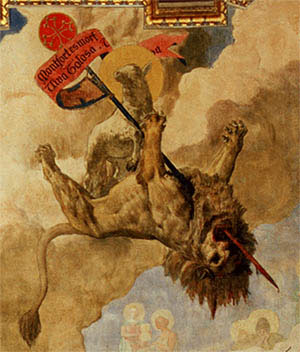
In the nineteenth century the Capitouls of Toulouse commissioned a series of historical murals. One of them shows a lion representing Simon de Montfort pierced through the body by a pole surmounted by the cross of Toulouse.
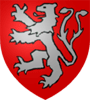 The symbolism is drawn from the arms
of the Montfort and Toulouse. The banner reads "Montfort is
dead. Long live Toulouse (Montfort est mort. Viva Tolosa). It is
a striking image and suggests a strong identification with Count
Raymond against Simon.
The symbolism is drawn from the arms
of the Montfort and Toulouse. The banner reads "Montfort is
dead. Long live Toulouse (Montfort est mort. Viva Tolosa). It is
a striking image and suggests a strong identification with Count
Raymond against Simon.
Simon left three sons and two daughters:
- Amaury de Montfort, his eldest son, who inherited his French
estates. Click here for more about Amaury
de Montfort

- Guy de Montfort, (named after his uncle Guy de Montfort) who married Petronille, Countess of Bigorre, on 6 November 1216 - an attempt to build a family dynasty in Occitania. He died at the siege of Castelnaudry on 20 July 1220.
-
 Simon
de Montfort, who eventually gained possession of the earldom of
Leicester (previously appropriated by King
John of England) because of the de Montfort family's allegiance
to the King of France. This Simon not only regained the
Earldom but played a leading role in establishing parliamentary
rights in England in the reign of Henry
III. He has been called "The father of parliament".
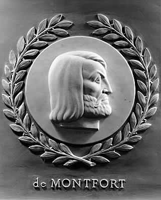
A plaque to him adorns a wall in the US House of Representatives.
In recent years a British university has been named after him,
and he is remembered with great honour to this day, a polar opposite
of his father who left only a legacy of bitterness and hatred.
Simon
de Montfort, who eventually gained possession of the earldom of
Leicester (previously appropriated by King
John of England) because of the de Montfort family's allegiance
to the King of France. This Simon not only regained the
Earldom but played a leading role in establishing parliamentary
rights in England in the reign of Henry
III. He has been called "The father of parliament".
A plaque to him adorns a wall in the US House of Representatives.
In recent years a British university has been named after him,
and he is remembered with great honour to this day, a polar opposite
of his father who left only a legacy of bitterness and hatred. - Petronilla became Abbess at the Cistercian nunnery of St. Antoine's.
- Amicie (or Amicia) named after her grandmother, founded the nunnery at Montargis and died there in 1252.
Click here for more about the heraldry and genealogy of Simon
IV de Montfort and other Crusader nobles
Click on the following link for more on the
Seal of Simon de Montfort 
Click here for more about the heraldry and genealogy of Simon's
brother Guy
de Montfort
Click here for more about the heraldry and genealogy of Simon's
son Amaury
de Montfort
Click on the following link for more on the
Seal of Simon de Montfort
|
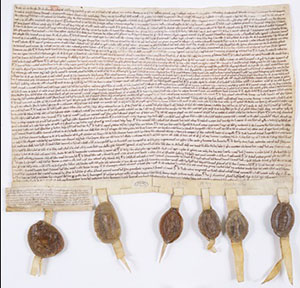
The Counts of Toulouse issued charters promising their subjects protection, justice and respect for established custom a generation before Magna Carta. The statute of Pamiers, imitating this tradition, was issued at Pamiers, near Toulouse, in December 1212 by Simon de Montfort. In this charter Simon styles himself as Earl of Leicester (comes Leyc’) and also Vicomte of Beziers and Carcassonne, and lord of Albi and the Razès. This charter, sealed and guaranteed by half a dozen French bishops, includes more than 50 clauses, prohibiting the sale of justice, dealing with the rights of heirs and widows, and promising not to demand military service from his tenants save by grace and in return for pay. Ten of its 11 opening clauses guarantee freedoms to the Church. Attached to it is a letter commanding publication, sealed by Simon himself. Many of the Statute of Pamiers’s clauses deal with problems also addressed by Magna Carta. It was almost certainly known in England. Several English knights fought in Simon’s army, including Walter Langton, brother of the Archbishop of Canterbury. In 1212 the English barons planned to depose King John and to make Simon de Montfort king in his stead. Simon’s son, another Simon (1208-65), would later become leader of an English baronial rebellion. In 1265, 50 years after Magna Carta, the younger Simon played a crucial role in the emergence of the English Parliament. |
 |
|
Statue of Simon de Montfort on the Haymarket Memorial Clock Tower in Leicester. This is the son of Simon de Montfort the Albigensian Crusader. |
 |
 |
||||||
|
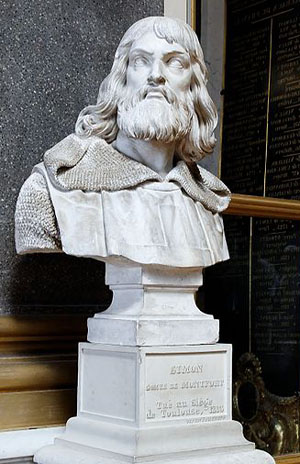
Simon IV de Montfort Buste par Jean-Jacques Feuchère, Galerie des batailles, Versailles |
||||||
 |
||||||
 |
||||||
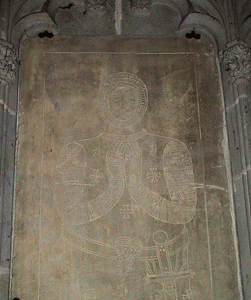
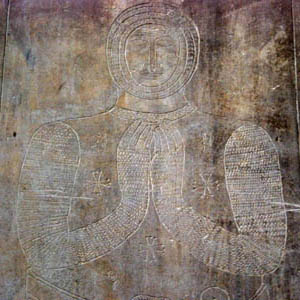
| Photograph of Simon's tombstone at Carcassonne,
with the contrast increased |
||||||
 |
||||||
|
On his surcoat (technically his "coat
of arms")
|
||||||
|
||||||
|
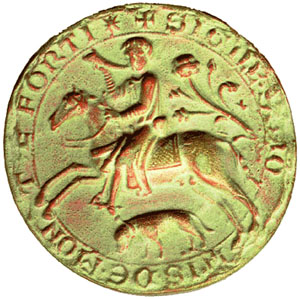
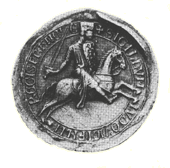
Seal of Simon IV de Montfort. Click on the following link for more on the Seal of Simon de Montfort. |
||||||
 |
||||||
|
The death of Simon de Montfort at Toulouse in 1218. Illustration by Alphonse-Marie-Adolphe de Neuville from François Guizot (1787-1874), The History of France from the Earliest Times to the Year 1789, London : S. Low, Marston, Searle & Rivington, 1883, p. 515 |
||||||
|
||||||
|
||||||
|
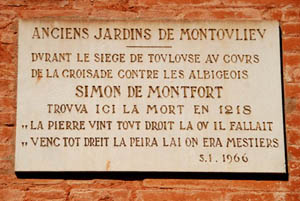
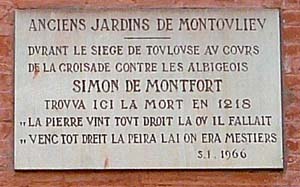
Today, the spot where Simon de Montfort met his end is marked by a plaque set into a wall of pink Toulouse brick (see left). It reads: "Old Montoulieu Gardens - During the siege of Toulouse in the course of the Albigensian Crusade Simon de Montfort was killed here in 1218". The last two lines are a quotation from the Song of the Cathar Wars, laisse 205, cited above: both read "now a stone hit just where it was needed" first in French then in the original Occitan. |
||||||
 |
Simon was roundly hated in the Languedoc for his cruelty and ambition. Here is a description of his death from the contemporary Song of the Cathar Wars, laisse 205, written in Occitan:
|
Ac dins una peireira, que fe us carpenters |
There was in the town a mangonel built by our carpenters |
Simon de Montfort left few friends in the lands he pillaged and tried to rule. He continues to be hated to this day. The consensus is that the writer of the Song of the Cathar Wars had it about right [laisse 208]. His scathing words about Simon's glowing epitaph in the Cathedral of St Nazaire (now the Basilica of Saint-Nazaire) in Carcassonne are given below:
|
E ditz e l'epictafi, cel qui•l sab ben legir, |
The epitaph says, for those who can read it,
That he is a saint and martyr who shall breathe again And shall in wondrous joy inherit and flourish And wear a crown and sit on a heavenly throne. And I have heard it said that this must be so - If by killing men and spilling blood, By wasting souls, and preaching murder, By following evil counsels, and raising fires, By ruining noblemen and besmirching paratge, By pillaging the country, and by exalting Pride, By stoking up wickedness and stifling good, By massacring women and their infants, A man can win Jesus in this world, then Simon surely wears a crown, resplendent in heaven. |
Click here to learn about the untranslatable Occitan word paratge
Amaury VI de Montfort
 Amaury
VI de Montfort (1195-1241) was the son of Simon de Montfort and
Alice of Montmorency, and the elder brother of another Simon de
Montfort.
Amaury
VI de Montfort (1195-1241) was the son of Simon de Montfort and
Alice of Montmorency, and the elder brother of another Simon de
Montfort.
Amaury de Montfort accompanied his father Simon and mother Alix de Montmorency on the Crusade against the gathers. He was just a boy at the beginning of the war, but was 18 and ready to become a knight by 1213. His knighthood was notable as it marked an important transition. Making a knight had been a rough-and-ready secular ceremony, but Simon turned the ceremony into a religious one, performed during a mass at the alter, and referring to passages in the Old Testament where God requires the first born to be dedicated to him. From now on knighthood would have a more distinctive Christian character. The following account comes from the Historia:
[429] …I will describe in detail the the procedure used for the Count's son's installation as a knight of Christ, since it was new and without precedent.
[430]The Count's eldest son becomes a knight. In the year of the Incarnation of the Word 1213, the noble Count of Montfort and numerous of his barons and knights gathered together at Castelnaudary on the feast of the nativity of John the Baptist [24 June]. The Count was accompanied by the two venerable bishops [of Auxerre and Orleans] and some crusader knights. Our most Christian Count wished the Bishop of Orleans to appoint his son a knight of Christ and personally hand him the belt of knighthood. The bishop for some time resisted this request but was at length vanquished by the prayers of the Count and our people, and yielded to their request. As it was summertime and Castelnaudary was too small to hold the huge crowd in attendance (not least because it had previously been destroyed once or even twice) the Count had a number of pavilions erected on a pleasant level place nearby.
[431] On the day of the feast the Bishop of Orleans donned his robes of office to celebrate a solemn mass in one of the pavilions. Everyone, knights as well as clergy, gathered to hear the mass. As the Bishop stood at the alter performing the mass, the Count took Amaury, his eldest son, by his right hand, and the Countess by his left hand; they approached the alter and offered him to the Lord, requesting the Bishop to appoint him a knight in the service of Christ. The Bishops of Orleans and Auxerre, bowing before the alter, put the belt of knighthood round the youth, and with great devotion led the Veni Creator Spiritus. Indeed a novel and unprecedented form of induction into knighthood! Who that was present could not refrain from tears? In this way, with great ceremony, Amaury became a knight.
(Peter of les Vaux-de-Cernay, translated by WA & MD Sibly, The History of The Albigensian Crusade)
Simon died on 25th June 1218 while besieging Toulouse. During a typically brave action to retrieve a siege engine called a "cat" he was struck full on the head by a stone from a trebuchet, traditionally claimed to have been operated by the women of Toulouse. Amaury had participated in the Albigensian Crusade under his father's command. Now he inherited the County of Toulouse, and was elected as the new leader of the Crusade, as the people of the Languedoc celebrated his father's death.
Amaury could not fill his father's shoes. Only with the help of France could he avoid utter defeat. Amaury ceded formal rights to his territories to King Louis VIII in 1224. He removed his father's body from the Cathedral at Carcassonne (probably fearing what would happen to it if he left it there) and took it with him to his ancestral home near Paris.
In 1230 Amaury became Constable of France, an office previously held by his uncle Mathieu II of Montmorency.
In 1239 he participated in the Sixth Crusade and was taken prisoner after the defeat at Gaza. He was imprisoned in Cairo and was freed in 1241, but died the same year in Calabria while on his way home.
|
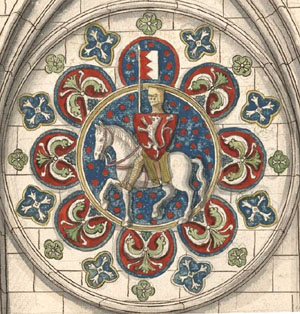
Amaury VI de Montfort, based on the image in Chartres Cathedral ? |
 |
|
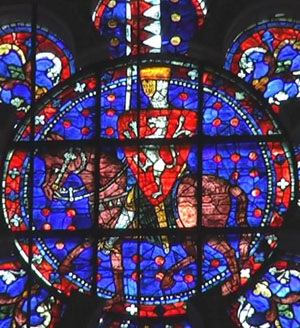
Amaury VI de Montfort, Chartres Cathedral |
 |
|
Amaury VI de Montfort, Chartres Cathedral |
 |
|
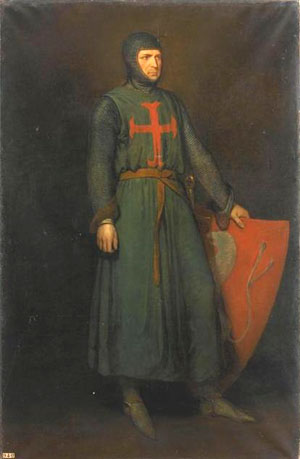
Amaury VI de Montfort by Henry Scheffer (1798-1862) |
 |
Dominic Guzmán (c 1170 - 1221)
"Saint Dominic" (1234)
Dominic Guzmán, came from Caleruega in Castile. His parents, Felix Guzmán and Joanna of Aza, belonged to the nobility of Spain. According to later stories, his birth and infancy were attended by many marvels forecasting his great sanctity. In 1184 Saint Dominic entered the University of Palencia, where he remained for ten years. We do not know the date of his ordination, but he became a cannon of the Cathedral of Osma in 1195.
Passing through the Midi on his way back from Denmark in 1205 he started preaching against the Cathars of the Languedoc. He had planned, (with the help of God, he said) to convert Cathars to the Roman faith by preaching to them. Despite God's help his preaching proved a failure.
Spurred by his lack of success he hit on the idea of using schools to teach people the Catholic faith - one of many ideas he was to copy from the Cathars. At this time the Catholic Church did not normally encourage education for the laity, and indeed actively discouraged it, especially for women. But the Languedoc was a special case. Dominic founded a convent at Sainte Marie de Prouille (near to Fanjeaux), a Catholic version of a Cathar convent at Dun (between Pamiers and Mirapoix) founded by Philippa, wife of the Count of Foix. Dominic's establishment was in effect the first Dominican nunnery.
The Church also tried open debates as a way of winning converts. Debates were permitted because the Roman clergy thought that they could humiliate the opposition intellectually and so facilitate mass defections to the Roman Church. This did not happen.
The Colloquy of Montréal in 1207 was the final debate in Pamiers between the Catholics (represented by Dominic Guzmán) and the Cathars (notably Benoît de Termes). Once again the the Roman Church made no progress, and if anything confirmed its role as a figure of fun and reservoir of ignorance and bigotry. When a highly respected noblewoman, Esclarmonde of Foix (the Count's sister), a Parfaite, tried to speak she was admonished by one of Dominic Guzmán's acolytes (Etienne de Metz): "go to your spinning madam. It is not proper for you to speak in a debate of this sort". Such attitudes voiced in front of a liberal educated audience succeeded only in confirming the extent of the gulf between the Roman Church and the general population of the Languedoc. In any case, even with God's personal help, the Roman Church once again failed to secure mass conversions, or indeed any conversions at all among the Parfaits.
Guzmán was humiliated by his failure. More vigorous action was called for. The great Bernard of Clairvaux (St Bernard) had asserted that "The Christian glories in the death of a pagan, because Christ is thereby glorified". Were not heretics even worse than pagans, even more deserving of death. Speaking on behalf of Christ, Guzmán promised the Cathars slavery and death.
Dominic Guzmán's promises were made good by Crusaders and the Inquisition. Dominic was a friend and companion of the famously brutal Simon de Montfort. We find him by de Montfort's side at the siege of Lavaur in 1211, and at the capture of La Penne d'Ajen in 1212. In the latter part of 1212 he was at Pamiers at the invitation of de Montfort. Before the battle of Muret on 12th September, 1213, Guzmán participated in the council of war that preceded the battle. Like most crusades, the one against the Cathars of the Languedoc was characterised by atrocities and unimaginable barbarity as at Béziers, Bram, Lavaur, and Marmande
In 1214 Dominic Guzmán returned to Toulouse. By this time he had attracted a small group of disciples. He had never forgotten his purpose, formulated eleven years before, of founding a religious order. Dominic had several times been offered, and had refused, the office of bishop. He had bigger plans.
Foulques, the Bishop of Toulouse, made him chaplain of Fanjeaux and in July, 1215, where he established the community whose mission was the propagation of the Roman Catholic faith and the extermination of heretics. In this same year a wealthy citizen of Toulouse put a house at their disposal. In this way the first convent of the Order of Preachers was founded on 25th April 1215. A year later Foulques established them in the church of Saint Romanus.
Dominic had dreamed of a world-wide Order. In November, 1215, a General Council (The Fourth Lateran) was to meet at Rome "to deliberate on the improvement of morals, the extinction of heresy, and the strengthening of the faith". Dominic was present at its deliberations hoping to win permission to establish his new Order. The council was opposed to the institution of any new religious orders, and legislated to that effect. Dominic's petition was refused.
This reversal did not stop Dominic. He simply found a way around what the Catholic Church holds to be an infallible ruling. Returning to Languedoc at the close of the Council in December, 1215, Dominic and his followers adopted the rule of St Augustine, which, because of its generality, could be adapted to any form Dominic might wish to give it. His new order a fait accompli, Dominic applied to the new pope Honorius III in August, 1216. On 22 December, 1216, a Bull of confirmation was issued. He became a favourite of the new pope. The following year he received the office and title of Master of the Sacred Palace, or as it is more commonly called, the Pope's Theologian, In 1217 he formulated a plan to disperse his seventeen followers over all Europe. The following year, to facilitate the spread of the order, Honorius III, addressed a Bull to all archbishops, bishops, abbots, and priors, requesting their favour on behalf of Dominic's new Order. By another Bull later in 1218 Honorius bestowed on the order the church of Saint Sixtus in Rome, which thus became the first monastery of the Order in Rome. Shortly after taking possession of this church, Dominic was given the apparently difficult task of cleaning up the activities of Catholic nuns in Rome. As the Catholic Encyclopedia gnomically puts it " Dominic began the somewhat difficult task of restoring the pristine observance of religious discipline among the various Roman communities of women".
With the support of the pope, Dominic next started a campaign of rapid expansion of his Order, attracting large numbers of followers keen to be associated with a movement sponsored by the papacy. A foundation near the University of Paris was followed by another at the University of Bologna where the church of Santa Maria della Mascarella was placed at the disposal of the Dominicans. In Rome the basilica of Santa Sabina was handed over to them. Next a convent was established at Lyons and then a monastery in Spain. Next came a convent for women at Madrid, similar to the one at Prouille. Then a convent at the University of Palencia, and a house in Barcelona, followed by houses at Limoges, Metz, Reims, Poitiers, and Orléans, then Bergamo, Asti, Verona, Florence, Brescia, and Faenza.. In March 1219 Honorius bestowed upon the Order the church of San Eustorgio in Milan. At the same time a foundation at Viterbo was authorised.
In Lombardy large numbers of people were abandoning the Roman Catholic Church for the Cathar Church, as they had done a few years earlier in the Languedoc. Honorius III addressed letters to the abbeys and priories of San Vittorio, Sillia, Mansu, Floria, Vallombrosa, and Aquila, ordering that members be deputed to begin a preaching crusade under the leadership of Saint Dominic. As it turned out no support was forthcoming, and despite propaganda to the contrary involving a series of wondrous miracles, Dominic's mission failed. As in the Languedoc, those who committed the crime of choosing a religion for themselves would eventually be extirpated by Dominican Inquisitors.
Towards the end of 1220 Dominic returned to Rome. Here he received more concessions for his order. In January, February, and March of 1221 three consecutive Bulls were issued commending the order to all the prelates of the Church.
In 1234 at Bologna he contracted an illness and died three weeks later. In a Bull dated 13 July, 1234, Gregory IX declared him a saint and made his cult obligatory throughout the Church.
Many churchmen had been keen participants in the extirpation of a rival faith, but none exceeded the zeal of Dominic Guzmán. His faithful Dominicans spawned the Medieval Inquisition, with all its horrors, pioneering new methods of torture and creating new crimes. Ordinances were passed which imposed new penalties for heresy. In 1233 Pope, Gregory IX charged the Dominican Inquisition with the final solution: the absolute extirpation of the Cathars. It was the beginning of the first modern police state in the world.
The role of Dominic himself is debated. When the Catholic Church was less sensitive about the record of the Inquisition, Dominic was hailed as its founder and his role as an Inquisitor was undoubted.
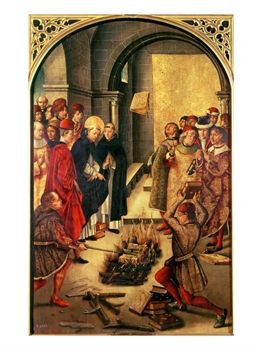
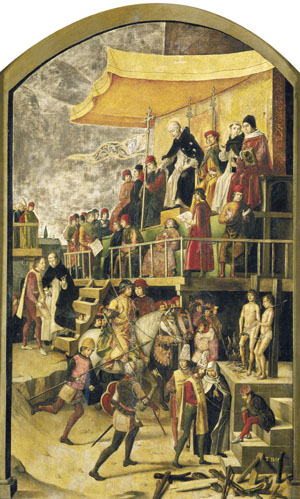
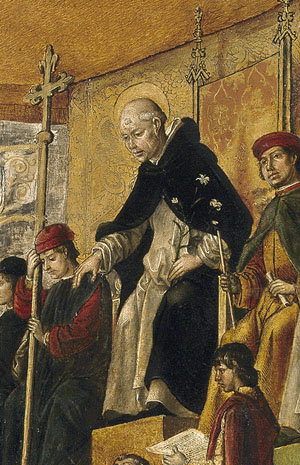
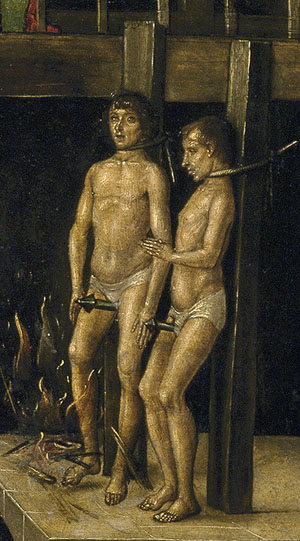
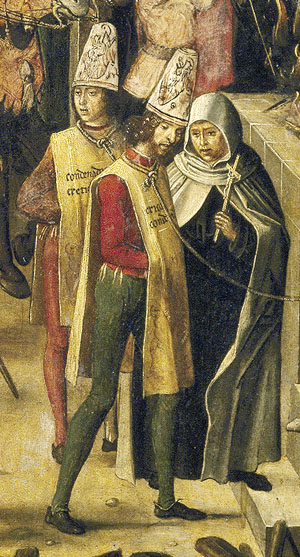
The painting on the left, by Berruguete, previously hung in the Sacristy of the Dominican monastery of Santo Tomás de Ávila (founded by the Dominican Thomas Torquemada, Inquisitor General of Spain). Berruguete painted panels on the life of Dominic Guzman which originally formed part of an altarpiece in the monastery, and this panel may have been one of these. The figures are dressed in the style of the late 15th century and are thought to have been inspired by autos-da-fe that took place in Ávila at this period. Saint Dominic, recognisable by his mantle ornamented with stars, is seated on a throne presiding over the tribunal, surrounded by other judges, one of them bearing the standard of the Inquisition. Below, two of Dominic's victims are tied to stakes awaiting their fate, being burned alive, having been sentenced by Saint Dominic.
As the record of the Inquisition becomes more ever more out of step with modern sensibilities, there has been a tendency on the part of the Catholic Church to dissociate Dominic from his role as father of the Medieval Inquisition - sometimes pointing out that earlier Inquisitions had existed (suggesting that he could not therefore be the founder of "The Inquisition"), sometimes that the Medieval Inquisition was not given formal papal sanction until after his death (suggesting that "The Inquisition" did not exist in his lifetime, so he could not have been any part of it).
A third option for exculpation is employed by the Catholic Encyclopedia under the entry on Saint Dominic "If he was for a certain time identified with the operations of the Inquisition, it was only in the capacity of a theologian passing judgement upon the orthodoxy of the accused. Whatever influence he may have had with the judges of that much maligned institution was always employed on the side of mercy and forbearance, as witness the classic case of Ponce Roger [sic]." This does not square easily on several counts with Dominic's own letter concerning Pons Roger, which shows Dominic acting as a Papal Inquisitor, (commissioned by Arnaud Amaury, on behalf of the Pope). Nor does the letter show him as as being particularly merciful, forbearing or lenient - (see box to the right). To resolve any possible doubt the Dominican master-Inquisitor Bernard Gui (I26I-I33I) in his Life of St. Dominic explicitly claims for Saint Dominic the title of First Inquisitor.
|
Sir Steven Runciman on the Dominicans, referring to the period after the Treaty of Meaux (or Treaty of Paris) in 1227:
Sir Steven Runciman,. The Medieval Manichee, Cambridge University Press, 1999), p 143 |
Dominic is now venerated as St Dominic, and is regarded by many Christians as one of the most holy men ever to have lived. Dominic's legacy has certainly been spectacular. As well as running various Inquisitions, Dominicans monopolised medieval philosophy leading it into the barren desert of scholasticism where it languished until revived by Enlightenment thinkers, not a single significant advance having been made for centuries (except, arguably, by heretical Franciscans).
Modern Dominicans consistently deny that Dominic ever exercised the office of Inquisitor, pointing out that the Papal Inquisition was formally constituted only after Dominic's death. Some see this as perhaps a little disingenouous, since Inquisitors were operating on the authority of papal legates under Innocent III well before the institution of the Inquisition reporting directly to the Pope was given a formal charter. Below is conclusive evidence that Dominic was an authorised Inquisitor even before the start of the Wars against the Cathars in 1209.
|
For Cathars who chose not to deny their faith the penalty was death. So too for those who recanted but then returned to their chosen faith. For confessed first-offender heretics judgements were less harsh - often in the form of penances - but with a more severe reserve judgement if the penances were not fulfilled. This letter was written by Dominic about the year 1208 and concerns a converted Cathar called Pons Roger.
The Latin text can be found in Balme and Lelaidier, Cartulaire, Vol. I, pp. 186-88. There several notable points in this letter: 1. The phrase "By the authority of the Lord Abbot of Citeaux, Legate of the Apostolic See, who enjoined this function on us ..." can only be a reference to Dominic's role as an Inquisitor. No other role fits the circumstances. 2. Most of the penances oblige Pons Roger to live in the same manner as a Cathar Parfait. There are several theories as why Dominic should have required Pons Roger to do this, but they lie outside of the present discussion. Note also the use of the word "command". Genuine penance is by definition voluntary. 3. Sentences of death were rarely committed to writing, but we know that Inquisitors were responsible for burning countless people to death. This sentence has survived possibly because it was passed on someone who was now a Catholic. "Should he refuse to observe these directives, we command that he be deemed a perjurer and a heretic excommunicated from association with the faithful." This is a conditional death sentence. A relapsed and excommunicated heretic would be burned alive. Note also the use of the word "command" again, this time the command is to a third party - something an Inquisitor could do but a simple preacher could not. |
Dominic's canonisation in 1234 was marked by a revealing incident at Toulouse. The bishop, Raimon de Fauga, and a number of Dominican friars had just solemnly celebrated the admission of their new Saint into heaven. As they were leaving the church for a celebratory feast, news arrived that a dying woman in the city had just received the Cathar Consolamentum. The bishop, the Dominican prior and his Dominican retinue promptly set off to deal with this crime. They found the woman at home in bed, gravely ill.
The men of God entered the house where she lay dying. In her delirium she mistook the Catholic bishop for a Cathar bishop and confessed to him her wish to die a good death. At this, and without any sort of trial, the bishop had her removed from the house. Lying on her deathbed, she was carried to a nearby field and there burned alive still in her bed. Their holy mission complete the bishop, prior and friars retired to enjoy their celebratory banquet, having first given thanks "to God and the Blessed Dominic". The Inquisitor Guillaume de Pélhisson recorded the event, pointing out that " God performed these works ... to the glory and praise of His name ... to the exaltation of the Faith and to the discomfiture of the heretics". As both Catholics and non-Catholics have observed at different times, it was a most suitable way to mark Dominic Guzman's canonisation.
|
The quotation is from Guillaume de Pélhisson, Chronicle, translated by Walter L Wakefield, Heresy, Crusade and Inquisition in Southern France 1100-1250, University of California, Berkeley, 1974, pp 215-16. |
Dominc Guzman's own record is recognised in the special language of the Catholic Encyclopedia, which sometimes appears carefully crafted to carry a subtly different message to the devout reader than it does to those familiar with history:
"While his charity was boundless he never permitted it to interfere with the stern sense of duty that guided every action of his life. If he abominated heresy and laboured untiringly for its extirpation it was because he loved truth and loved the souls of those among whom he laboured".
From a secular point of view there was no harm at all in the Cathars, and no reason for them to be even mildly persecuted, let alone burned alive. Yet it is not difficult to find Roman Catholic authorities who seek to justify the Church's genocide and make out that it acted for the best. This is as close as the Catholic Encyclopaedia comes to admitting fault:
Ecclesiastical authority, after persuasion had failed, adopted a course of severe repression, which led at times to regrettable excess.
A Handbook of Heresies, approved by a Roman Catholic Censor and bearing the Imprimatur of the Vicar General at Westminster, refers to Guzmán's "heroic exercise of fraternal charity". His failure as a preacher is not mentioned, nor the fact that even using trickery and torture almost no Parfaits could be induced to abandon their faith. The thousands of Cathar deaths are not referred to except in the most oblique terms:
The long and arduous task was at length successful, and by the end of the fourteenth century Albigensianism, with all other forms of Catharism, was practically extinct.
And the opportunity is taken to condemn Cahar beliefs once again:
This anti-human heresy, by destroying the sanctity of the family, would reduce mankind to a horde of unclean beasts....
|
Dominic's Preaching Friars (Dominicans) and their Inquisition were soon operating throughout Europe, introducing their Inquisitorial techniques to new lands: The following text is from a record of the deeds of the Archbishops of Trier contemporary with the events described.
This extract is from Gesta Treverorum: Continuatio quarto, edited by Georg Waiz, in Monumenta Germaniae historica, Scriptores, XXIV, 400-2. English translation from Wakefield & Evans, Heresies of the High Middle Ages, §45A (PP 267-8). |
There is not a hint of remorse or regret for the holocaust, and one can only assume that, if it could, the Roman Church would act in the same way again if similar circumstances arose in the future, lead perhaps by another charismatic leader like Saint Dominic.
|
|

  |
|
|
Auto Da Fe Presided Over By St-Dominic
of Guzmán(1475); Pedro Berruguete (around 1450-1504)
commissioned by fellow Dominican
Torquemada, Oil on wood . |
|
 |
|
|
Auto Da Fe Presided Over By Saint Dominic
Of Guzmán (1475); Pedro Berruguete (around 1450-1504)
commissioned by fellow Dominican
Torquemada, Oil on wood . |
|
 |
|
|
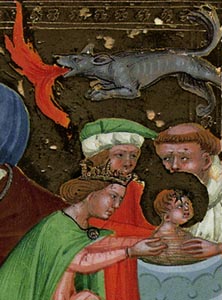
The birth of Dominic Guzman from a Vatican Manuscript, the Legendarium from Hungary, circa 1330. Note the fire breathing dog - a portent. His noble mother wears a crown. He wears ahalo (originally silver ?). From the Early Life of St. Dominic, Legendarium, Biblioteca Apostolica Vaticana (Vatican City), Vat. lat. 8541, fol. 90v |
|
 |
|
|
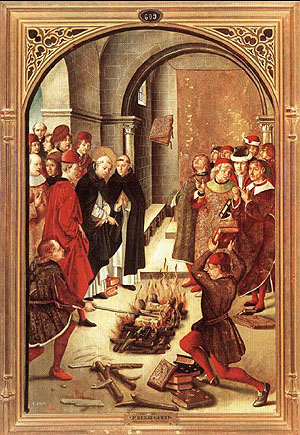
Saint Dominic and the Albigenses, 1480, Pedro Berruguete (Museo del Prado). |
|
 |
|
|
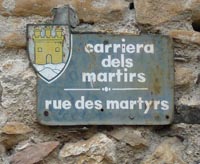
Commemorative Road Sign at Minerve where 140 - 180 Cathars were burned alive for disagreeing with Catholic theology. |
|
 |
|
|
|
 |
|
|
Auto Da Fe Presided Over By Saint Dominic
Of Guzmán (1475); Pedro Berruguete (around 1450-1504)
commissioned by Torquemada, Oil on wood . 60 5/8 x 36 1/4
(154 x 92 cm). |
|
 |
|
|
|
|
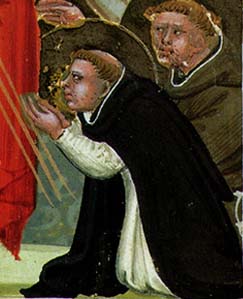
St Dominic prays in the traditional manner
with St Francis behind him. From the Early Life of St. Dominic |
|
 |
|
|
Saint Dominic (with a halo), Arnaud Amaury, and other Cistercian abbots crush helpless Cathars underfoot - a sanitised version of the persecution of the Cathars |
|
|
|
|
Auto Da Fe Presided Over By Saint Dominic
Of Guzmán (1475); Pedro Berruguete (around 1450-1504)
commissioned by Torquemada, Oil on wood . 60 5/8 x 36 1/4
(154 x 92 cm). |
|
 |
|
|
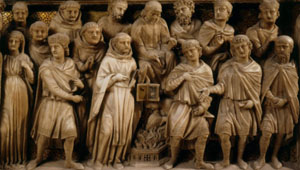
Nicola Pisano, Cathar "heretics" before Saint Dominic the (fictitious) Dispute of Fanjeaux |
|
 |
|
|
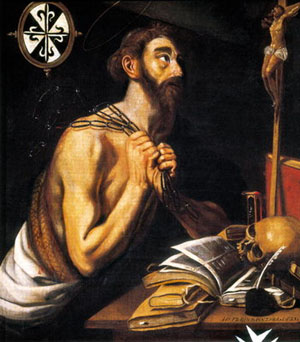
Saint Dominic was a proponent of the scourge
or "discipline" to mortify the flesh. Here he is
flagellating himself with iron chains. |
|
 |
|
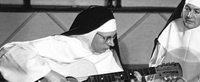 In
the 1960s a Belgian Dominican
nun known as The Singing Nun had a hit record with a song
called Dominique, all about Guzmán's life, including
his role in crushing Catharism in the Languedoc - the song has him
converting a heretic, which is perhaps less than a full representation
of historical reality. The song was a number 1 hit in the
UK and the USA. Its jolly tune provides a bizarre counterpoint to
the reality of Guzmán's life, his war mongering, his Dominican
Order and the horrors of the Inquisition.
The Singing Nun committed suicide in 1985.
In
the 1960s a Belgian Dominican
nun known as The Singing Nun had a hit record with a song
called Dominique, all about Guzmán's life, including
his role in crushing Catharism in the Languedoc - the song has him
converting a heretic, which is perhaps less than a full representation
of historical reality. The song was a number 1 hit in the
UK and the USA. Its jolly tune provides a bizarre counterpoint to
the reality of Guzmán's life, his war mongering, his Dominican
Order and the horrors of the Inquisition.
The Singing Nun committed suicide in 1985.
The Words to Dominique by the Singing Nun
|
Dominique, nique, nique s'en
allait tout simplement |
Dominic, nique, nique, just
goes travelling, |
|
A l'e poque ou Jean-sans-Terre de' Angleterre
etait Roi |
At a time when John Lackland was King of
England |
| Refrain | Refrain |
|
Certain jour, un hérétique
Par des ronces le conduit, |
One day a heretic took him through the thorns |
| Refrain | Refrain |
|
Ni chameau, ni diligence il parcout l'Europe
a pied |
Without a horse or cart he crossed Europe
on foot |
| Refrain | Refrain |
|
Enflamma de toute ecole filles et garcons
pleins d'ardeur |
To inflame girls and boys from every school
with ardour |
| Refrain | Refrain |
|
Chez Dominique et ses freres le pain s'en
vint a manquer |
In Dominic’s house, he and his Brothers ran
out of bread |
| Refrain | Refrain |
|
Dominique vit en reve les precheurs du monde
entier |
Dominic, in a dream, saw the brother-preachers
in the whole world |
| Refrain | Refrain |
|
Dominique, mon bon Pere, garde-nous simples
et gais |
Dominic, my good Father, keep us simple and
happy |
| Refrain | Refrain |
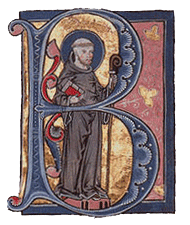
Bernard of Clairvaux (1090 – 1153),
Saint Bernard (1174)
Bernard had been dead for half a century by the start of the Cathar Crusade - but he was an important figure in the Catholic Church when the Cathar "heresy" in the Languedoc first attracted attention. His influence was felt in many ways during the Crusade.
Bernard was born at Fontaines, near Dijon, in France. His father, a knight, died on crusade. His mother died while Bernard was still a child. His guardians sent him to study at Châtillon-sur-Seine in order to qualify him for high ecclesiastical office and he joined the community at Cîteaux in 1098. The community of reformed Benedictines at Cîteaux grew so rapidly that it was soon able to set up daughter establishments. One of these daughter monasteries, Clairvaux, was founded in 1115, in a valley of a tributary of the river Aube. Bernard, a recent initiate, was appointed abbot. Clairvaux became the chief monastery of one of the five branches into which the order was divided under the direction of the Abbot of Cîteaux. Bernard became the primary builder of the Cistercian monastic order.
In 1128 he was invited to the synod of Troyes, where he was instrumental in obtaining the recognition of the new order of Knights Templar, the rules of which he is said to have drawn up. The Templars were essentially fighting Cistercian monks.
|
Saint Bernard (with the halo) accepting a new recruit into the Cistercian Order, while Cistercian nuns also accept a new recruit
(Vincent de Beauvais, Miroir historial, Musée Condé, MS. 722, f. 210 [detail], Maître François, Paris, c. 1470-80) |
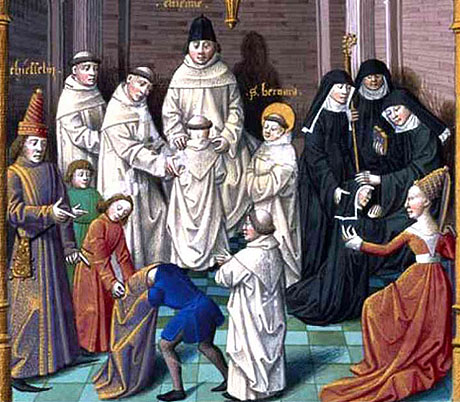 |
His was the main voice of conservatism during the 12th century Renaissance. Bernard was the prosecutor at Peter Abelard's trial for heresy. Bernard had been hostile to Peter Abelard and other scholars at the University of Paris, the center of the new learning based on Aristotle. Abelard was one of the greatest - arguably the greatest - scholastic philosopher of the Middle Ages. Bernard, not an intellectual himself, found it objectionalble that people should learn "merely in order that they might know". For Bernard, education served a single purpose: the indoctrination of priests. The trial was not determined by the strength of the cases put forward by the prosecution and the defence. When Abelard lost he appealed to Rome where Bernard's word was enough to confirm his condemnation. Abelard died soon afterwards.
Towards the middle of the twelfth century the preaching of a priest called Henry of Lausanne was drawing attention to what he saw as flaws in Roman Catholic theology and practices. In June 1145, at the invitation of Cardinal Alberic of Ostia, Bernard would travel to the territories of the Count of Toulouse to combat heresy. The threat was not at this time perceived as Catharism, but the teachings of Henry who had come to Occitania having been, as Bernard said, "forced to flee from all parts of France". Here is a translation of an extract from a letter from St Bernard to Alphonse Jordan, Count of Toulouse, written in 1145 before he set off to follow Henry to the Languedoc. It gives an idea of how popular Henry's taching had been.
The Churches are without congregations, congregations are without priests, priests are without proper reverence, and, finally, Christians are without Christ.
(Sancti Bernardi epistolae 241 from Migne, Patrologia latina, CLXXXII, 434-36; Cited by Walter Wakefield & Austin Evans, Heresies of The High Middle Ages (Columbia, 1991) p 93)
Bernards's secretary, Geoffrey of Auxerre, writing in the same year repeats Bernard's comments and goes on:
The life of Christ was barred to the children of Christians so long as the grace of baptism was denied to them. Prayers and offerings for the dead were ridiculed as were the invocation of saints, pilgrimages by the faithful, the building of temples, holidays on holy days, the anointing with the chrism; and in a word, all the institutions of the [Catholic] Church were scorned.
(Sancti Bernardi vita et res gestae libris septem comprehensae; Liber tertius auctore Gaufrido monacho, v 16, 17 in Patrologia latina, CLXXXV, 312-13; Cited by Walter Wakefield & Austin Evans, Heresies of The High Middle Ages (Columbia, 1991) p 93)
 With
the invective removed it sounds as though the Reformation has arrived
in the Languedoc some three centuries before Martin Luther introduced
it to Germany. After his visit, Bernard's main impression seems
to have been the shameless corruption in his own Church. The
people of the Languedoc had abandoned the Roman Catholic Church
en mass for unnamed heresies:
With
the invective removed it sounds as though the Reformation has arrived
in the Languedoc some three centuries before Martin Luther introduced
it to Germany. After his visit, Bernard's main impression seems
to have been the shameless corruption in his own Church. The
people of the Languedoc had abandoned the Roman Catholic Church
en mass for unnamed heresies:
... if you question the heretic about his faith, nothing is more Christian; if about his daily converse, nothing more blameless; and what he says he proves by his actions ... As regards his life and conduct, he cheats no one, pushes ahead of no one, does violence to no one. Moreover, his cheeks are pale with fasting; he does not eat the bread of idleness; he labours with his hands and thus makes his living ... Women are leaving their husbands, men are putting aside their wives, and they all flock to those heretics! Clerics and priests, the youthful and the adult among them, are leaving their congregations and churches and are often found in the company of weavers of both sexes.
(from Bernard's sermon 65 on the Caticle of Canticles (or Song of Songs, or Song of Solomon): Sancti Bernardi Sermones super Cantica canticorum, Semon 65 from Sancti Bernardi Opera, Cited by Walter Wakefield & Austin Evans, Heresies of The High Middle Ages (Columbia, 1991) p 130)
Although he does not mention the word Cathar, there are several indications here that Bernard is referring to Cathars: living the Christian ideal; pale through fasting; working for a living; appealing equally to men, women, and Catholic priests. The term "weaver" is frequently used as a synonym for Cathar Parfait, since this was their most favoured itinerant trade. Bernard may have had some sympathy for the Cathars. He never said so explicitly, but he did share some of their views. The world had no meaning for him save as a place of banishment and trial, in which men are but "strangers and pilgrims" (Serm. i., Epiph. n. I; Serm. vii., Lent. n. I). The words could have been taken from a Cathar instruction manual.
Despite any sympathy he might have had, he was happy enough to see those whom he saw as his enemies destroyed. Speaking of heretics, he held that "it would without doubt be better that they should be coerced by the sword than that they should be allowed to draw away many other persons into their error." (Serm. lxvi. on Canticles ii. 15). Killing god's enemies was not merely permitted, but glorious. He asserted in a letter to the Templars "The Christian who slays the unbeliever in the Holy War is sure of his reward, the more sure if he himself is slain. The Christian glories in the death of the pagan, because Christ is thereby glorified". He also pointed out that anyone who kills an unbeliever does not commit homicide but malicide (St Bernard, De Laude Novae Militiae, III (De Militibus Christi). For him all infidels were creatures of Satan. After being asked about how heretics could bear the agony of the fire not only with patience but even with joy, Bernard answered the question in a sermon where he ascribed the steadfastness of heretical "dogs" in facing death to the power of the devil. (Serm. lxvi. on Canticles ii. 15).
Bernard played the leading role in the development of the cult of the Virgin Mary - which many historians have seen as an attempt to counter the prominent role of women in new movements - notably those of the troubadours and the Cathars.
Bernard preached the Second Crusade. His eloquence was extraordinarily successful. At the meeting at Vézelay after Bernard's sermon many of all classes took the cross, most notably King Louis VII of France and his then queen, Eleanor of Aquitaine. It was said that when Bernard preached, women went in fear. Mothers hid their sons from him, wives their husbands, and companions their friends. Bernard proudly informed the Pope of his success in preaching a crusade: "I opened my mouth; I spoke; and at once the crusaders have multiplied to infinity. Villages and towns are now deserted. You will scarcely find one man for every seven women. Everywhere you will see widows whose husbands are still alive". His patter was reminiscent of that of a high-pressure salesman selling to credulous punters:
But to those of you who are merchants, men quick to seek a bargain, let me point out the advantages of this great opportunity. Do not miss them. Take up the sign of the cross and you will find indulgence for all sins that you humbly confess. The cost is small, the reward is great.
Actually the cost was death. Most of those women were soon to become real widows for the crusader army was chopped to pieces in Anatolia before getting anywhere near to the Holy Land. The disastrous outcome of the crusade was a blow to Bernard, who found it difficult to understand why God would let his own army down like this. Perhaps the best solution was that the outcome had been a great success after all, because it had transferred so many Christian warriors from God's earthly army to his heavenly one. Not everyone was convinced. The disaster was so severe that Christians throughout Europe started considering the ultimate blasphemy - that after all God might be on the side of the Moslems.
On receiving the news of the catastrophe, an effort was made to organise another crusade. Bernard attended a meeting at Chartres in 1150 convened for this purpose. He was elected to lead the new crusade, but Pope Eugene III failed to endorse him or his project, and it came to nothing.
Bernard was discredited and looked like a spent force, but his influence was greater than it appeared, and Cistercians in his image would promote further Crusades. The Crusade against the Cathars of the Languedoc was precipitated by the murder of a Cistercian legate, preached by Cistercian orators, initially lead by a Cistercian abbot, supported by Cistercian monks, and even documented by Cistercian chroniclers.
Bernard's comments justifying the killing of God's supposed enemies are echoed in the massacres carried out by a later famous Cistercian abbot and military commander, Arnaud Amaury, the Abbot of Citeaux, most famously at Béziers where he is credited with the immortal command ""Kill Them All, God will know his own"
Bernard was canonised in 1174 and declared a Doctor of the Roman Catholic Church in 1830.
|
Bernard preaching a Crusade |
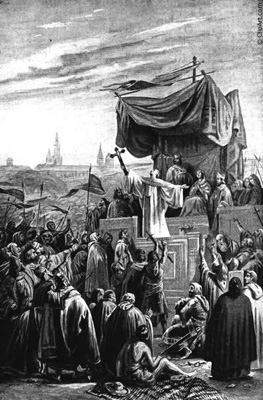 |
|
Bernard receiving milk from the breast of
the Virgin Mary at Speyer Cathedral in 1146. |
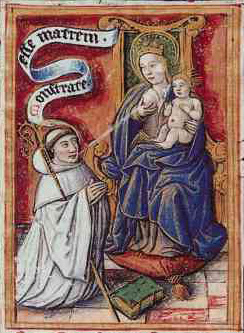 |
|
Saint Bernard |
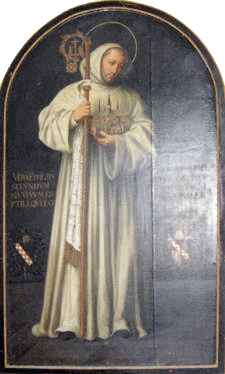
|
|
Virgin de la Leche with Christ Child and St. Bernard Clairvaux (detail), By an unknown artist from Peru, 1680. Peyton Wright Gallery, Santa Fe |
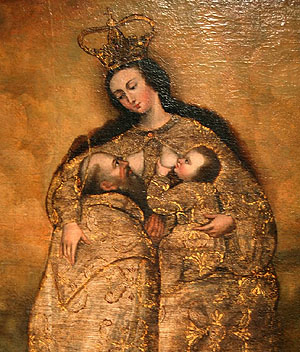 |
|
Saint Bernard |
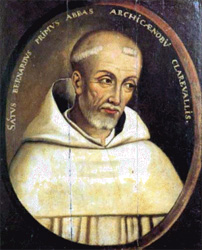 |
|
Cistercian nuns also accept a new recruit by the laying on of hands and touching the head with a testament.
(Vincent de Beauvais, Miroir historial, Musée Condé, MS. 722, f. 210 [detail], Maître François, Paris, c. 1470-80) |
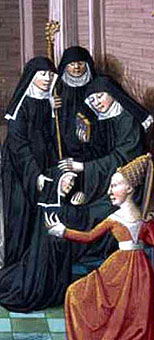 |
|
St. Bernard of Clairvaux |
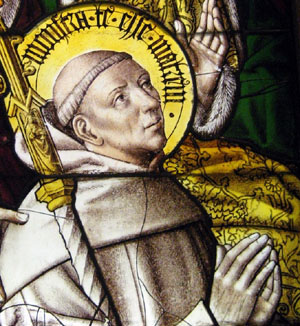 |
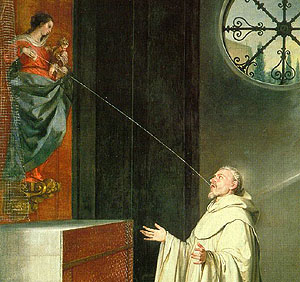
|
The Vision of St Bernard, |
Fulk of Marseille
(Folquet de Marselha, Folquet de Marseille)
also Folc, Foulques, and Folquet
(b. circa 1150 - d. 1231)
Fulk came from a Genoese merchant family in Marseille. He was also a wealthy citizen with some renoun. A contemporary (John of Garlande) later described him as "renowned on account of his spouse, his progeny, and his home." A troubadour, and known as Folquet, he began composing songs in the 1170s and was known to Raymond Geoffrey II of Marseille, Richard the Lionheart, Raymond V of Toulouse, Raymond-Roger of Foix, Alfonso II of Aragon and William VIII of Montpellier.
His love songs were lauded by Dante. There are 14 surviving cansos, one tenson, a lament, an invective, three crusading songs and one religious song (although its authorship is disputed). Like other troubadours, he was credited by biographies of the Troubadours with having conducted love affairs with noblewomen about whom he sang (and with causing William VIII of Montpellier to divorce his wife, Eudocia Comnena).
Folquet's life changed around 1195 when he renounced his former ways and abandoned his family for the Catholic Church. He joined the Cistercian Order and entered the monastery of Thoronet (Var, France). He placed his wife and two sons in monastic institutions as well.
He soon rose in prominence as a Cistercian and was elected abbot of Thoronet. As abbot he helped found the sister house of Géménos to house women, possibly including his abandoned wife.
A few years later Papal legates - fellow Cistercians - deposed the Bishop of Toulouse, Raymond (Ramon) de Rabastens, and were probably instrumental in arranging Folquet's nomination for the position in 1205.
As Bishop of Toulouse, Folquet (now referred to as Fulk, sometimes Fulk of Toulouse (Folquet de Tolosa, Foulques de Toulouse) took an active role in combating Catharism, the favoured religion of the area. Throughout his Episcopal career he sought to encourage Catholic religious enthusiasm and suppress other forms of Christianity (primarily Cathar and Waldensian). In 1206 he created what would later become the convent of Prouille near to Fanjeaux to offer women a religious community that would rival similar existing nearby Cathar institutions.
When a preaching mission led by his fellow Cistercians failed to make any impression other than attracting popular derision, he participated in a preaching mission led by Bishop Diego of Osma. He continued to support this new form of preaching after Bishop Diego's death by supporting Diego's successor Dominic de Guzmán (later Saint Dominic) and his followers, eventually allotting them property and a portion of the tithes of Toulouse to ensure their continued success. (They soon developed into the Dominican Order and Prouille became a Dominican convent).
Because of his abrasive style, Bishop Fulk had tumultuous relations with his diocese, exacerbated by his support of the Cathar Crusade, widely perceived then as now as a war of aggression against Toulouse and the whole region - then independent but annexed to France when the aggression proved successful.
Hated by Raymond VI, Count of Toulouse and by many Toulousains he abandoned Toulouse on 2 April 1211, after the Crusaders laid siege to Lavaur. Soon afterwards he instructed all clerics to leave the city of Toulouse.
He was present at the siege of Lavaur in April-May 1211, which ended in a massacre; he then travelled north to France, where he preached the Albigensian Crusade alongside a fellow Cistercian Guy of les Vaux-de-Cernay. He then returned to the south, participating in the Council of Pamiers in November 1212, in the Council of Lavaur in January 1213, in the meeting with King Peter II of Aragon on 14 January 1213. He was present at the Battle of Muret on 12 September 1213, and at the Council of Montpellier in January 1215. There he was instructed by the Papal legate, Peter of Benevento, to take possession of the Château Narbonnais, the Count's residence, at Toulouse and so returned to the city in February 1215.
In July 1215 Folk issued a diocesan letter instituting Dominic Guzman's brotherhood of preachers which became the Domincan Order. In November 1215 he and Dominic, with Guy de Montfort, attended the Fourth Lateran Council.
Toulousains rebelled in August 1216 against Simon IV de Montfort, their new lord according to the Fourth Lateran Council. Foulques' attempted settlement led to further violence. He tried to relinquish his position but his requests to the pope were declined.
In October 1217, when Simon de Montfort was besieging Toulouse, he sent a group of sympathisers to Paris to plead for the help of the French king, Philippe Augustus. This group included Fulk as well as Simon's wife, the countess Alix de Montmorency. They returned in May 1218, bringing a party of new Crusaders including Amaury de Craon. Fulk spent much of the following decade outside his diocese, assisting the crusading army and the Church's attempts to subdue the region. He was at the Council of Sens in 1223.
After the Peace of Paris ended the Cathar Crusade in 1229, Fulk returned to Toulouse and began to construct further institutions - in addition to the Dominican Inquisition - designed to control the region and extirpate the Cathars. He helped to create the University of Toulouse and also administered an Episcopal Inquisition.
He died in 1231 and was buried, beside the tomb of William VII of Montpellier, at the Cistercian abbey of Grandselves, near Toulouse, where his sons, Ildefonsus and Petrus had been abbots.
|
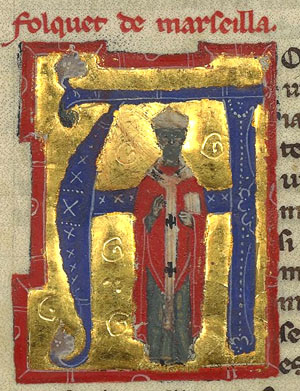
"Folquet de Marseilla" depicted in his bishop's costume and holding a bible in BnF ms. 854 fol. 61. |
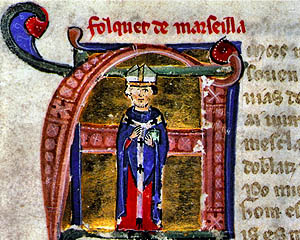
|
|
Saint Etienne's - The Cathedral in Toulouse |
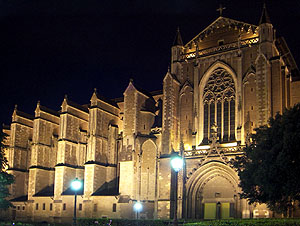 |
|
"Folquet de Marseilla" depicted in his bishop's costume in a 13th-century chansonnier.. BnF MS. 12473 fol. 46 |
 |
|
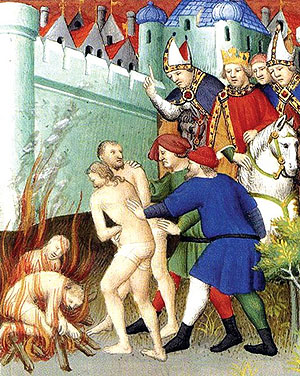
Bishops supervise the burning of "heretics" |
 |
Philip II, King of France:
(Philip Augustus, reigned 1180-1223).
Though pressured by Innocent III to take an active role in the Crusade against the Cathars, Philip repeatedly declined, though he did encourage his vassals to join the crusade.
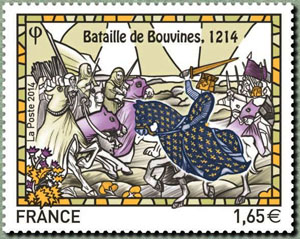
After a twelve years struggle with the Plantagenet dynasty, Philip broke up the great Angevin Empire and defeated a coalition of his rivals (German, Flemish and English) at the Battle of Bouvines in 1214. This victory would have a lasting impact on western European politics: the authority of the French king became unchallenged, while the English king was forced by his barons to sign the Magna Carta and faced a rebellion in which Philip and his son (the future Louis VIII) intervened.
Philip was nicknamed "Augustus" by the chronicler Rigord for having extended the royal demesne, the domains ruled directly by the kings of France, as opposed to the territories ruled indirectly by vassals of the king. Philip Augustus transformed France from a small feudal state into the most prosperous and powerful country in Europe.
|
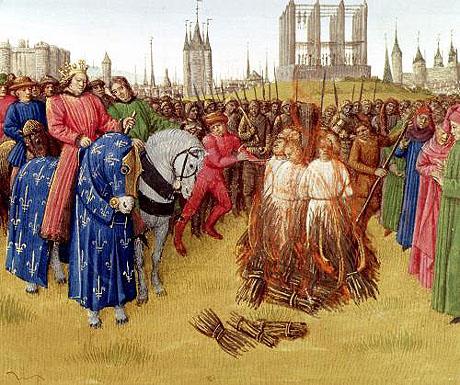
"The burning [Supplice] of the Heretics in 1210" Illustration from the illuminated manuscript Grandes Chroniques de France depicting the burning of Amalrician heretics before King Philip II of France. In the background is the Gibbet of Montfaucon and, anachronistically, the Grosse Tour of the Temple fortress. Jean Fouquet (1455-1460), Bibliothèque nationale de France, Paris |
 |
 |
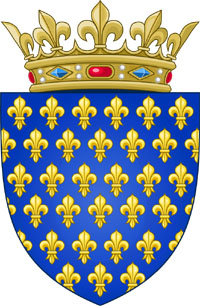 |
|
Battle of Bouvines, 1214 |
 |
|
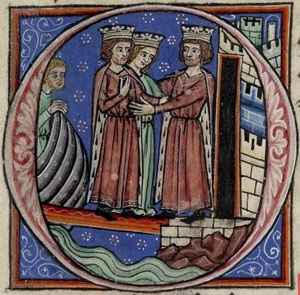
Richard I and his sister Jeanne (or Joanna, or Joan) greeting Philip Augustus, King of France |
 |
Louis VIII: (reigned 1223-1226).
Louis VIII, the Lion (5 September 1187 – 8 November 1226) reigned from 1223 to 1226. He was also disputed King of England from 1216 to 1217. Louis VIII was born in Paris, the son of Philip II and Isabelle of Hainaut from whom he would inherit the County of Artois.
On 23 May 1200, at the age of 12, Louis was married to Blanche of Castile, following prolonged negotiations between Philippe Augustus and Blanche's uncle John of England.
While Louis VIII ruled as king for only three years, he was an active leader in his years as Crown Prince. In 1215, the English barons rebelled in the First Barons' War against the unpopular King John of England (1199–1216). The barons offered the throne to Prince Louis, who landed unopposed on the Isle of Thanet in eastern Kent, England at the head of an army on 21 May 1216. There was little resistance when the prince entered London and Louis was proclaimed King at St Paul's Cathedral with great pomp and celebration in the presence of all of London. Even though he was not crowned, many nobles, as well as King Alexander II of Scotland, gathered to pay homage. On 14 June 1216, Louis captured Winchester and soon controlled over half of the kingdom. He was proclaimed "King of England" in London on the 2 June 1216. Just as it seemed that England was under his control, King John's death in October 1216 caused many of the rebellious barons to desert Louis in favour of William Marshall, Regent for John's nine-year-old son, Henry III.
Under William Marshall, a call for the English "to defend our land" against the French led to a reversal of fortunes on the battlefield. After Louis' army was beaten at Lincoln on 20 May 1217, and his naval forces (led by Eustace the Monk) were defeated off the coast of Sandwich on 24 August 1217, he was forced to make peace on English terms. The principal provisions of the Treaty of Lambeth were an amnesty for English rebels, Louis to undertake not to attack England again, and 10,000 marks to be given to Louis as a face-saving measure. The effect of the treaty was that Louis agreed he had never been the legitimate King of England.
Before decamping back to France he stole the relics of Saint Edmund the Martyr from the abbey at Bury-Saint-Edmunds, and would later deposit them at Saint Sernin in Toulouse.
From 1209 to 1215 the Albigensian Crusade had been largely successful for the northern forces, but this was followed by a series of local rebellions from 1215 to 1225 that undid many of these earlier gains, especially after the death of Simon de Montfort.
His English adventure over, Louis turned to fighting the Duke of Aquitain (also Henry III, King of England) and the Count of Toulouse. Louis VIII started the conquest of Guyenne, leaving only a small region around Bordeaux to Henry III. Louis was a devout and keen crusader, and distinguished himself by massacres that disturbed even his own war hardened troops, notably when he oversaw the atrocity at Marmande in 1219.
Louis VIII succeeded his father on 14 July 1223; his coronation took place on 6 August of the same year in the cathedral at Reims. As King, he continued to seek revenge on the Angevins, seizing Poitou and Saintonge. In 1225, the council of Bourges excommunicated the Count of Toulouse, Raymond VII, and declared a renewed crusade against the people of the Languedoc. Louis renewed the conflict in order to enforce his royal rights, Amaury de Montfort having sold his feudal rights to Louis. Roger Bernard II (the Great), Count of Foix, tried to keep the peace, but the king rejected his embassy and took up arms against the Counts of Foix and the Count of Toulouse. The took Avignon after a three-month siege, but he did not complete the conquest before his death. While returning to Paris, King Louis VIII became ill with dysentery and died in the Château de Montpensier, on Monday 8 November 1226. The troubadour Guilhem Figueira commented in D'un sirventes far en est son que m'agenssa "Rome, you killed good King Louis because with your false preaching, you lured him away from Paris". His son, Louis IX (1226–70), succeeded him on the French throne.
Louis VIII had thirteen children by Blanche of Castile:
- Unnamed daughter [Blanche?] (1205 - died soon after).
- Philip (9 September 1209 – before July 1218), betrothed in July 1215 to Agnes of Donzy.
- Alphonse (b. and d. Lorrez-le-Bocage, 26 January 1213), twin of John.
- John (b. and d. Lorrez-le-Bocage, 26 January 1213), twin of Alphonse.
- Louis IX (Poissy, 25 April 1214 – 25 August 1270, Tunis), King of France as successor to his father.
- Robert (25 September 1216 – 9 February 1250, killed in battle, Manssurah, Egypt), Count of Artois.
- Philip (20 February 1218 - 1220).[11]
- John (21 July 1219 - 1232), Count of Anjou and Maine; betrothed in March 1227 to Yolande of Brittany.
- Alphonse (Poissy, 11 November 1220 – 21 August 1271, Corneto), Count of Poitou and Auvergne. He married Jeanne of Toulouse, daughter of Raymond VII and Jean of England. his mother, who was regent of France, forced the Treaty of Paris on Raymond VII of Toulouse. It stipulated that a brother of King Louis was to marry Joan of Toulouse, daughter of Raymond VII of Toulouse, and so in 1237 Alphonse married her. Since she was Raymond's only child, they became rulers of Toulouse at Raymond's death in 1249.
- Philip Dagobert (20 February 1222 - 1232[12]).
- Isabelle (March 1224[13] – 23 February 1270).
- Etienne (end 1225[14] - early 1227[15]).
- Charles (posthumously 21 March 1227 – 7 January 1285), Count of Anjou and Maine, by marriage Count of Provence and Folcalquier, and King of Sicily.
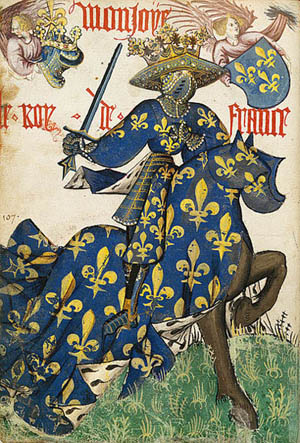 |
|
Coronation of Louis VIII and Blanche of Castile at Reims in 1223, miniature from the Grandes Chroniques de France, painted in the 1450s (Bibliothèque nationale de France) |
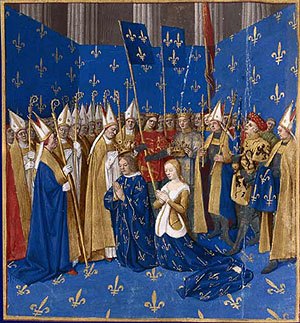 |
Blanche of Castile (1188-1252),
Regent of France (1226-1236)
 Blanche
was the third daughter of Alphonso VIII, King of Castile, and
of Eleanor of England, daughter of Henry
II. Under a treaty between Philippe
Augustus and King
John of England, she had married Louis
VIII. When Philip died Louis, their son and the heir to
Kingdom of France (Louis
IX), was twelve years old. Blanche ruled as regent
until he came of age in 1236.
Blanche
was the third daughter of Alphonso VIII, King of Castile, and
of Eleanor of England, daughter of Henry
II. Under a treaty between Philippe
Augustus and King
John of England, she had married Louis
VIII. When Philip died Louis, their son and the heir to
Kingdom of France (Louis
IX), was twelve years old. Blanche ruled as regent
until he came of age in 1236.
The regency of Blanche of Castile (1226-1234) was marked by the victorious struggle of the Crown against her cousine Raymond VII of Toulouse in the Languedoc, against Pierre Mauclerc in Brittany, against Philip Hurepel in the Ile de France, and by indecisive combats against Henry III, King of England. In this period of disturbances the queen was supported by the legate Frangipani, whith whom she was widely roumoured to be engaged in a sexual relationship.
Accredited to Louis VIII by Honorius III as early as 1225, Frangipani won over to the French cause the sympathies of Gregory IX, who was inclined to listen to Henry II, and through his intervention it was decreed that all the chapters of the dioceses should pay to Blanche of Castile tithes for the Albigensian Crusade. It was the legate who received the submission of Raymond VII of Toulouse, at Paris, in front of Notre-Dame. This submission put an end to the Albigensian war and prepared the annexation of the Languedoc to France by the Treaty of Paris (April 1229).
The influence of Blanche of Castile over the government extended far beyond Saint Louis' minority. Even later, in public business and when ambassadors were officially received, she appeared at his side. She died in 1253.
|
Louis IX, Saint Louis, and his mother Blanche de Castille stained glass in the nave of l'église Saint-Louis de Saint-Louis-en-l'Isle in the Dordogne. |
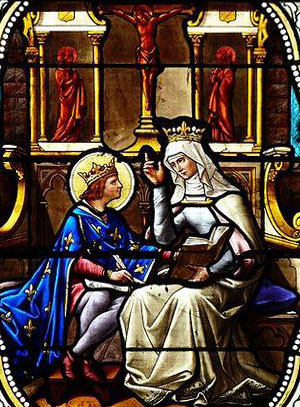 |
|
Blanche of Castile. Detail from Blanche of Castile and King Louis IX of France in the Bible moralisée de Tolède, dite bible de Saint-Louis, scène de dédicace, circa 1220-1230, The Morgan Library & Museum, Accession number M240 |
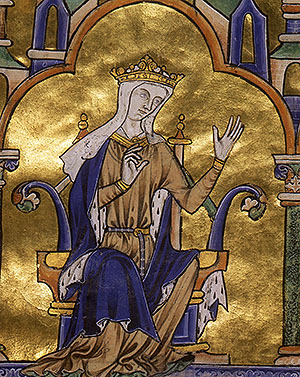 |
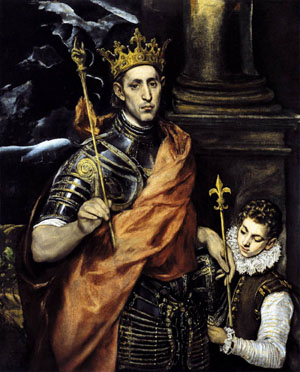
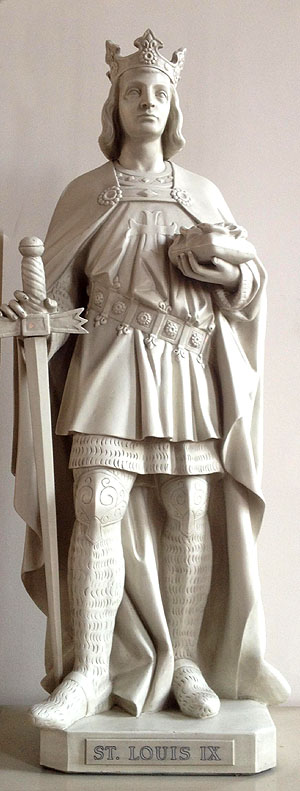
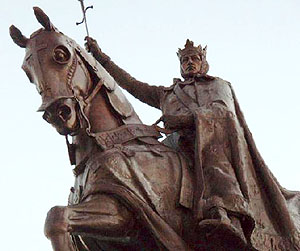
Louis IX: (1215-1270), St Louis,
King of France (1236-1270)
Louis IX, King of France, was the son of Louis VIII and Blanche of Castile, born at Poissy, 25 April, 1215. He ded near Tunis on 25 August, 1270.
The regency of Blanche of Castile (1226-1234) had been marked by the victorious struggle of the Crown against Raymond VII. In the first years of the king's personal government, the Crown fought off an attack led by the Count de la Marche, in league with Raymond's close relative, Henry III, King of England. King Louis IX's victory over this coalition at Taillebourg, 1242, destroyed any hope of success for the uprising planned in Ramon VII's territories to expel the French invaders.
He was eleven years of age when the death of Louis VIII made him king, and nineteen when he married Marguerite of Provence by whom he had eleven children. The regency of Blanche of Castile (1226-1234) was marked by the victorious struggle of the Crown against Raymond VII of Toulouse in the Languedoc, against Pierre Mauclerc in Brittany, against Philip Hurepel in the Ile de France, and against Henry III, King of England. In this period of disturbances the queen was supported by the papal legate Frangipani. Accredited to Louis VIII by Honorius III as early as 1225, Frangipani won over to the French cause the sympathies of Gregory IX, who had been inclined to listen to Henry III. Through his intervention it was decreed that all the chapters of the dioceses should pay tithes to Blanche of Castile to continue the Albigensian Crusade. It was the legate who received the submission of Raymond VII at Paris, in front of Notre-Dame. For the time being, this submission put an end to the Albigensian war and prepared the way for the annexexation of the Languedoc by France under the Treaty of Meaux-Paris in April 1229.
In the first years of the king's personal government, the Crown had to combat a fresh uprisings against French rule, led by the Count de la Marche, in league with Henry III of England. Saint Louis' victory over this coalition at Taillebourg, 1242, was followed by the Peace of Bordeaux which annexed to the French kingdom a part of Saintonge.
As part of the general uprising in 1242 a number of Inquisitors
were massacred at Avignonet by knights from Montségur,
the last remaining Cathar stronghold. This triggered a new military
action to "cut off the head of the dragon". Hughes des
Arcis, the King's representative (seneschal of Carcassonne)
and the Archbishop of Narbonne laid the siege of the Château
of Montségur
( Montsegùr)
in 1243-4, culminating in the burning alive of more than 225 Cathar
Perfects.
Montsegùr)
in 1243-4, culminating in the burning alive of more than 225 Cathar
Perfects.
Louis IX turned his thoughts towards a crusade to the Holy Land. Stricken with a malady in 1244, he resolved to take the cross when news came that Turcomans had defeated the Christians and the Moslems, and invaded Jerusalem. He opened negotiations with Henry III, King of England, which he thought would prevent new conflicts between France and England. By the Treaty of Paris (28 May, 1258) Louis IX concluded an agreement with the King of England. By this treaty Louis IX gave Henry III all the fiefs and domains belonging to the King of France in the Dioceses of Limoges, Cahors, and Périgueux; and in the event of Alphonsus of Poitiers dying without issue, Saintonge and Agenais would escheat to Henry III. For his part, Henry III renounced his claims to Normandy, Anjou, Touraine, Maine, Poitou, and promised to do homage for the Duchy of Guyenne. It was generally considered, that St. Louis made too many territorial concessions to Henry III. Some historians hold that if Louis IX had carried on the war against Henry III, the Hundred Years War might have been averted. St. Louis considered that by making the Duchy of Guyenne a fief of the Crown of France he was gaining a significan legal advantage. The Treaty of Paris, was as displeasing to the English as it was to the French.
By the Treaty of Corbeil, Louis imposed on the King of Aragon the abandonment of his claims to all the fiefs in Languedoc excepting Montpellier, and the surrender of his rights to Provence (11 May, 1258).
|
Saint Louis, King of France, with a Page',
|
 |
 |
 |
|
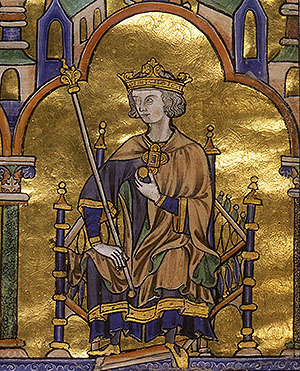
Louis IX. detail from Blanche of Castile and King Louis IX of France in the Bible moralisée de Tolède, dite bible de Saint-Louis, scène de dédicace, circa 1220-1230, The Morgan Library & Museum, Accession number M240 |
 |
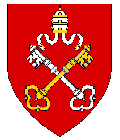
Pope Innocent III (born 1160, Pope 1198 - 1216)
Innocent III, was born Lotario de' Conti, son of Count Trasimund of Segni and nephew of Pope Clement III. Innocent was a keen supporter of Crusades, including the disastrous Fourth Crusade.
 |
 |
Mass desertions from the Roman Church to the Cathars in the Languedoc (and the consequent loss of prestige and revenue) had already suggested to him the idea of a Crusade against his fellow Christians. Arnaud Amaury, Abbot of Cîteaux had been conducting a preaching campaign that had proved an even greater failure than the one run by Dominic Guzman (St-Dominic).
|
The luxurious lifestyle of Arnaud Amaury and his Cistercian monks excited mockery rather than envy in the Languedoc. Arnaud, personally humiliated, was now out for blood. The murder of a papal legate - a fellow Cistercian monk - provided the ideal excuse for action. At Arnaud's prompting, Innocent III ordered a crusade against the people of the Languedoc. Their sovereign, Raymond VI, Count of Toulouse, appealed for an impartial investigation. Innocent sent a lawyer called Milo, ostensibly to to carry out a fair assessment, but with secret instructions to take orders from Arnaud Amaury - Raymond's mortal enemy. Arnaud was therefore able to slake his thirst for blood and was soon leading the papal crusade. He personally adopted the role of its first military commander. His crusader troops - the dregs of France - enjoyed the same privileges as those who fought the Moslems. Killing Cathars, like killing Moslems, assured the killer the highest place in Heaven. |
|

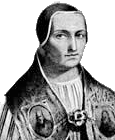 Innocent
claimed to have been given the whole world to rule over by God,
and succeeded in extending the papacy's feudal power, acquiring
as fiefs Portugal, Aragon, Hungary and England, and purporting to
reassign important feudal properties of the Counts
of Toulouse and Peter
II, the King of Aragon.
Innocent
claimed to have been given the whole world to rule over by God,
and succeeded in extending the papacy's feudal power, acquiring
as fiefs Portugal, Aragon, Hungary and England, and purporting to
reassign important feudal properties of the Counts
of Toulouse and Peter
II, the King of Aragon.
Innocent III opened the Fourth Lateran Council on 15 November 1215. This was the most important council of the Middle Ages. Besides deciding on another crusade to the Holy Land, it issued seventy decrees, the first of which was a creed (Firmiter credimus) against the Cathars and Waldensians, in which the term "transubstantiation" received its first ecclesiastical sanction. It also established the essential principals of what would become the Papal Inquisition under his nephew Pope Gregory IX.
A hymn, called Veni Sancte Spiritus, popular among the Crusaders as they burned supposed heretics, is usually attributed to Innocent III. It is sometimes called the "Golden Sequence," and is prescribed in the Roman Liturgy for the Masses of Pentecost and its octave, exclusive of the following Sunday.
Click on the following link to read a more detailed article about Pope Innocent III
Click on the following link for a translation of Canon
Three of the Fourth Lateran Council (1215)
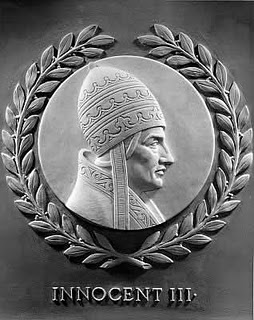 |
|
Lotario di Segni became Pope Innocent III in 1198 |
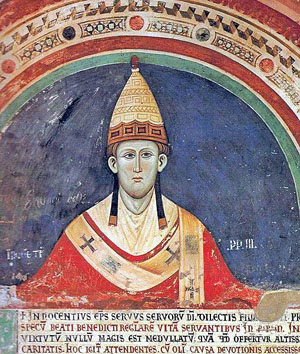 |
| Pope
Innocent III with Cistercian
abbot Arnaud
Amaury NKP XXIII F144 0 04v |
|
Bernard Gui (1261-1331) Dominican Inquisitor
Remember that name; for the present he is burning Albigensians, but he has higher ambitions.
(Umberto Eco, The Name of the Rose).
Gui was born at Royères, in the Limousin, in 1261. He was also known as Bernardo Gui and in Latin as Bernardus Guidonis, He entered the Dominican Convent at Limoges, and became a friar in 1280. Ten Years later he became Prior of Albi, and subsequently Prior at Carcassonne, Castres, and Limoges.
He lived after the Crusades against the people of the Languedoc, but played an active part in the mopping up operations that followed identifying and punishing Cathar believers and their sympathisers.
 He
is remembered for his tenure as Inquisitor
of Toulouse
which he took up at the behest of Pope Clement V between 1307 and
1323. He is known to have passed sentence on at least 900 people
over fifteen years. His victims included Cathars,
Waldensians,
so-called False Apostles, Beguines, Jews, and alleged sorcerers
and necromancers. Unknown numbers were executed. Documentation survives
for 42 who lost their lives for the crime of believing something
other than Catholic teachings.
He
is remembered for his tenure as Inquisitor
of Toulouse
which he took up at the behest of Pope Clement V between 1307 and
1323. He is known to have passed sentence on at least 900 people
over fifteen years. His victims included Cathars,
Waldensians,
so-called False Apostles, Beguines, Jews, and alleged sorcerers
and necromancers. Unknown numbers were executed. Documentation survives
for 42 who lost their lives for the crime of believing something
other than Catholic teachings.
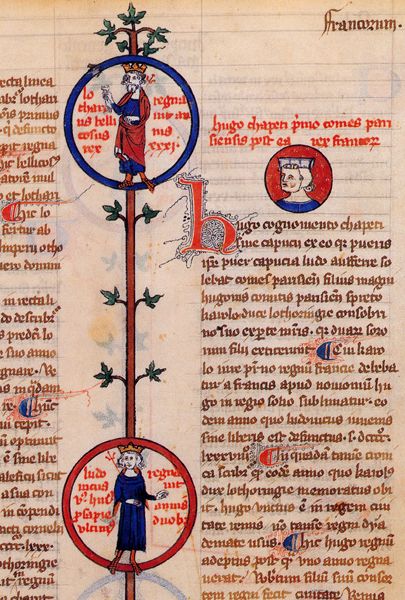 |
For his services to the Roman Church Gui was made Bishop of Tui in Galicia by Pope John XXII, and a year later became Bishop of Lodève.
His fame, or infamy, rests mainly on his most important work, Practica inquisitionis heretice pravitatis or "Conduct of the Inquisition into Heretical Wickedness", It gives a list of supposed heresies in the early 14th century, and advises Inquisitors how to deal with the questioning of members of each "heretical" group. It is useful as a source of information on the prerogatives and duties of Inquisitors and for forms of condemnation and instructions for examinations. It also reveals how difficult Inquisitors found it to argue against Cathars in open debate.
This work was lost for a time, but was rediscovered and published by the abbé Douais at Toulouse in 1886.
Click on the following link to read an extract of Gui's work.
Bernard Gui died at the castle of Lauroux in what is now the Hérault département on 30th December, 1331.
|
Bernard Gui was a real Dominican
Inquisitor
|
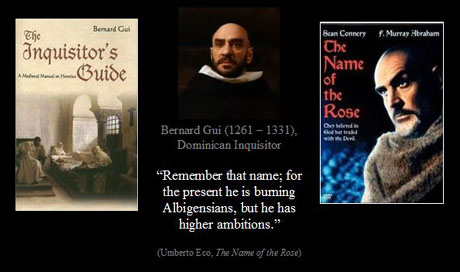 |
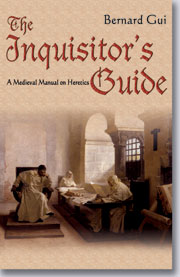 |
|
|
|
|
F. Murray Abraham as the Dominican Inquisitor Fra Bernard Gui in "The Name of the Rose" |
|
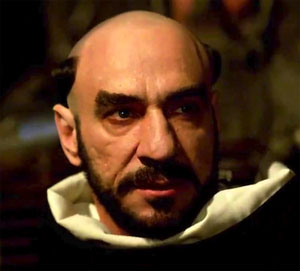 |
Jacques Fournier
Jacques Fournier, Bishop of Pamiers: (c 1280 - 1342) Famous for his Inquitation records which survived in the Vatican Archives after he was elected Pope as Benedict XII.
Jacques Fournier is believed to have been born in Saverdun in the Comté de Foix around the 1280s to a family of modest means. He became a Cistercian monk and left to study at the University of Paris. In 1311 he was made Abbot of Fontfroide Abbey. In 1317 he became Bishop of Pamiers. There he undertook a rigorous hunt for Cathar believers, which won him praise from Catholic authorities, but alienated local people. He was an exceptional Inquisitor. Uniquely "Monsignor Jacques" was interested in what had really happened, kept records of his interrogations and managed to have them preserved to provide a treasure trove for historians. He made a name for himself by his skill as an Inquisitor during the period 1318-1325. He conducted a campaign against the last remaining Cathar believers in the village of Montaillou, as well as others who questioned the Catholic faith. Inquisitorial efforts stretched into the territories of Aragon, from where the last known Cathar Parfait of the Languedoc, Guilhem Belibaste, was lured back to be burned alive by the Archbishop of Narbonne.
Fournier's records have been documented in Emmanuel Le Roy Ladurie's pioneering microhistory, Montaillou, village occitan. Complete editions of the register have been published in Latin and in French, but only portions have been translated into English.
He personally supervised almost all of his operations, occasionally using torture to extract information. The bulk of his interrogations relied on Fournier's verbal skill at drawing out information. He conducted 578 interrogations in the 370 days his Inquisition was in in operation.
The Fournier Register is a set of records from the Inquisition run by Fournier between 1318 and 1325. Fournier interrogated hundreds of suspects and had transcripts recorded of each interrogation. He demanded a great deal of detail from those appearing before him. Most of those he interrogated were local peasants and the Fournier register is one of the most detailed records of life among medieval peasants. The records have been the focus of scholars, most notably Emmanuel Le Roy Ladurie whose pioneering work of microhistory Montaillou is based on the material in the register. Thanks to his records, we know more about life in the tiny Pyrenean village Montaillou than we know about life in London or Paris in the early fourteenth century.
Prior to Bishop Fournier the local authorities had done little to pursue so-called heretics, and the region was one of the last areas of Europe to be home to a significant number of adherents to the Cathar religion, a full century after the French Crusade against the Cathars of the Languedoc.
The severest sentence was to be burnt at the stake, but this was rare, with this inquisition only sentencing five heretics to this fate. More common was to be imprisoned for a time or to be forced to wear a yellow cross on one's back. Other punishment's included forced pilgrimages and confiscation of property.
The record was assembled in three stages:
- During the inquisition itself a scribe would make quick notes in short form to record the conversation.
- These would then be expanded into full minutes, which were then presented to the accused for review and alterations in case of errors.
- Finally a final version would be recorded.
The process involved translating the dialogue from the local Occitan language to the Latin of the Church.
In 1326, on the successful rooting out of what were believed to be the last Cathar adherents in the area, he was made Bishop of Mirepoix in the Ariège. A year later, in 1327, he was made a cardinal.
|
Benedict X is now considered an antipope, but in his own time and for long afterwards recognised as the rightful pope. As a result, the man the Roman Catholic church now officially considers the tenth Pope Benedict took the number XI, rather than X. This has advanced the numbering of all subsequent Popes Benedict by one. |
Fournier succeeded Pope John XXII (1316–34) as Pope Benedict XII in 1334, being elected on the first conclave ballot.
He made peace with the Emperor Louis IV, and came to terms with the Franciscans, who were then at odds with the Roman See. He was a reforming pope who tried to curb the luxuries of the monastic orders, though without success. It was he who ordered the construction of the Palais des Papes in Avignon. He rejected many of the ideas developed by John XXII and campaigned against the Immaculate Conception. He engaged in long theological debates with noted figures such as William of Ockham and Meister Eckhart. He died on 25th April , 1342).
birth (c. 1280)
Bishop of Pamiers (1317)
Bishop of Mirepoix (1326),
Cardinal (1327)
Pope Benedict XII based in Avignon (1334).
Died 1342
The manuscript of Jacques Fournier's Inquisition Record is currently found in the Vatican Library, Lat. MS. 4030. and modern editions are available in Latin and French. For further information, see:
- Fournier, Jacques, Le Registre d'Inquisition de Jacques Fournier, evêque de Pamiers (1318-1325), Latin manuscript no. 4030 in the Vatican Library, edited by Jean Duvernoy, Toulouse, 1965, 3 vols. (in Latin)
- Fournier, Jacques, Le Registre d'Inquisition de Jacques Fournier (Evêque de Pamiers) 1318-1325, traduit et annoté par Jean Duvernoy, Préface de Emmanuel Le Roy Ladurie, École des Hautes Études en Sciences Sociales, Centre de Recherches Historiques, Civilisations et Sociétés 43, (Paris: Mouton, 1978) 3 vols. (in French)
- Ladurie, Emmanuel LeRoy. Montaillou: The Promised Land of Error, trans. by Barbara Bray. (New York: Vintage Books, 1979).
- Ladurie, Emmanuel Le Roy. Montaillou, village occitan de 1294 à 1324. (Paris: Editions Gallimard, 1975).
Here is what the 1912 Catholic Encyclopedia had to say about him, before the value of the Fournier Register had been appreciated.
Pope Benedict XII (JACQUES FOURNIER)
|
Third of the Avignon popes, b. at Saverdun in the province of Toulouse, France, elected 20 December, 1334; d. at Avignon 24 April, 1342. Nothing is known of his parentage or boyhood. In youth he became a Cistercian monk in the monastery of Boulbonne, whence he moved to that of Fontfroide, whose abbot was his natural uncle, Arnold Novelli, by whose name Fournier was also known. He studied at the University of Paris, where he received the doctorate in theology. Meantime he was made Abbot of Fontfroide, succeeding his uncle who was created cardinal 19 December, 1310. In December 1317, he became Bishop of his native Diocese of Pamiers, was translated to Mirepoix 26 January, 1327, and was made cardinal by Pope John XXII, 18 December, 1327. On the latter's death, 4 December, 1334, the cardinals in conclave, most of whom opposed a return to Rome, demanded of Cardinal de Comminges whose election seemed assured, the promise to remain at Avignon. His refusal precipitated an unexpected canvass for candidates. On the first ballot, 20 December, 1334, many electors, intending to sound the mind of the conclave, voted for the unlikely Cardinal Fournier, who, though he was one of the few men of real merit in the college, was but lightly regarded because of his obscure origin and lack of wealth and following. He amazed the conclave by receiving the necessary two-thirds vote. On 8 January, 1335, he was enthroned as Benedict XII.
|
|
||
|
Resolved to re-establish the papacy at Rome, Benedict signalized his accession by providing for the restoration of St. Peter's basilica and the Lateran. He was prepared to acquiesce in the petition of a Roman deputation soliciting his return, but his cardinals pictured the impossibility of living in faction-rent Italy. They were right, whatever were their motives, and Benedict yielded. Conscience-stricken during a critical illness, he proposed as a compromise a transfer of his court to Bologna. The cardinals urged the slender hope of securing obedience, and Benedict decided to remain at Avignon, where in 1339 he commenced to build the massive papal castle which still exists. Mindful always of distracted Italy, he often sent money to succour the famine-stricken people and to restore churches. Reform of abuse was Benedict's chief concern. Immediately after his elevation he remanded to their benefices clerics not needed at Avignon, and menaced with summary chastisement violators of the law of residence. He revoked the scandalous "expectances" granted by his predecessors and forbade conferring benefices in commendam. He condemned unseemly "pluralities" and conferred benefices with such conscientious discrimination that several were left long vacant, and so gave colour to the calumny that he was himself harvesting their revenues. He inveighed vigorously against greed for gain among ecclesiastics; regulated the taxes on documents issued by papal bureaux; made episcopal visitation less of a financial burden to the clergy; abolished the practice of countersigning requests for papal favours, which was extremely lucrative to venal officials; and established the Registry of Supplications for the control of such petitions. Abhorring nepotism, he granted preferment to but one relative, naming the eminent John Bauzian Archbishop of Arles in deference to the insistence of the cardinals; he compelled his only niece to discourage noble suitors, and marry one of her own humble rank. A legend, vouched for by Ægidius of Viterbo (d. 1532), accredits him with saying, "a pope should be like Melchisedech, without father, mother, or genealogy". Monastic reform particularly engaged his zeal. Himself a Cistercian, he sought to revive pristine monastic fervour and devotion to study. Pertinent papal constitutions and visitations of monasteries attest his solicitude for a monastic renaissance.
|
|
||
|
Being a learned theologian, he was as bishop, cardinal, and pope, keenly interested in scholastic discussions. He terminated the controversy on the vexed question as to whether the Beatific Vision was enjoyed before or only after the General Judgment. John XXII had advocated the latter view and stirred up vigorous discussion. Eager to solve the question, Benedict heard the opinions of those maintaining the theory of deferred vision, and, with a commission of theologians, gave four months to patristic research. Their labours terminated in the proclamation (29 January, 1336) of the Bull "Benedictus Deus" defining the immediate intuitive vision of God by the souls of the just having no faults to expiate. Zealous too for the preservation of the Faith, he stimulated the bishops of infected districts to vigilance in the repression of heresy and urged the use of the preventive remedies of the Inquisition. He combatted energetically the anti-papal doctrines which the ecclesiastico- political theorists of the disturbed Avignon period had spread, and which were unfortunately sustained by a school of misguided Franciscans. (See FRATICELLI, MARSILIUS OF PADUA , WILLIAM OF OCCAM, MICHAEL OF CESENA.) Distressed by disloyalty in Ireland, he tried to persuade Edward III to establish the Inquisition in his realm and urged him to assist the Irish bishops to extirpate heresy. But, though the most ardent foe of heresy, Benedict was remarkably patient and loving in dealing with heretics. He looked also to the union of the Eastern Church with Rome through a delegate of the Emperor Andronicus, whose sincerity, however, Benedict was forced to question; manifested his solicitude for the Church in Armenia which, in the early fourteenth century, suffered from Mohammedan invasions, succouring the unfortunates in temporal matters and healing doctrinal differences which had long rent Armenia with schism.
|
|
||
|
In purely ecclesiastical affairs Benedict's pontificate was creditable to himself and productive of good to the Church. Pious, prudent, and firm, he strove conscientiously to meet the Church's needs at a critical period. In political relations, however, he was not so successful. Inexperienced in politics, he had little taste for diplomacy and an imperfect knowledge of men and affairs of the world. Conflicting political motives confused him, and hesitancy and vacillation contrasted painfully with his firmness and decision in ecclesiastical matters. Though determined to act independently of Philip VI of France, the latter generally succeeded in committing the pope to his policy. He helped to prevent his return to Rome. He frustrated his desire to make peace with the Emperor Louis of Bavaria whom John XXII had excommunicated for fomenting sedition in Italy, proclaiming himself King of the Romans, and intruding an antipope. Willing to absolve him should he but submit to the Church, Benedict exposed to Louis's delegates his generous terms of peace (July, 1335). But Philip, aided by the cardinals, persuaded the pope that his generosity encouraged heresy and rebellion. Benedict yielded. Thrice the imperial envoys came to Avignon, but French influence prevailed, and, on 11 April, 1337, Benedict declared it impossible to absolve Louis. The latter, as Benedict feared, allied himself with Edward III of England against France. In vain the pope tried to avert war, but he was no match for the kings and their allies. His good offices were spurned; and he was humiliated by Philip's later alliance with Louis, who had also allied to himself the pope's political and ecclesiastical enemies, and by the emperor's denial of the pope's authority over him, and, worst insult of all, by his usurpation of papal power in declaring the nullity of the marriage of John Henry of Bohemia and Margaret Maultasch, that the latter might marry his son, Louis of Brandenburg. The French king hindered Benedict's projected crusade against the infidels, making the war with England an excuse to forego his promise to lead the armies, and even diverting the money subscribed for it to financing his own wars, despite the protests of the conscientious pope. Benedict's crusading ardour found solace in Spain, where he encouraged the campaign against the Mohammedans who in 1339 invaded the peninsula.
|
|
||
|
Benedict XII has not escaped calumny. Reformer, foe of heresy, builder of the Avignon papal palace, unwilling ally of France and enemy of Germany, he made many enemies whose misrepresentations have inspired most non-Catholic appreciations of his character. Much harm was done to his memory by the satires of Petrarch, who, though befriended and honoured by Benedict, yet bitterly resented his failure to return to Rome. His natural obesity, too, stimulated caricature and undeserved criticism. But history offers a vindication and testifies that, though he failed to cope successfully with the political difficulties to which he fell heir, his piety, virtue, and pacific spirit, his justice, rectitude, and firmness in ruling, his zeal for doctrinal and moral reform, and his integrity of character were above reproach. |
|
Opponents and Victims of the Crusade.
Raymond VI of Toulouse,
Ramon
VI de Tolosa,
 Raimond
VI de Toulouse
Raimond
VI de Toulouse
Raymond of St-Gilles (1156-1222),
Count of Toulouse (1196-1222).
 Raymond
VI was the reigning Count
of Toulouse at the time of the outbreak of the Cathar
Wars.
Raymond
VI was the reigning Count
of Toulouse at the time of the outbreak of the Cathar
Wars.
Raymond held his lands under the feudal system from a number of his relatives. Most of these lands were held as a vassal of the King of Aragon, but some (notably Provence) he held from the Holy Roman Emperor, some from the King of France and some from the King of England.
Raymond was not a great fighter, but he was a good diplomat, and most historians agree that he played a poor hand as well as he possibly could.
With a suzerain like Peter II of Aragon, allies like the Count of Foix, loyal vassals to the East like the Viscount of Béarn and the Count of Comminges, relatives like the Trencavels, loving subjects, and the secret sympathy of many of crusader nobles, it looked as though he might beat off the combined might of Western Christendom. But it was not to be. Pope Innocent III had secretly planned his humiliation from the first, possibly as a way to establish a precedent for his personal dream of becoming feudal suzerain of the whole world. Worse, for Raymond, the crusaders were led by Simon de Montfort, a man of great courage, impressive military skill, vast personal greed, and demonic abilities to be everywhere at once.
Raymond claimed to be a good Catholic, but he was closely associated with the Cathar cause. He listened to Cathar sermons and always travelled with a Cathar Parfait in his retinue, yet the circumstances of his death confirm that he was indeed Catholic. Many of his nobles, friends, allies, relatives and supporters were undoubtedly Cathars. As Raymond pointed out at the time, no-one in his position could possibly exterminate Cathar belief as ruthlessly as Pope Innocent III required him to.
|
|
|
In 1215 Simon de Montfort besieged Toulouse and Narbonne. Raymond was obliged to negotiate with the pontifical legates. They made him the most humiliating propositions, that he had no option but to accept. Stripped of his estates, he retired to England, where his close relative King John of England offered him sanctuary - until pressed to expel him by the Roman Catholic Church.
Raymond attended the Fourth Lateran Council (1215), where his case was put to Pope Innocent III by the irrepressible Raymond Roger, Count of Foix. It looked as though the case was going to be accepted, but there were, according the the Song of the Cathar Wars, irregular manoeuvrings behind the scenes. The pope, initially sympathetic, now purported to cede the estates of Raymond to Simon de Montfort, reserving for Raymond's son (the future Raymond VII) the Marquessates of Provence and Beaucaire.
Again exiled, this time in Aragon, Raymond VI reassembled his troops, and took Toulouse in 1217, defending it successfully against Simon de Montfort, who was killed on 25 June, 1218 besieging it.
Before his death Raymond VI had wrested from Amaury de Montfort nearly all the conquests of Simon de Montfort.
Raymond VI died in 1222 at a period when his lands looked safe. Excommunicated, he had already abdicated in favour of his son, Raymond VII, in order that his lands should not be forfeit - even if the novel temporal claims of the papacy were ever accepted. He died while excommunicated and thus was denied a Catholic burial, though he he had been accepted into the ranks of the Knights Hospitallers shortly before he died.
Click on the following link for more on the
House of Toulouse
Click on the following link for more on Counts
of Toulouse
Click on the following link for more on Raymond
VI ofToulouse
Click on the following link for more about the
arms of fighters in the Cathar Wars
Click on the following link for more on the Knights
Hospitallers
Click on the following link for more about Raymond-Roger
Trencavel
Click on the following link for more about Raymond
Trencavel II
Click on the following link for more on Peter
II of Aragon
Click on any of the the links on the menu below for other important figures in the Cathar Crusade.
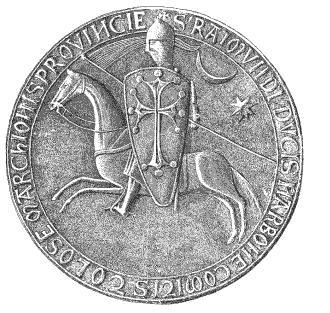 |
Raymond VI of Toulouse and the Knights Hospitallers.
The Rue Dalbard runs through one of the oldest neighborhoods in Toulouse. This road housed the Toulouse headquarters of the Knights Hospitallers.
In the Languedoc, Grand Priories of the Hospitallers (now the Knights of Malta) were established at Toulouse and Saint Gilles, under the patronage of the Counts of Toulouse. They are the oldest Hospitaller Priories built in Europe. Between them the two Grand Priories controlled some 80 Hospitaller priories in the Languedoc.
The remains of the thirteenth century Priory in Toulouse is concealed by a splendid façade of the seventeenth century. Only the discreet arms over the front door give away the nature of the building behind the façade.
The knights Hospitallers were founded in 1099 as an order of monks dedicated to aiding the Lord's sick, running a hospital named after Saint Jean the Baptist, not far from the Church of the Holy Sepulchre in Jerusalem. Along with the Knights Templars, the Hospitallers would soon develop into a military Order of fighting monks, the shock-troops of the Catholic Church. Today, the Knights Hospitallers are the world's oldest surviving Order of chivalry.
Within 10 years of their foundation in Jerusalem the Knights Hospitallers occupied the Church of Notre-Dame de la Dalbade in Toulouse, but this occupation does not appear to have been authorized, and they were ejected in 1110. The Count of Toulouse then gave to them the nearby Church of St. Rémésy and land around it, and this became their new headquarters in Toulouse, adjacent to the Church of Notre-Dame de la Dalbade.
The Order was hierarchical, based on numerous Priories, each with its own Master. Each Priory was subject to a Grand Priory. Each Grand Priory belonged to a "Tongue" - (one each for the languages of Provence, Auvergne, Aragon, Castile, France, England, Germany and Italy). All Tongues were in turn subordinate to the Grand Master. The Tongue of Provence, representing the Occitan speaking lands of the Count of Toulouse, had two Grand Priories, one at Saint-Gilles and one at Toulouse, the two centres of power of the Saint-Gilles family, Counts of Toulouse.
 The
Grand Priory of St. Gilles had 53 dependent Priories and Toulouse
28 dependent Priories. (There were separate Tongues for the Auvergne
and for France). The priory of Saint-Gilles, the first of all the
European priories, had been created by Brother Gerard Tenque, founder
of the Order, under Bertrand, son of Raymond of Saint-Gilles, Count
of Toulouse, a Crusader who left for the Holy Land in 1109 and died
there in 1112.
The
Grand Priory of St. Gilles had 53 dependent Priories and Toulouse
28 dependent Priories. (There were separate Tongues for the Auvergne
and for France). The priory of Saint-Gilles, the first of all the
European priories, had been created by Brother Gerard Tenque, founder
of the Order, under Bertrand, son of Raymond of Saint-Gilles, Count
of Toulouse, a Crusader who left for the Holy Land in 1109 and died
there in 1112.
The remains of twenty Grand Masters of the Knights of Saint John of Jerusalem lie in chapel adjoining the Church of Notre-Dame de la Dalbade in Toulouse, including those of the founder of the Order Brother, Brother Gerard Tenque.
The Death of Raymond VI,
Count of Toulouse
The Counts of Toulouse were generally buried in the Basilica of Saint Sernin, but Raymond VI was regarded as an abettor of heresy and enemy of the Church. On the other hand, his family had a long tradition as crusaders and still had friends in high places, notably the military Orders patronized by his family since their foundation. On 30 May 1218 Raymond made his will in favour of his son Raymondet (the future Raymond VII), and the Hospitallers and Templars of Toulouse. Witness were:
- Bertran, Count of Comminges,
- Roger Bernard, Count of Foix,
- Dalmace de Creissel
- Pierre de Recalde.
On 5 July the same year, in St. John's Church, Raymond VI was affiliated to the Order of the Knights Hospitaller of St. John of Jerusalem. Witnesses were
- Dalmace de Creissel,
- Pierre de Recalde,
- Doat of Alaman,
- Brother Jerome Papis, Knight Hospitaller,
- Pierre Arnaud, Raymond's notary
- Ariber, Raymond's chaplain
- Brother Armand de Cabanis, Master of the Grand Priory of the Hospital of Toulouse, acting on behalf of Bertran, Prior of Saint-Gilles.
The act specifies the last wishes of Raymond VI:
"I, Raymond, by the Grace of God Duke of Narbonne, Count of Toulouse, Marquis of Provence and son of Queen Constance, [the sister of the King of France, Louis VII]; I give and entrust myself to the Lord God Almighty, to Blessed Mary, Mother of Jesus, to Saint John the Baptiste and to the Hospital founded in his honour in Jerusalem. I promise the Lord God, and you, Armand de Cabanis, Master of the House of the Hospital of Jerusalem located in Toulouse, that I do not wish to take any other religious habit than that of the Hospital and if by chance I should die before receiving it, I wish to be buried in the House in Toulouse of the Hospital of St John of Jerusalem."
And Master Armand de Cabanis confirmed:
"I, Armand de Cabanis, on behalf of My Lord Bertran, Prior of the Order in Saint-Gilles, and on behalf of the whole community of the Hospital of St. John of Jerusalem, I receive you, Lord Raymond, Brother of the Hospital, henceforth to enjoy all spiritual and temporal benefits available here, as in Outremer. In the name of Lord Bertran, Prior of Saint-Gilles, and on behalf of the entire Community the Hospital, I assure you Count Raymond, that when you wish to receive the religious habit, the Brothers of the Hospital you will give it to you and receive you as a Brother, according to the Rule of the Hospital. For a certain surety, I order that this document be validated and authenticated with my seal. "
Count Raymond VI had been excommunicated on several occasions for his failure to persecute his Cathar subjects. In 1222 he was still excommunicated, which meant that he was not entitled to enter a church, to partake in any of the sacraments of the Church or even, if he died, to a Christian burial. It was his custom to go twice a day to the Basilica of Notre-Dame de la Daurade, not far from the Hospitallers' Grand Priory, where he would pray outside the door of the church.
On 22 September, 1222 Raymond became ill outside the Basilica of Notre-Dame de la Daurade. Immediately, he went to his friend (and viguier) Hugues Jean at the hôtel Maurand (a large private town house, known as an hôtel particular) on the rue du Taur. Hugues Jean was a member of the eminent Cathar family Maurand. There, in the garden of the Hôtel, Raymond suffered a stroke. Paralyzed, and having lost all power of speech, he was carried into the hôtel.
Father Jordan River, a priest from the nearby church of Saint-Sernin, rushed to him, wanting to remove the dying count from the hôtel. Perhaps suspicious of the priest's intentions, Hugues Jean sent to Armand de Cabanis, Master of the Hospitallers. Armand arrived with a troop of his knights and carrying a Hospitaller cloak. He entered the hôtel and, to the dismay of the priest, threw the Hospitaller cloak over Raymond's prone body. In doing this he signalled unambiguously that Raymond VI was now a Knight Hospitaller (in accordance with the agreement made three years earlier). The Master would ensure that, as a Brother of the Grand Priory of the Hospital of Toulouse, the Count would have his wishes respected and defended, if necessary by force of arms by his brother Knights. Guilhem Catel, in his History of the Counts of Toulouse, recounts the scene .
"Old Raymond being excommunicate, went in the morning to pray to God in front of the Church Notre-Dame de la Daurade. Although he was unwell, he returned after his meal, so weak that one witness recounts that he could not stand unaided and having gone to the "Bourg" [ie outside the city proper], to the home of a man named Hugues Jean, in the parish of Saint-Sernin, after eating figs, he found himself unwell, and recognizing his indisposition promptly sent for Sir Jordan River, priest of Saint-Sernin, to be reconciled with the Church and to ask Jordan to give him the Blessed Sacrament, protesting that he was very distressed to be excommunicated. The priest of Saint-Sernin came, and the stricken man pressed him in such ways as he could, as he could not speak. Raising his eyes he held his hands together unto death, in the arms of the said priest, witnessing his great contrition. Knights of Saint John of Jerusalem, having arrived, with whom he had become a Brother, they threw a cloak over him, such that the said knights wear, on which was sewn a white cross, and when someone tried to remove this coat, he held it with his hands and could no longer speak, he kissed very devoutly the cross sewn onto it. "
On Raymond's death, his body was immediately removed from the parish of Saint-Sernin and brought within the defensive walls of the Grand Priory of the Hospital on the rue de la Dalbade. Excommunicated, Raymond VI could not be buried in consecrated ground, despite the sympathy of his brother Knights Hospitaller. It is possible that Jordan, the priest of Saint-Sernin, had planned to burn the body since Raymond had died still excommunicated. This would explain Hugues Jean's urgent message to the Grand Master, the troop of Hospitaller knights and the immediate removal of Raymond's body from the parish of Saint Sernin to safe Hospitaller territory in the city.
For centuries, the Hospitallers were to keep the remains of the excommunicated Count. They placed his body in a plain white marble sarcophagus, set in the cloister garden of the Grand Priory. On the marble, one could read a discreet inscription, in poor Occitan:
Not a hi jos terra ome per gran senhor that fo that Getes my terra if Gleisa no fos.
There is no great[er] Lord under the earth who could have been dispossessed of his lands if he had had the Church
Later, the Hospitallers separated Raymond's head from the body. Witnesses in 1377 and 1517 note that the bones of the Count were abandoned in a corner, or scattered here and there. The head was kept for at least four centuries with the treasures of the Grand Priory, and shown to distinguished visitors. A curious impression was supposedly visible at the back of the skull, "a lily marked by nature on the bone behind the head" according to Nicolas Bertrandi. The marks were taken as proof of divine planning, validating the annexation of the County of Toulouse by France, the arms of which feature lilies.
Knights Hospitaller
Soon after the fall of Jerusalem in 1187, the Knights were confined to the County of Tripoli, another County belonging to the Saint-Gilles family. When Acre was captured in 1291, the order took refuge in the Kingdom of Cyprus, but sought a kingdom of their own. In 1309 they took the island of Rhodes, then part of the Byzantine Empire. Under the rule of the newly named "Knights of Rhodes", the city of Rhodes was rebuilt as a model of the medieval European ideal. Many of the city's famous monuments, including the Palace of the Grand Master, were built during this period. Like their fellow warrior-monks, the Knights Templars, the Knights Hospitallers became fabulously wealthy with properties throughout Europe.
When the Knights Templars were dissolved by the papacy on trumped-up charges in the early fourteenth century, their property was transferred to the Knights Hospitallers, so in 1314 the Hospitallers became even more wealthy. The following year 1315 the Priory at Toulouse was elevated to Grand Priory with thirty-five dependent priories in the southwest of France. In the 14th century the Hospitallers' establishment on the rue de Dalbade included the Saint Rémésy church (now jointly dedicated to Saint John), the Hospitallers' dwellings, a cloister, a tower used as a relic and document repository, a cemetery, as well as seven shops opening onto the street.
In 1523 Rhodes fell to the Ottoman Sultan, Suleiman the Magnificent leaving the Order without a state. Seven years later, On 24 March, 1530, Charles V gave to the Order the Island of Malta, then a dependence of Sicily. By the act, the Grand Master of the Hospitaller Order of Saint John of Jerusalem became Prince of Malta. The Knights Hospitallers, previously known as the Knights of Rhodes, now became the Knights of Malta. In 1630, the Grand Master was awarded ecclesiastic equality with cardinals, and the unique hybrid style His Most Eminent Highness, qualifying him as a Prince of the Church.
In 1668 the Grand Prior of Toulouse, Antoine Robin-Graveson, began to replace the medieval priory with a large hôtel with a prestigious façade, more like a palace, probably designed by the architect Jean-Pierre Rivalz. The reconstruction concerned the buildings on the rue de Dalbade. As well as a new façade and entrance, there was a new reception room, and chapter house (which can be seen today). At the same time the cloister was demolished and the cemetery abandoned. The new building, known as the Hôtel des Chevaliers, was completed twenty years later in 1688.
The hôtel became national property in 1791, during the French Revolution. It was divided into lots to be sold, but the planned sale did not take place. It was eventually sold in 1812 and in 1813 the tower was demolished along with adjacent outbuildings. The archives were also destroyed. In 1839 the site was acquired by cloth merchants who wanted to build a warehouse. The Church of Saint Rémésy and St. John, part of the Grand Priory, was destroyed, and in 1840 a larger hôtel was built with five bays extending along the rue de Dalbade, with a return along the rue Saint-Jean. In 1839 and 1845, the remains of Knights Hospitallers were collected and transferred into a chapel of the neighboring the Church of Notre-Dame de la Dalbade where they remain today. Their names are framed by statues of two knights in arms.
In 1877 the hôtel was purchased by the Archbishop of Toulouse Julien Desprez to house the Catholic Institute he founded. In 1903 a new school, the Ecole Superieure de Commerce de Toulouse, created by the Chamber of Commerce of Toulouse, moved into the hôtel. The school moved out to new premises in 1985, and in 1986 the hôtel was purchased by the State. It was assigned to the Regional Chamber of Accounts and the Caisse des Dépôts. At that time the building was included in the supplementary inventory of historical monuments. It was fully listed as monument histprique in October 25, 1990.
In 1996, after a restoration, the hôtel became the headquarters of the Direction Régionale des Affaires Culturelles de Midi-Pyrénées ("La DRAC") the regional representatives of the Ministère de la Culture.
The Remains of Raymond VI
The last people who testified having seen Raymond's skull were late in the seventeenth century, shortly after the reconstruction of the Grand Priory, completed in 1685. On Sept. 18, 1692, a man called Percin and in 1695 the historian La Faille [Germain de La Faille ?] saw it. La Faille noted that the lily was the size of a small shield. Alas the skull has since disappeared, and we cannot test it to see how the lily design was created.Shortly before Christmas 1997, a team of archaeologists made a discovery at the Hôtel des Chevaliers on the site of the Grand Priory. Two sarcophagi were discovered in two previously unknown enfeus [an enfeu being a type of funerary monument] in a crypt. On the wall was a fresco in brilliant colors representing the life of St. James of Compostela.
On the right are the two recently discovered enfeus under the Hotel des Chevaliers, originally under the Grand Priory. (Forground the sarcaphagus of the "Dame de Laurac", Background the possible sarcophagus of Raymond VI)
One sarcophagus bears the carved figure of a recumbent noblewoman, who has come to be known as the "Dame de Laurac". A carved, unpainted, coat of arms adorns the sarcophagus. (In French heraldry, une tour emmottée, un lambel à cinq pendants surmonté de cinq fleurs de lys en chef. In English heraldry, a tower on a motte. In chief five fleurs-de-lys. A label of five points).
|
the "Dame de Laurac" in the Hôtel
de Saint John in Toulouse.
|
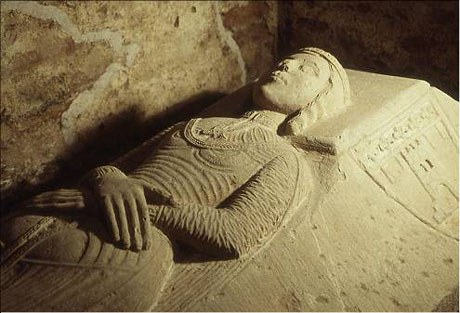 |
The other sarcophagus is of white stone. Bertran de la Farge who saw it in 2004 noted that a cross of Toulouse is engraved on the wall nearby. The barely legible inscription on a plaque in Occitan says: "... Raymond of Toulouse ...". At the time of its discovery hopes were high that Raymond's mortal remains would be discovered inside. Here is what Dominique Baudis then mayor of Toulouse said at the time:
"I share the excitement and hope of those who have discovered the tomb that may contain the remains. If this is Raymond VI, then opening the sarcophagus will not merely reveal his mortal remains. It will illuminate a precious asset of which Raymond was the bearer and defender: Freedom of Conscience. It is as if a great humanism lesson, still relevant today, has risen from the depths of the Middle Ages to the surface of the present time. ".
In the light of the known history of Raymond's remains, it seems unlikely that his body would be found inside. Nevertheless, the sarcophagus might well be his.
Despite widespread public interest, the DRAC has decided to clam up on the whole topic. In the great French tradition of executive secrecy the organization created to care for the national patrimony on behalf of the French people have opted to close the site to the public and publish nothing at all about the enfeus, sarcophagi or anything else. French enmity to the Counts of Toulouse and the cultural tradition they represent, might not yet be over.
.jpg)
|
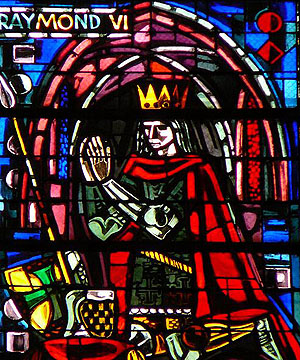 |
|
The Counts
of Toulouse are popular |
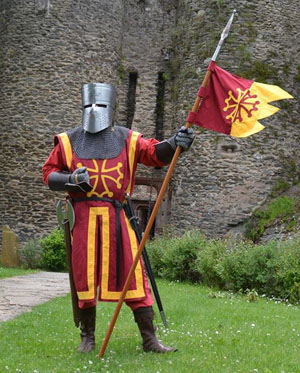 |
|
Raymond of Toulouse (as imagined by Gordon Napier) |
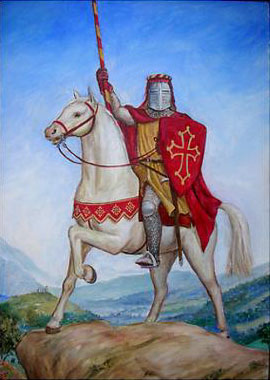 |
|
The Languedoc Cross (from the armourial bearings of the Counts of Toulouse). Offten erroneously referred to as the "Cathar Cross" |
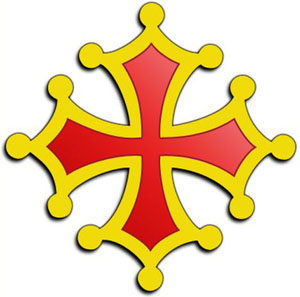 |
|
|
Flags in Béziers |
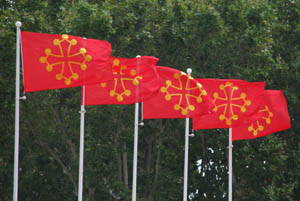 |
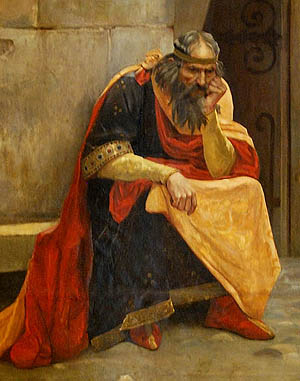 |
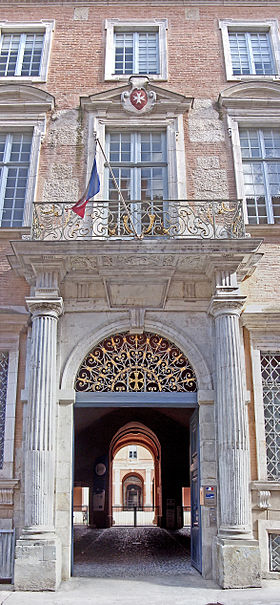 |
|
An SCA reproduction of a Templar cloak |
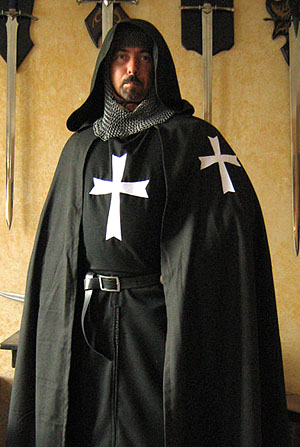 |
|
Hospitallers at Church |
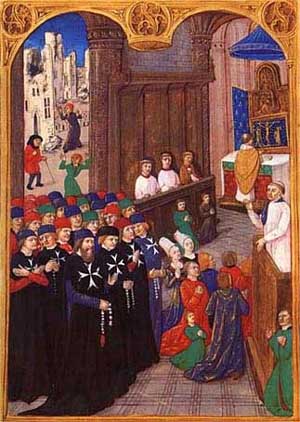 |
|
Hospitaller Cross |
.jpg) |
|
|
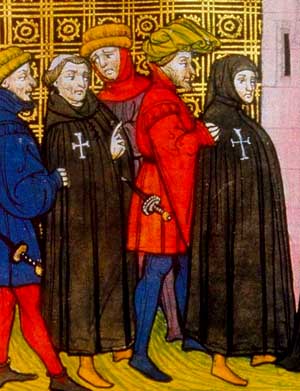 |
|
HRH Prince Richard Duke of Gloucester. |
 |
| Enfeu with sarcophagi in the Hôtel de Saint John in Toulouse. |
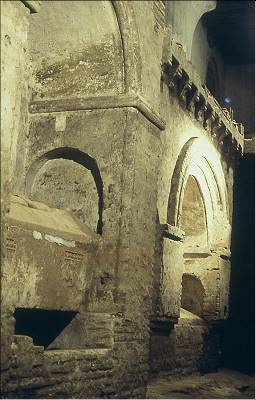 |
| Enfeu with sarcophagi containing the remains of earlier Counts of Toulouse.at Saint Sernin |
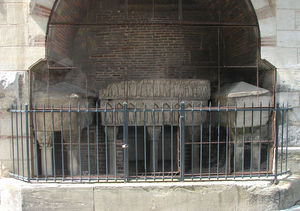 |
Who's Who In The Cathar War: Raymond VII of Toulouse Ramon
VII de Tolosa: Raimond
VII de Toulouse
Raymond of St-Gilles (1197-1249),
Count of Toulouse (1222-1249)
... also Duke of Narbonne, Count of Quercy, Rouergue and Saint-Gilles; Count of Agen (Aquitaine); Marquis of Provence (Holy Roman Empire) Count of Melgueil (Papacy).
When Raymond VI died excommunicated in 1222, he had already abdicated in favour of his son, Raymond VII, nicknamed Raymondet, in order that his lands should not be forfeit. He had died believing that his family's territories were safe.
Raymond VII was a better military leader than his father, and had assisted him in the reconquest of his estates. At the age of eighteen he successfully besieged the town of Beaucaire and then held it for several months against Simon de Montfort, his Crusader brother Guy de Montfort, his son Amaury de Montfort, and a French Catholic army, before the besiegers gave up, came to terms and left.
The wars continued into another generation, Raymond VII fighting against Amaury de Montfort, son of his Raymond VI's enemy, Simon de Montfort. While Raymond VII was a better warrior than his father, Amaury could not match the prowess of his father Simon. In military terms, it looked as though the Albigensian Crusade had failed. In January, 1224, Amaury de Montfort, reduced to the sovereignty of Narbonne, concluded a treaty with Raymond, ceding his rights in the Languedoc to the King of France.
In 1226 a new Royal Crusade was launched. Louis VIII, King of France, seized Avignon and occupied the Languedoc without resistance. On his return to France he died on 8th November 1226, at Montpensier. Raymond VII, took several fortified places from Louis' seneschal (Imbert de Beaujeubut) but in 1228 new bands of crusaders began to plunder the country of Toulouse.
Raymond sought peace from the regent of France, Blanche of Castile, wife of the old king and mother of the new king. As part of the peace, under the Treaty of Meaux (also called the Treaty of Paris), Raymond was obliged to demolish the walls of Toulouse, to allow the establishment of the Inquisition, and to give his daughter Jeanne of Toulouse in marriage to Alphonse of Potiers, brother of King Louis IX of France. Afterwards, Raymond returned to Paris. On 12 April, 1229 was obliged to do public penance at Notre Dame and to publicly undertake to start persecuting the Jews of the Languedoc, after which he was released from his excommunication.
Divorces (technically annulments) were routinely given to powerful noblemen at the time. Any friend of the papacy, or anyone powerful enough to cause trouble, could expect a divorce on request. Raymond did not now fall into this category. By denying him a divorce, the new Pope ensured that there would be no male inheritor in the Saint-Gilles family.
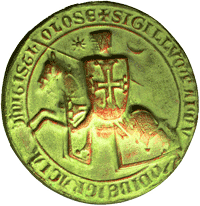 Raymond
had one last hope of popular uprising in the Languedoc against the
French occupiers and the Inquisition.
It was planned for 1242, supported by the Holy Roman Emperor (Raymond's
suzerain for Provence), Jaume I of Aragon, Henry
III, King of England, Hugues de Lusignan Count of La Marche,
Roger
IV, Count of Foix, Viscount Trencavel, and other allies.
It proved a disaster. The Holy Roman Emperor kept delaying
until it was too late. Henry III was defeated at Taillebourg
(an event mysteriously omitted from many English history books).
The Aragonese forces were not enough to galvanise the exhausted
population, and the new Count of Foix deserted his family's ancient
ally, sealing both their fates. The only achievement of note
was the killing of a few Inquisitors at Avignonet,
which prompted the final notable action of the war - the famous
siege of the Château of Montségur
(
Montsegùr)
, in 1243-4.
Raymond
had one last hope of popular uprising in the Languedoc against the
French occupiers and the Inquisition.
It was planned for 1242, supported by the Holy Roman Emperor (Raymond's
suzerain for Provence), Jaume I of Aragon, Henry
III, King of England, Hugues de Lusignan Count of La Marche,
Roger
IV, Count of Foix, Viscount Trencavel, and other allies.
It proved a disaster. The Holy Roman Emperor kept delaying
until it was too late. Henry III was defeated at Taillebourg
(an event mysteriously omitted from many English history books).
The Aragonese forces were not enough to galvanise the exhausted
population, and the new Count of Foix deserted his family's ancient
ally, sealing both their fates. The only achievement of note
was the killing of a few Inquisitors at Avignonet,
which prompted the final notable action of the war - the famous
siege of the Château of Montségur
(
Montsegùr)
, in 1243-4.
|
In 1247, as Raymond was starting out for Palestine on Crusade to the Holy Land with Louis IX, King of France, he died. He was buried in Fontevraud Abbey along with his Plantagenate relatives (his mother Jeanne of England, his uncle Richard I of England, and his maternal grandparents Henry II and Eleanor of Aquitaine). As his enemies had planned, Saint-Gilles lands passed to his sister Jeanne of Toulouse and her husband, Alphonse de Poitiers brother of King Louis. When Jeanne and Alphonse died without an heir, the The County of Toulouse passed to the French Crown. The disaster was total. It marked the end of all hope of expelling the French from Aquitaine or the Languedoc, the loss of Provence, the end of Aragonese influence north of the Pyrenees to balance the French influence, the loss of all hope for the Trencavel family as for countless other nobles deprived of their lands, and the irrevocable weakening of the county of Foix, which today is also part of France. |
|
Click on the following link for more on the
House of Toulouse
Click on the following link for more on Counts
of Toulouse
Click on the following link for more on Raymond
VII of Toulouse
Click on the following link for more about the
arms of fighters in the Cathar Wars
Click on the following link for more on the
Seal of Raymond VII Count of Toulouse
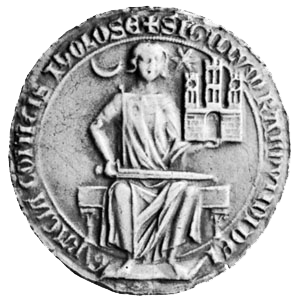 |
|
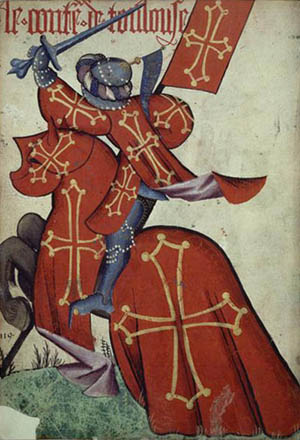 |
|
Raymond
VII, Count
of Toulouse being flogged in Paris |
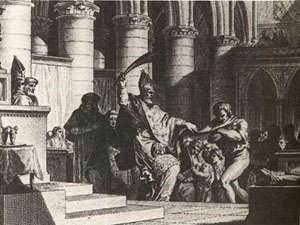 |
|
Raymond
VII, Count
of Toulouse |
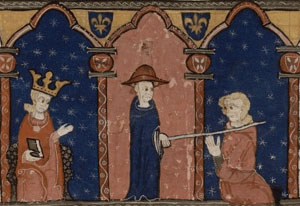 |
 |
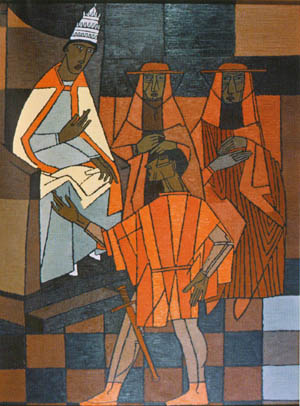 |
Raymond-Roger Trencavel (1184-1209),
Viscount of Carcassonne, Béziers, Albi and the Razès
(1194-1209)
(
Ramon-Roger Trencavel,
Raimond-Roger
de Trencavel)
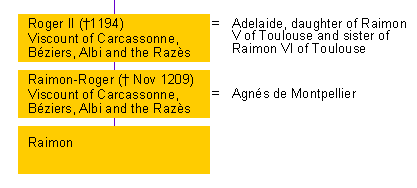
 It
was Raymond-Roger Trencavel, Viscount of Béziers
and Carcassonne,
who faced the full force of the first crusade.
It
was Raymond-Roger Trencavel, Viscount of Béziers
and Carcassonne,
who faced the full force of the first crusade.
Ramon VI of Toulouse had proposed an alliance with Raymond-Roger, his nephew, and when the offer was rejected he offered his submission to the Crusaders and joined the Crusade.
Aware that the Crusaders were on the way, Raymond-Roger reconsidered his position and joined them en route to offer his submission too, but it was rejected. (If he joined them as well, his lands would be protected and there would be no-where for the Crusaders to destroy and pillage - which is why Arnaud Amaury rejected the offer.) Raymond-Roger returned to Carcassonne, ordering Béziers to prepare for action on his way. He sent all Jews away to safety, knowing that the Catholic army would kill them if they ever got hold of them. This was a precaution as no-one expected Béziers to fall, and certainly not for a long time.
Everyone had known that the Jews would have been slaughtered if the town fell, but not that the Crusaders would massacre everybody they found, Catholics included, if they took the town, as they did on 22nd of July 1208. Still under the command of their leader Arnaud Amaury, Abbot of Cîteaux, appointed by Pope Innocent III, the Crusaders now turned towards Carcassonne.
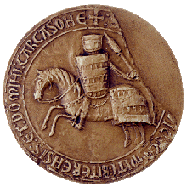
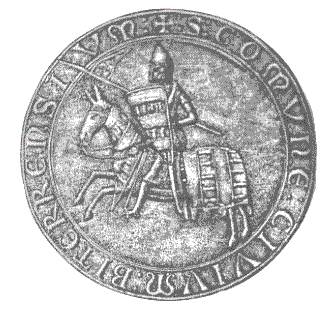 From 1st to 15th of August Carcassonne
was besieged. Raymond-Roger Trencavel was seized during
a truce. Without their commander the inhabitants surrendered.
The Crusaders expelled the inhabitants with a day's safe conduct,
so that they could loot at leisure.
From 1st to 15th of August Carcassonne
was besieged. Raymond-Roger Trencavel was seized during
a truce. Without their commander the inhabitants surrendered.
The Crusaders expelled the inhabitants with a day's safe conduct,
so that they could loot at leisure.
Raymond-Roger was imprisoned in his own cachette. Peter II of Aragon of Aragon, his suzerain, could not help him and left the Crusaders bitter and disappointed. It was at this stage that Simon de Montfort was appointed to hold Raymond-Roger's territories, and so took over leadership of the Crusaders who stayed.
Raymond-Roger Trencavel, Viscount of Carcassonne, Béziers, Albi and the Razès died in mysterious circumstances in his own prison on 10th of November 1208, a few weeks after his capture. He was aged just 24.
He left an infant son, Raymond II, who became the ward of Raymond Roger Count of Foix. He later sought exile in Aragon, returning during the course of the later Cathar Wars in a failed attempt to reclaim his rightful lands and titles
Click on the following link for more about Raymond
Trencavel II
Click on the following link for more about the
House of Trencavel
Click on the following link for more about the
arms of fighters in the Cathar Wars
Click on the following link for more on Peter
II King of Aragon
Click on the following link to learn more about Raymond
VI Count of Toulouse
Click on the following link to learn more about the
House of Toulouse
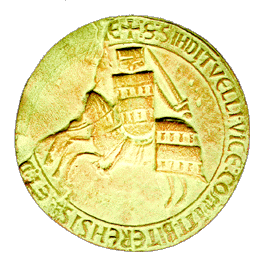 |
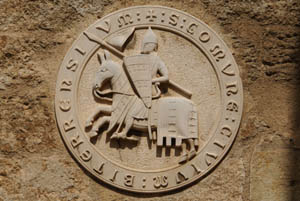 |
|
|
Cité of Carcassonne |
|
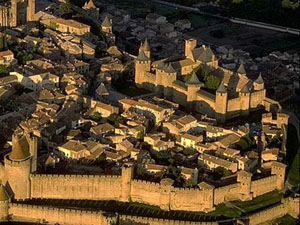 |
|
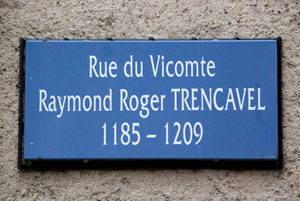 |
|
|
|
|
Carcassonne - Château Comtal |
|
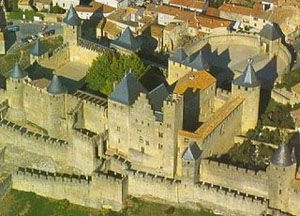 |
|
Raymond Trencavel II (1204-1263),
Viscount of Carcassonne, Béziers, Albi and the Razès
( Ramon
Trencavel II,
Raimond
de Trencavel II)
At the time of the suspicious death of his twenty-four year old father, Raimond Trencavel was still an infant. Although he was not guilty of heresy or anything else he was deprived of his patrimony and contrary to all feudal law his titles and lands were awarded to Simon de Montfort.
|
Raymond sought exile in Aragon, returning during the course of the later Cathar Wars in attempts to reclaim his rightful lands and titles. The most notable attempt occurred in 1240. he led a revolt with his loyal vassals, fellow faidits, Catalan and Aragonese troops, and fellow Occitan nobles in liberating Limoux, Alet, Montreal, and other towns. Then he tackled his late father's strongest fortress, Carcassonne, now in the hands of the French invaders. On 17th September 1240 an offensive was launched reinforced with mines and catapults with the support of the inhabitants of the Carcassonne suburbs of Saint-Michel and Saint-Vincent. The defense led by Guillaume des Ormes leading Louis IX's royal troops, drove Raymond back on October 12. The offensive had failed after a month. Raymond was then himself besieged at Montreal. Raymond VII of Toulouse stayed neutral and mediated a truce under which his cousin Raymond Trencavel returned to Aragon. Towns that had supported their dispossessed lord were treated with the customary brutality.
Raymond was forced to renounce his rights to his four Viscounties in 1246. A year later he smashed his seal as a sign of submission to Louis IX, the King of France. Breaking a ruler's seal was something that normally happened only on the death of its owner. Raymond's vassals, like the Lord of Termes, were released from their feudal allegiance and the family of Trencavel was destined to disappear from history, another victim of the rapacious aggression of the French Catholic crusaders.
Click on the following link for more about Raymond-Roger
Trencavel
Click on the following link for more about the
House of Trencavel
Click on the following link for more about the
arms of fighters in the Cathar Wars
Click on the following link for more on Peter
II King of Aragon
Click on the following link to learn more about Raymond
VI Count of Toulouse
Click on the following link to learn more about the
House of Toulouse
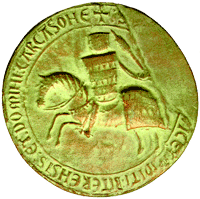 |
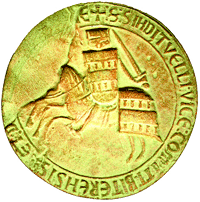 |
|
|
|
||
|
||
| Various possible interpretations of the Trencavel Coat of Arms |
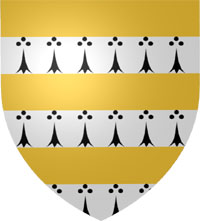 |
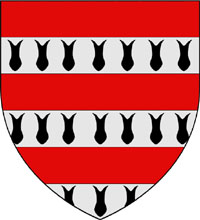 |
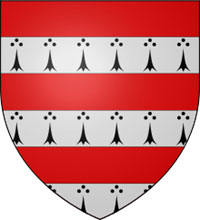 |
|
Barbican, Aude Gate, Carcassonne |
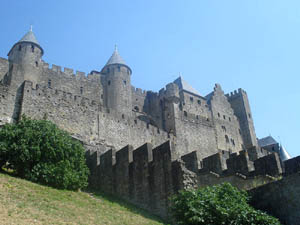 |
|
Béziers where the Abbot-Comander Arnaud Amaury reported killing 20,000 without regard to age, sex or rank. |
|
|
|
Tom Felton in the role of Trencavel . TV adaptation of the novel Labyrinth by Kate Mosse . Directed in 2012 |
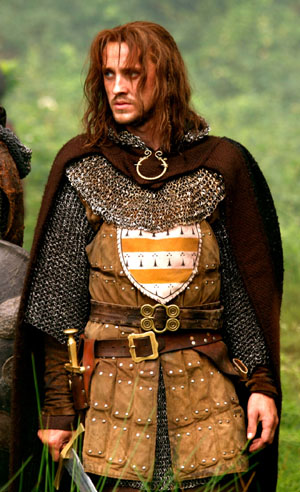 |
|
Road sign in Béziers |
 |
|
Raimond Trencavel, vicomte of Carcassonne
in 1240. The arms are represented as "fascé de gueules et d’argent chargé de ravelles noires" red and white bars, the red ones charged with black radishes, a pun on "trenca ravel" - sliced radished. |
 |
The Counts of Foix.
Raymond Roger (1152 - 3rd April 1223),
Count of Foix (1188-1223)
(
Ramon Roger, Coms de Fois, [or Foish or Foig]).
Raymond-roger was the son of Roger-Bernard of Foix and Cécile Trencavel. He married Philippa de Moncade in 1189. They had three children: Esther, Roger-Bernard (who succeeded him as Count of Foix) et Cécile.
He accompanied the French king Philippe Augustus on Crusade to the Holy Land in 1191 and was present at the siege of Ascalon and at the fall of Saint-Jean-d'Acre. He returned when Philippe Augustus abandoned the Crusade, miffed at the superior generalship of his fellow monarch Richard Cœur de Lion, King Richard I, The Lionheart.
Raymond-roger increased his family domains in the foothills of the Pyrenees. He took the high Urgell and the Cerdagne with a view to retaking Andorra. With Arnaud de Castelbon he found himself fighting the combined forces of Count Ermengol VIII of Urgell and Bernard de Villemur, the Bishop of Urgell. Both Raymond-Roger and Arnaud were captured and imprisoned from February to September 1203. King Peter II of Aragon intervened to secure their release, and awarded the Raymond-Roger various Catalan seigneuries in 1208 followed by the the castles of Usson and Quérigut in 1209.
Raymond Roger was one of the most impressive personalities of the Cathar Crusade, indeed of all European history. He was a close relative of Raymond VI, Count of Toulouse and a staunch ally. He was famed for his military prowess as much as for his chivalry, loyalty and attachment to paratge. He was not merely a patron of the troubadours, but a formidable poet himself.
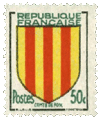 From
the taking of Carcassonne
in 1209 when Simon
de Montfort emerged as the military leader of the Crusade, Raymond-Roger
aligned himself with Raymond
VI of Toulouse. He started by retaking Preixan. Two years later
he was victorious at the battle of Montgey. His own castle at Foix
was besieged four times. In 1214 he was obliged to submit and his
castle was handed over to the papal legate who allowed Simon de
Montfort to occupy it. Raymond-Roger supported the uprising led
by Count Raymond VII of Toulouse and took part in the defence of
Toulouse in 1217 during with Simon de Montfort was killed. Soon
aferwards, in 1208, he was able to regain his own castle at Foix.
From
the taking of Carcassonne
in 1209 when Simon
de Montfort emerged as the military leader of the Crusade, Raymond-Roger
aligned himself with Raymond
VI of Toulouse. He started by retaking Preixan. Two years later
he was victorious at the battle of Montgey. His own castle at Foix
was besieged four times. In 1214 he was obliged to submit and his
castle was handed over to the papal legate who allowed Simon de
Montfort to occupy it. Raymond-Roger supported the uprising led
by Count Raymond VII of Toulouse and took part in the defence of
Toulouse in 1217 during with Simon de Montfort was killed. Soon
aferwards, in 1208, he was able to regain his own castle at Foix.
It is not provable that he was a Cathar believer himself, but his close relatives certainly were. His wife, Philippa of Foix, became a Parfaite. His sister, Esclaremonde of Foix, was perhaps the most famous Parfaite.
The Count was a great orator, and attended the Fourth Lateran Council of 1215 to defend Raymond of Toulouse before Innocent III and his Council. When he himself was accused of having murdered priests, he did not trouble to deny it, and told Innocent to his face that in the circumstances he regretted not having killed more of them. Not perhaps a good example of his diplomatic skills, but a very good one of his confidence, standing and courage.
By the time of his death in 1223, the count had regained all of his terittories with the exception of Mirepoix. Characteristically, he died while besieging it
Roger Bernard II, Count of Foix (1223-1241). Surnamed "the Great", Roger Bernard was another charismatic leader, man of culture, and protecter of his people, a loyal ally of Raymond VII of Toulouse. His wife, Ermessinde de Castelbon, was a Cathar Believer .
Roger IV, Count of Foix (1241-1265). Roger initially aligned himself with Raymond VII of Toulouse, but abandoned the alliance after the final failed uprising against the French in 1242.
Foix For an aside about the link between the Counts of Foix and
Andorra, and how a later Count acquired the throne of France, click
here
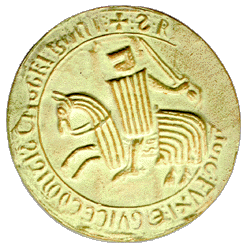
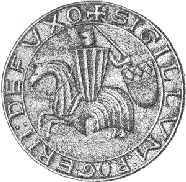
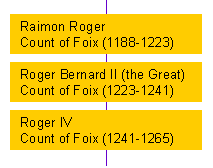 |
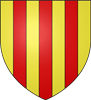 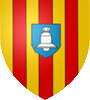 |
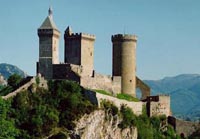 |
.jpg) |
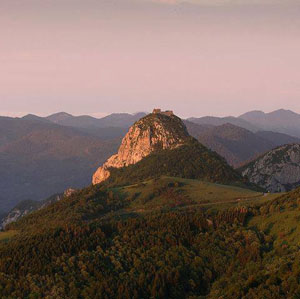 |
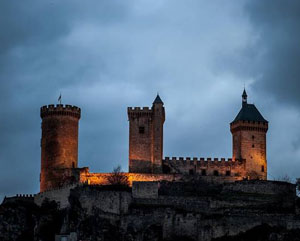 |
Esclarmonde de Foix (c 1151 - 1215)
Esclarmonde was born sometime after 1151. Her name means " Light of the World " in Occitan. She was nicknamed "The Great Esclarmonde" (La grande Esclarmonde).
She was the daughter of Roger Bernard I, Count of Foix and Cécile Trencavel. She was therefore sister to Raymond-Roger Count of Foix. She married Jourdain de l'Isle-Jourdain, Seigneur de l'Isle-Jourdain. Their children included Bernard who later inherited the County of Foix, Guillaumette, Olive, Othon de Terride and Bertrand, Baron de Launac.
She was widowed in October 1200, and from this time turned openly to the Cathar Church. In 1204 she received the Consolamentum from the hands of the Cathar Bishop Guilhabert de Castres, so becoming a Parfaite, a member of the Cathar Elect. The ceremony, at which three other great noblewomen (Aude de Fanjeaux, Faye de Durfort, and Raymonde de Saint-Germain) also received the Consolamentum, took place at Fanjeaux in the presence of her brother Raymond-Roger Count of Foix. From this time on she would become a champion of the Cathar faith.
She took up residence in Pamiers and it is thought that she was
responsible for the decision to refortify the Castle at Montségur
(
Montsegùr)
in preparation for the likely assaults by the French Catholic Crusaders.
In 1207 she took part in (and probably organised) the Colloquy of
Pamiers (also called the Colloquy of Montreal) the last public debate
between the Cathars and the Roman Catholic Church whose representatives
were led by Dominic
Guzman (St-Dominic). It was at this debate that Esclarmonde
famously tried to speak, only to be admonished by a representative
of the Roman Church: "go to your spinning madam. It is not
proper for you to speak in a debate of this sort". The churchman's
faux pas, as obvious to an educated Occitan auience as it is to
most people today, was not at all obvious to Dominic
Guzman . and his supporters. The Catholic church's treatment
of such a prestigious figure as Esclarmonde could only have had
the opposite effect to that intended, yet up until the twenty first
century the Church never seems to have grasped why their representatives
lost in these debates so comprehensively or so consistently.
The following year, 1208, despairing of success through peaceful means, Innocent III would launch the Albigensian Crusade.
Esclarmonde de Foix and her sister-in-law Philippa jointly ran a House for Parfaites at Dun in the Pyrénées,. A sort of prototype convent, it functioned as a school for the education of girls and as a sort of retirement home for aged Parfaites.
Esclarmonde is credited with opening a number of hospitals, schools and Cathar convents - something the Roman Church had not done previously, but started to do later as part of its concerted hearts and minds campaign. Dominic Guzman's first Dominican friary can still be seen at Prouille, within sight of Fanjeaux in the Languedoc.
|
One of the many modern images reflecting
a mythical |
 |
Esclarmonde of Foix has become become something of a role model for feminists, and her name - almost forgotten for seven hundred years - is becoming ever more popular. A quick web search will reveal a range of sites from Esclarmonde de Foix fan clubs to an "Esclarmonde de Foix Memorial Travel Scholarship" at the University of Winnipeg. According to at least one Gnostic Church she was an Cathar Archdeaconess in life and is now a saint.
|
|
|
|
|
Esclarmonde of Foix effigy - Mallorca - Spain |
 |
Peter II, King of Aragon - Pere el Catòlic.
Peter II, (1174-1213) was King of Aragón (1196-1213) and count of Barcelona (as Pere I), son and successor of Alfonso II. He was surnamed the Catholic.
His parents were Alfonso II of Aragon and Sancha of Castile. He was crowned (1204) at St Pancrace's Church in Rome by Pope Innocent III , and accepted the pope as overlord of Aragón and Catalonia. He acknowledged the feudal supremacy of the Papacy - in line with Innocent III's largely successful attempts to establish himself at the apex of the feudal system. He was crowned in Rome by Innocent, swearing to defend the Catholic faith (hence his surname, "the Catholic").
On June 15, 1204 he married Marie of Montpellier, daughter and heiress of William VIII of Montpellier by Eudocia Comnena. Peter was her third husband. Together they had a short-lived daughter Sancha (1205-1206); and a son, James. Later, Peter discarded her. She died in Rome in 1218 and was buried in St Peter's Basilica.
In 1212 Peter he helped Alfonso VIII of Castile to defeat the Moors at Las Navas de Tolosa. This battle was the turning point in the history of Medieval Iberia. The forces of King Alfonso VIII of Castile were joined by the armies of his rivals, Peter II of Aragon and Alfonso II of Portugal to fight the Muslim Almohad rulers of the southern half of the Iberian Peninsula. Caliph al-Nasir led the Almohad army. The defeat of the Almohads signaled the beginning of a long decline in the power of the Moors in the Peninsula.
Following his performance against the Moors, Peter II was the most famous and respected crusader of the period. He had driven the Moslems from much of Spain, and won plaudits from the Papacy for his leadership. But Peter's problems had already started when the crusaders purported to replace Raymond-Roger Tranceval as Viscount of Carcassonne and Béziers in 1209. How could they do this? Feudal law was absolutely clear that it was for Peter as suzerain, to appoint, confirm and dispossess his own vassals - but now Innocent had a legal claim to be Peter's suzerain. Even the Northern Lords were uneasy about this precedent. As they clearly saw, if Innocent III got away with this then neither they nor any sovereign in Christendom would be safe.
Peter returned from Las Navas in the autumn of 1212 to find that in the course of the Cathar Crusade. Simon de Montfort had conquered Toulouse, exiling Raymond VI Count of Toulouse, Peter's vassal and brother-in-law. Peter crossed the Pyrenees and arrived at Muret in September 1213 to confront de Montfort's army. He was accompanied by Raymond of Toulouse, who gave Peter excellent counsel, to avoid battle and instead to starve out Montfort's forces. This suggestion was rejected as unknightly. Peter fought at the subsequent battle of Muret in 1213, but was killed during a needless show of bravado. (He was fighting in disguise - a common ploy for kings at the time and not apparently regarded as unknightly. A lowly vassal armed as the King of Aragon attracted the scorn of the Crusaders and Peter, unable to contain himself, shouted out something to effect of "here I am, come and get me".) He died, as brave as he was foolish at the hands of two French Crusader knights.
The death of the most famous Crusader in Europe, a King, surnamed
the "Catholic", fighting against brother crusaders, shook
both armies and indeed left the whole of Christendom horrified and
bewildered. Though no-one realised at the time, his
death marked the beginning of the end of Aragonese hegemony north
of the Pyrenees.
He is buried in the Convent of Sigena at Vilanueva de Sigena. He was succeed by his son Jaume El Conqueridor (Jaime I or, in English, James I, the Conqueror).
Click on the following link for more about Aragon
and Catalonia
Click on the following link for more about the
arms of Aragon
Click on the following link for more about the
arms of fighters in the Cathar Wars
Click on the following link for more about the
relationship between the Houses of Aragon and Toulouse
|
Peter II, King of Aragon |
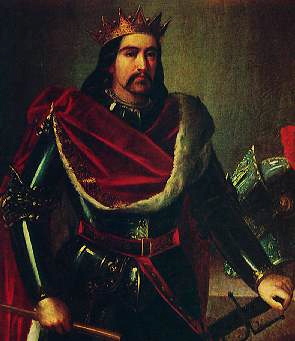 |
|
Coat of arms of the King of Aragon |
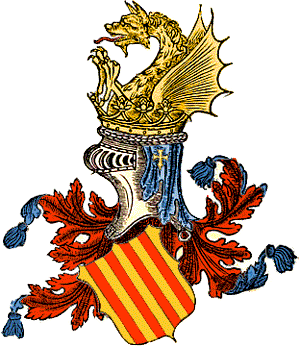
|
|
King of Aragon wearing his Coat of arms |
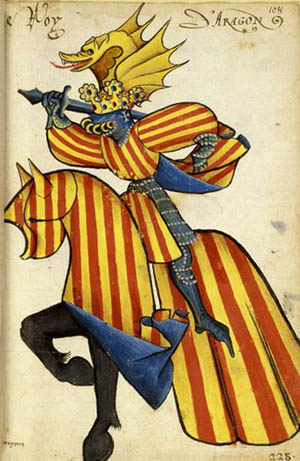 |
 |
Savaric (Savory) de Mauléon and others
 Savaric de Mauléon (
Mauléoun, Basque Maule) (1181-1233) Vassel of King
John of England (as suzerain of the Aquitaine). Baron of Poitou.
Seneschal of Saintonge, Seigneur of Châtellaillon, Talmond, Benon,
Angoulême, la Flotte en Ré and Fontenay. He was also a celebrated
Troubadour.
He is recorded as having written a poem to Eleanor, Countess of
Toulouse, undertaking to support her with 500 knights against the
invaders of her domains.
Savaric de Mauléon (
Mauléoun, Basque Maule) (1181-1233) Vassel of King
John of England (as suzerain of the Aquitaine). Baron of Poitou.
Seneschal of Saintonge, Seigneur of Châtellaillon, Talmond, Benon,
Angoulême, la Flotte en Ré and Fontenay. He was also a celebrated
Troubadour.
He is recorded as having written a poem to Eleanor, Countess of
Toulouse, undertaking to support her with 500 knights against the
invaders of her domains.
As brother-in-law of Raymond VI, Count of Toulouse, King John of England was a natural ally, particularly since John's mother Eleanor of Aquitaine had divorced the King of France and married the King of England, taking her dowery, the Aquitaine, with her. It is not surprising therefore that John's Seneschal, Savaric de Mauléon should come to fight alongside Raymond of Toulouse. He is mentioned several times in the Song of the Crusade. [61, 86, 87, 89, 93, 103, 123]. One source, the anonymouse History of the Dukes of Normandy and Kings of England, suggests that it was on John's initiative that Savaric became involved.
Niort in the Aquitaine was defended against the French by Savary on behalf of John in 1205. Savary had been a prisoner taken at Mirebeau and subsequently sworn an oath of fealty to the King of England. From thenceforth he proved a wise and valuable ally. It was Savary de Mauléon who stayed the hand of King John when he planned to execute the defenders of Rochester after their eventual surrender in November 1214.
All records except one portray Savaric as a most noble knight. The One exception is the Historia Albigensis which consistently bases its character assessments on how much the person in question supports the Crusade. Here is my favourite example from the whole of the Historia Albigensis [254]:
With our enemies came that most depraved apostate, that iniquitous transgressor, son of the Devil, servant of the Antichrist, Savary de Mauleon; more evil than any heretic, worse than any infidel, assailant of the Church, the enemy of Christ. O most corrupt of of mortals - or should I say himself a mortal infection - I speak of Savary, who, villain unredeemed, shameless and senseless, rushed head first against God and dared to assault the Holy Church of God! Prime mover of heresy, architect of cruelty, agent of perversity, comrade of sinners, accomplice of the perverted, a disgace to mankind, a man unacquainted with manly virtues, devilish - himself the devil incarnate.
This traslates as "Savaric was a strong ally of the Count of Toulouse". Actually, if the author of the Historia Albigensis had known more about Savaric, he might have been less strident. For example when Savaric was not rewarded financially for his contribution to the campaign at Castelnaudry in 1211 he went off with the son of Raymond VI, Count of Toulouse (the future Raymond VII) and held him hostage until a ransom was paid. Later, in 1219 Savaric would go crusading in the Holy land, and would later fight alongsideLouis VIII in his murderous campaign against Raymond VII in 1226.
A branch of his family still lives in the Languedoc.
Click on the following link for more about the
coat of arms of Savaric (Savory) de Mauléon and other fighters
in the Cathar Wars
Bernard,
Count of Commynges and Couserans (1181-1225) Vassal
and loyal ally of the Counts
of Toulouse, 1st Cousin to Ramon VI.
Click on the following link for more about the
coat of arms of the Count of Comminges and other fighters in the
Cathar Wars

|
The Viscount of Béarn Vassal and loyal ally of the Counts of Toulouse.
Click on the following link for more about the
coat of arms of the Viscount of Béarn and other fighters
in the Cathar Wars

|
Guilhem Belibaste
(
Guilhèm Belibasta,
Guillaume Bélibaste) (c 1280 - 1323)
Guilhem Belibaste the last known Cathar Parfait in the Languedoc. He lived almost a century after the start of the Cathar Wars.
 He
lead an extraordinary life for anyone of the period, let alone
a Cathar
Parfait.
He was the son of another Guilhem Bélibaste, a rich farmer
from Cubières, now in the Aude
departement of the Languedoc-Roussillon. His family are known
to have held Cathar sympathies.
He
lead an extraordinary life for anyone of the period, let alone
a Cathar
Parfait.
He was the son of another Guilhem Bélibaste, a rich farmer
from Cubières, now in the Aude
departement of the Languedoc-Roussillon. His family are known
to have held Cathar sympathies.
After killing a shepherd he fled Cubières and became a shepherd himself. At some stage he adopted Cathar beliefs. He was the pupil of Pierre and Jacques Authié who had recently re-introduced the Cathar faith to the Sabarthes area on what is now the French side of the Pyrenees. He eventually took the Consolamentum and became a Parfait.
He settled in Catalonia at Sant Mateu and Morella - an area under the control of the King of Aragon, and beyond the reach of the Papal Inquisition then established in the French controlled territories. Like other Parfaits he worked for a living, in his case making baskets and carding combs. He was also mentor and pastor to a local community of Cathars, some of whom had fled persecution in the Languedoc. Members of this community travelled regularly between the two regions, including Pierre Maury, a native of Montaillou.
In violation of the celibacy demanded of the Cathar elect, Bélibaste enjoyed sexual relations with at least one woman. According to Cathar belief, this act nulified the effects of the Consolamentum so from that point onwards he was no longer a Parfait.
In 1313 Belibaste's lover, Raymonde Piquier, became pregnant, Bélibaste persuaded Pierre Maury to marry her to provide cover for his relationship with her, making it appear the child was Maury's. A few days later, he dissolved the marriage (another odd thing for a Cathar Parfait to do), apparently stricken by jealousy.
After a sting operation initiated Jacques Fournier, the Inquisitor Bishop of Pamiers, in which he was induced to return to territory controlled by the Inquisition, he was captured and condemned to death. His last night on earth went some way to restoring his tarnished reputation, since he spent it trying to help the friend who had betrayed him. He was burned at the stake in 1323, in Villerouge Termenès, the property of the Archbishop of Narbonne.
Much of Bélibaste's biography can be found in the pages of Emmanuel Le Roy Ladurie's book Montaillou. Bélibaste is frequently mentioned in the interrogations of suspected Cathar sympathisers from Montaillou.
Bélibast is sometimes used as an example to illustrate Cathar ideas and practices, but there are just too many oddities in his life for him to used as an examplar. After taking the Consolamentum he is known to have lied and had sex. He contemplated suicide knowing that his Consolamentum had been invalidated. His theology was not sophisticated and probably best explained by aspects of Cathar theology being abondoned or neglected as the faith was persecuted into oblivion - though Belibaste seems to have been well aware that his behaviour had nullified his status at a Parfait. Despite this, like a long line of more orthodox Parfaits before him, he went to the stake with a dignity and fortitude that any martyr would envy.
Below are a couple of recent works in French concerning Belibaste, with English translations and notes.
|
Bélibaste, l’imparfait cathare (Version longue du texte rédigé pour l’article " Bélibaste, l’imparfait ", paru dans Pays Cathare magazine, hors-série n° 1, décembre 1997, pp. 70-71.) |
Bélibaste, The Imperfect Cathar (from "Bélibaste, l’imparfait", which appeared in the Pays Cathare magazine, hors-série n° 1, December 1997, pp. 70-71.) | |
|
Le dernier et le plus célèbre des parfaits cathares occitans nous a laissé l’exposé le plus complet qu’on ait sur la doctrine des cathares. Pourtant, il fut sans doute l’un des plus médiocres pasteurs de l’église des " Bons chrétiens ". |
Not everyone would accept that this is the most complete surviving account of Cathar doctrine (nor the most reliable) but it certainly throws an interesting light on the supposed mechanics of reincarnation. |
The last and most celebrated Cathar in Occitania has left us the most complete account that we have on Cathar doctrine. However he was, without doubt, one of the most mediocre pastors of the Church of the Good Christians. |
|
Un criminel devenu parfait Guilhem Bélibaste naît vers 1280 à Cubières, un village du Razès (Aude). Sa famille, des paysans aisés, est totalement acquise au catharisme. A Cubières, les Bélibaste reçoivent de nombreux parfaits de marque comme Pierre Autier et Philippe d’Alayrac. Les frères de Guilhem, bergers, accompagnent même fréquemment certains de ces parfaits dans leurs tournées clandestines. En effet, malgré les efforts de l’église catholique depuis presque un siècle pour éliminer l’hérésie cathare, celle-ci est encore bien vivace et se développe même à nouveau en Ariège et en Razès grâce à la prédication des frères Autier. |
A Criminal who became a Parfait Guilhem Bélibaste was born around 1280 at Cubières, a village in the County of Razès (now in the Aude). His family of yeoman farmers, was totally given over to the Cathar faith. At Cubières, the Bélibaste family received numerous notable Parfaits such as Pierre Autier and Philippe d’Alayrac. Guilhem's brother, who were shepherds, frequently accompanied some of these Parfaits on their clandestine journeys. despite the efforts of the Catholic Church over almost a century to eliminate the the Cathar heresy, it was still in good health, and was growing again in the Ariège an in the Razès, because of the preaching of the Autier brothers. |
|
|
Malgré ces antécédents familiaux, ce n’est pas par vocation que Guilhem Bélibaste entre dans les ordres, mais un peu par hasard. Vers 1305-1306 au cours d’une rixe il tue un berger de Villerouge-Termenès (Voir plus loin). Une procédure judiciaire est lancée contre lui. L’archevêque de Narbonne, seigneur de Villerouge et de Cubières le reconnaît coupable et confisque ses biens. Pour sauver sa peau, Bélibaste abandonne sa femme, son fils, et rentre dans la clandestinité auprès des parfaits cathares. Pour sauver son âme et par pénitence, il doit rentrer dans les ordres. Il est initié et ordonné parfait à Rabastens (Tarn) par Philippe d’Alayrac. Mais les deux compagnons sont arrêtés et enfermés dans la sinistre prison de l’Inquisition de Carcassonne : le Mur. Ils parviennent cependant en 1309 à s’en échapper et se réfugient en Catalogne dans le comté d’Ampurias. Quand Philippe d’Alayrac retourne dans le royaume de France exercer son ministère, Bélibaste, moins courageux, préfère ne pas l’accompagner. Bien lui en prend car peu de temps après, il apprend l’arrestation et la mort sur le bûcher de son ancien compagnon. |
From the Inventaire des archives de l’archevêché de Narbonne (now in the bibliothèque de Narbonne.) the victim has now been identified. He was called Barthélémy Garnier, from Villerouge Termenès.
It was very common at this time for Lords Spiritual to hold temporal lordships. |
Despite his family affiliations, it was not by way of a vocation that Guilhen Belibaste became a Cathar Parfait, but rather by chance. Around 1305-1306 in the course of a fight, he killed a shepherd from Villerouge Termenès (see below). A judicial action was taken against him. The Archbishop of Narbonne, Lord of Villerouge and of Cubières held him guilty and conficated his belongings. To save his skin Bélibaste abandoned his wife and son, and took to the clandestine world of the Cathar Parfaits. To save his soul, and by way of penitance, he had to join the Elect. He was initiated and ordained as a Parfait at Rabastens (now in the Tarn) by Philippe d’Alayrac. But the two companions were arrested and locked-up in the sinister prison of the Inquisition at Carcassonne: "The Wall". However, in 1309 they managed to escape and sought refuge in Catalonia, in the county of Ampurias. When Philippe d’Alayrac came back to the Kingdom of France to exercise his ministry, Bélibaste, less courageous, prefered not to accompanie him. It was a wise choice, because shortly after he learned of the arrest and death at the stake of his erstwhile companion. |
|
Fuyant l’insécurité, il s’éloigne par étapes de la frontière où il risque d’être reconnu et arrêté. Par précaution il change aussi de nom : il se fait appeler Pierre Penchenier, nom inspiré de son nouveau métier, fabricant de peignes de tisserands. Il se loue aussi parfois pour des travaux saisonniers dans les vignes ou travaille comme berger près de Poblet avec son ami Pierre Maury. |
Fearing for his saftey, he distanced himself, in stages, from the fronteer where his risked being recognised and arrested. as a precaution he also changed his name: he had himself called Pierre Penchenier, a name inspired by his new career as maker of carding combs. He also sold his labour for seasonal work in the vinyards and worked as a shepherd near to Poblet with his friend Pierre Maury. |
|
|
L’imparfait cathare de Morella En 1314 il se fixe à Morella, dans le royaume de Valence. En effet, dans le village voisin de San Matéo vit une petite communauté de cathares occitans en exil, pour la plupart originaires de Montaillou (Ariège), et dont il devient le pasteur. Au sein de cette communauté il abuse parfois de son autorité spirituelle, notamment avec son ami Pierre Maury trop généreux : Ce dernier raconte : " Comme nous avions acheté en indivision, Bélibaste et moi, six brebis, dont j’avais entièrement payé le prix (et je lui avait donné en outre cinq sous), l’hérétique voulut emmener avec lui trois brebis sur ces six, disant qu’elles étaient à lui, et que je lui avais donné l’argent de ces brebis et les cinq sous pour l’amour de Dieu. ". Pour donner le change aux catholiques, il fait croire qu’il est marié en vivant avec une veuve, Raimonde Marti, et sa fille. En réalité Raimonde Marti est sa concubine depuis plusieurs années et tombe enceinte en 1320. Pour donner le change cette fois-ci aux cathares, car il a rompu son voeu de chasteté, il la marie à son ami Pierre Maury qui endosse la paternité, puis, jaloux, défait ce mariage. |
Cathars did not believe in marriage, so it is not obvious why Belibaste thought he had the power to perform a marriage ceremony, or to annul one. |
The Imperfect Cathar of Morella In 1314 he moved to Morella, in the Kingdom of Valence. The neighbouring village of San Matéo sheltered a small community of Cathars in exile from Occitania, most of them from Montaillou (in the Ariège), to whom he became their pastor. In the heart of this community he sometimes abused his spiritual authority, notably with his over-generous friend Pierre Maury: This latter recounted: "as we had bought jointly , Bélibaste and me, six sheep, for which I had paid the entire price (and, in addition, given him five shillings), the heretic wanted to take three of the six, saying that they were his, and that I had given him the money for these sheep and the five shillings for the love of God. To mislead the Catholics, he made out that he was married and living with a widow Raimonde Marti, and her daughter. In reality Raimonde Marti had been his mistress for several years, and fell pregnant in 1320. Now, to mislead the Cathars, because he had broken his vow of chastity, he married her to his friend Pierre Maury, who [ostensibly] accepted paternity, then, jealous, annulled the mariage. |
|
Cependant, il prend au sérieux son rôle de pasteur. Il prêche, bénit, administre le consolament (sacrement cathare) aux mourants et reçoit régulièrement des croyants parmi lesquels Arnaud Sicre, dont la mère est morte sur le bûcher. A ce dernier il enseigne à sa manière, naïve, populaire mais imaginative, les croyances de sa religion : " Alors l’ennemi de Dieu, Satan, fit des corps d’homme dans lesquels il enferma ces esprits. (...). Ces esprits, quand ils sortent des tuniques, c’est à dire d’un corps, se sauvent tous nus, apeurés, et ils courent si vite, que si un esprit était sortit d’un corps à Valence et devait entrer dans un autre dans le comté de Foix, et qu’il plût abondamment sur tout le parcours, c’est à peine si trois gouttes de pluies l’atteindraient. Courant ainsi apeurés, il se pose dans le premier trou vide qu’il peut trouver, c’est à dire dans le ventre de tout animal qui porte un embryon encore sans vie : chienne, lapine, jument, ou n’importe autre animal, ou encore dans le ventre d’une femme, de telle sorte cependant que si cet esprit a mal agit dans son premier corps, il s‘incorpore dans le corps d’une bête brute; si au contraire il n’a pas fait de mal, il entre dans le corps d’une femme. Ainsi les esprits s’en vont de tunique en tunique jusqu’à ce qu’ils entrent dans une belle tunique, c’est à dire dans le corps d’une homme ou d’une femme qui a l’entendement du bien (c’est à dire cathare), que dans le corps ils soient sauvés, et qu’après être sortis de cette belle tunique, ils retournent au Père saint ". |
"an embryo as yet without life". Belibaste apparently shared the traditional Catholic view (abandoned by the Vatican late in the nineteenth century) that an embyo aquired life when it aquired a soul - not at conception but some weeks through the embyo's development |
However, he took seriously his role as pastor. He preached, blessed, administered the Consolamentum (Cathar sacrement) to the dying, and regulrly received believers, including Arnaud Sicre, whose mother died at the stake. To this latter [Arnaud Sicre] he taught in his naïve way, populist but imaginitive, the beliefs of his religion: "Then the enemy of God, Satan, made men's bodies in which he trapped these spirits ... These spirits, when they leave their tunics, that is to say their bodies, flee completely naked, terrified, and they run so fast that if a spirit left a body in Valence and had to enter another in the County of Foix [on the other side of the Pyrenees] and if it was raining hard over the whole journey, barely three rain drops would have fallen during that time. Fleeing, thus frightened, it will place itself in the first empty hole that it can find, that is to say in the belly of any animal carrying an embryo as yet without life: bitch, doe, mare, or any other animal, or again in the belly of a woman, in such a way however that if this spirit has behaved badly in its previous body, it will be implanted in the body of a brute beast; if on the other hand it as not behaved badly it will enter the body of a woman. Thus the spirits pass from tunic to tunic, until they enter into beautiful tunic, that is to say into the body of a man or a woman who has the understanding of good (ie a Cathar), in which body it will be saved, and after leaving this beatiful tunic, it will return to the Holy Father. |
|
En réalité Arnaud Sicre, si désireux de "s’ouvrir à l’entendement du bien "n’est là que pour gagner la confiance de Bélibaste, le faire arrêter, et se faire restituer les biens confisqués à sa mère par l’inquisiteur qui l’a envoyé. |
A good example of just one technique developed by Inquisitors |
In reality, Arnaud Sicre, so keen to "open himself to the understanding of Good" was only there to win the confidence of Bélibaste, to have him arrested, and to have the goods confiscated from his mother, restored to him [Sicre] by the Inquisition who had sent him. |
|
Le dernier parfait occitan Bélibaste, qui malgré les entorses à la règle désire rencontrer d’autres parfaits pour se faire réordonner, se laisse convaincre par Arnaud Sicre de revenir en Languedoc. Sur le chemin à Tirvia dans le diocèse d’Urgell, en mars ou avril 1321, Arnaud Sicre le dénonce au bayle du comte de Foix, seigneur du lieu. Arrêté, conduit à Castelbon, il est emprisonné dans la tour du château avec -comme cela est de coutume- son dénonciateur. Pendant la nuit Bélibaste tente vainement de convaincre Arnaud de recevoir le consolament, et de se suicider ensemble du haut de la tour pour entrer directement au ciel. Jugé à Carcassonne, Bélibaste est brûlé la même année dans le château de Villerouge-Termenès, résidence de l’archevêque de Narbonne son seigneur, qui l’avait déjà condamné pour meurtre. Avec Bélibaste disparaît l’église cathare occitane: après sa mort et jusqu’au milieu du XIVe siècle, on ne brûle que de simples croyants. Cependant subsiste une église cathare en Bosnie dont les membres se convertiront à l’Islam à la fin du XVe siècle. Le dernier parfait occitan s’écarta souvent de la règle de vie rigoureuse des parfaits. Il mourut cependant avec dignité, sans abjurer sa foi. Sa mort en martyr milite encore aujourd’hui pour la tolérance religieuse. Gauthier LANGLOIS |
Belibaste having broken his vow of chastity was no longer a Parfait. To become one again he would need to undergo the Consolamentum a second time.
One of the few mentions of Cathar suicide (as opposed to the Endura)
|
Bélibaste, despite the attendant dangers wanted to visit other Parfaits in order to have himself re-ordained. He allowed himself to be convinced by Arnaud Sicre to return to the Languedoc. On the road to Tirviain the diocese of Urgell, in March or April 1321, Arnaud Sicre denounced him to the Bailiff of the Count of Foix, lord of the place. Arrested and taken to Castelbon, he was imprisoned in the tower of the château with (as was the custom) his denouncer. During the night Bélibaste attempted in vain to convince Arnaud to receive the Consolamentum, and to commit suicide together [jumping] from the top of the tower to enter directly into heaven. Judged at Carcassonne, Bélibaste was burned the same year at the Château of Villerouge Termenès, residence of the Archbishop of Narbonne his lord, who had already condemned him for murder. With Bélibaste the Cathar Church in Occitania disappeared: after his death and up until the middle of the Fourteenth Century, only simple believers were burned. However, a Cathar Church subsisted in Bosnia, the members of which converted to Islam at the end of the Fifteenth Century. The last Parfait in Occitania strayed often from the rule of the rigorous life of the Elect. However, he died with dignity without abjuring his faith. His death as a martyr argues to this day for religious telerance. Gauthier LANGLOIS (translated into English by the webmaster) |
|
|
||
|
Pour en savoir plus... L’essentiel de ce que l’on sait sur Bélibaste est contenu dans les dépositions d’Arnaud Sicre et de Pierre Maury recueillies par l’inquisiteur Jacques Fournier, futur pape sous le nom de Benoît XII. Ces dépositions qui se lisent comme de petits romans ont été publiées par Jean DUVERNOY : Le registre d'inquisition de Jacques Fournier (Évêque de Pamiers), 1316-1325. aux éditions Mouton, Paris, 1978. Les origines de Bélibaste et le meurtre commis par lui ont été éclairés par un article de G. LANGLOIS : " Note sur quelques documents inédits concernant le parfait Guilhem Bélibaste et sa famille ", dans la revue Heresis publiée par le Centre d’Études Cathares, n° 25, 1995. Le seul ouvrage consacré exclusivement à Bélibaste est en italien : Lidia FLÖSS : Il caso Belibaste, Milano : Luni Editrice, 1997. Enfin, Henri GOUGAUD lui a consacré un roman : Bélibaste, publié aux éditions du Seuil en 1982. Tous ces ouvrages peuvent être consultés et pour certains commandés au Centre d’Études Cathares à Carcassonne. (Tél. 04 68 47 24 66). Le château des archevêques de Narbonne à Villerouge-Termenès (Aude), abrite une très belle exposition permanente sur Bélibaste et son temps. (Tél. 04 68 70 09 11). |
Most of what we know about Bélibaste comes from the depositions of Arnaud Sicre and Pierre Maury to Jacques Fournier. These depositions have been published by Jean Duvernoy [one of the leading Cathar expects of the present day]: Le registre d'inquisition de Jacques Fournier (Évêque de Pamiers), 1316-1325. published by Mouton, Paris, 1978. The origins of Belibast and the murder committed by him are set out in an article by G. LANGLOIS: "Note sur quelques documents inédits concernant le parfait Guilhem Bélibaste et sa famille", dans la revue Heresis published by the Centre d’Études Cathares, n° 25, 1995. [reproduced below in French and in Enlish translation] The only work dedicated exclusively to Bélibaste is in Italian: Lidia FLÖSS : Il caso Belibaste, Milano: Luni Editrice, 1997. Henri GOUGAUD has written a novel: Bélibaste, pulished by Seuil in 1982. All of these works can be read at the Centre d’Études Cathares at Carcassonne. (Tél. 04 68 47 24 66). The Château of the Archbishops of Narbonne at Villerouge Termenès (Aude), houses a permanent exhibition dedicated to Bélibaste and his times. (Tél. 04 68 70 09 11). |
|
|
Note sur quelques documents inédits concernant le parfait Guilhem Bélibaste et sa famille (Article publié dans la revue Heresis, n° 25, décembre 1995, pp. 130-134.) |
||
|
Trois actes inédits permettent d’éclairer quelques aspects de l’histoire du dernier parfait occitan connu et de sa famille. Guilhem Bélibaste, rendu célèbre par les travaux de Jean Duvernoy, l’étude d’Emmanuel Leroy-Ladurie sur Montaillou, le roman d’Henri Gougaud et dont la vie est présentée au château de Villerouge-Termenès n’était jusqu’alors connu qu’à travers les sources Inquisitoriales. Sept personnes avaient déposé sur Bélibaste et sa famille devant l’inquisiteur Jacques Fournier, parmi lesquelles le berger Pierre Maury de Montaillou, ami de Bélibaste, et le mouchard Arnaud Sicre qui avait permis l’arrestation de Bélibaste (1).
|
Three unpublished legal documents allow us to clarify some aspects of the history of the last known Parfait in Occitania and his family. Guilhem Bélibaste, made famous by the works of Jean Duvernoy, the study by Emmanuel Leroy-Ladurie on Montaillou, the novel of Henri Gougaud, and whose life is presented at the Château of Villerouge Termenès was until now known only through Inquisitorial records. Seven people had made depositions against Bélibaste and his family before the Inquisitor Jacques Fournier, among them Pierre Maury of Montaillou, a friend of Bélibaste, and the despicable Arnaud Sicre who had been responsible for Bélibaste's arrest. |
|
|
Les trois actes découverts sont donc précieux. Ces trois actes ne sont connus qu’à travers des analyses, rédigées vers 1640 par le notaire Antoine Rocque dans son Inventaire des archives de l’archevêché de Narbonne (2). A défaut des actes originaux disparus à la Révolution, cet inventaire dont l’intérêt avait déjà été signalé par J. Tissier (3), nous livre l’analyse de plusieurs milliers d’actes et registres. Les pièces décrites dans cet inventaire avaient été conservées et analysées pour servir à prouver les droits temporels ou spirituels de l’archevêque de Narbonne. Aussi les mentions d’hérésie y sont rares et le plus souvent marginales dans le contenu des actes.
|
The three newly discovered legal documents are therefore precious. These three documents are known only through analysis, carried out around 1640 by the notary Antoine Rocque in his Inventaire des archives de l’archevêché de Narbonne (2). Lacking the original documents, lost during the Revolution, this inventory (the value of which had already been noted by Jean Tissier (3), provides us with an analysis of a myriad documents and registers. The pieces described in this inventory had been conserved and analysed to serve as proof of the rights, spiritual and temporal, of the Archbishop of Narbonne. Mentions of heresy in them are rare and most often marginal in the description of these documents. |
|
|
Le premier acte nous apprend qu’un certain Raimond Bélibaste avait une maison dans le village de Cubières en 1260. Ce Raimond est peut-être le grand père de Guilhem Bélibaste. Quoi qu’il en soit la famille Bélibaste apparaît établie à Cubières depuis au moins le milieu du XIIIe siècle. |
The first document tells us that a certain Ramon Bélibaste had a house in the village of Cubières in 1260. This Ramon is perhaps the grandfather of Guilhem Bélibaste. In any case the family Bélibaste seems to have been established at Cubières at least from the middle of the thirteenth Century. |
|
|
On savait par la déposition de Pierre Maury que Guilhem Bélibaste avait fuit Cubières entre Pâques 1305 et le 24 juin 1306 après avoir tué un berger au cours d’une rixe. Le second acte confirme l’existence de ce meurtre et la date (avant fin 1307). Cet acte précise qu’une procédure judiciaire avait été lancée par l’archevêque de Narbonne, (sans doute par son bayle de Villerouge), procédure qui permet de mieux expliquer la fuite de Bélibaste. Il précise aussi que les biens de Bélibaste avaient été confisqués au profit de l’archevêque, suite à la condamnation pour meurtre. Quels étaient ces biens? Sa part de l’héritage de ses parents? Cela suppose alors que Guilhem senior ou sa femme était décédé avant fin 1207, soit peu avant ou peu après la fuite de leur fils. Quoi qu’il en soit, suite à cette confiscation, le fils et la femme que Guilhem junior laissa à Cubières restèrent sans doute fort démunis au point de vue matériel. Ce qui permettrait d’expliquer leur décès avant 1311, à moins que la justice y soit pour quelque chose.
|
It was known from the deposition of Peyre Maury that Guilhem Bélibaste had fled Cubières between Easter 1305 and 24 June 1306 after having killed a shepherd in the course of a quarrel. The second document confirms the fact of of this murder and the date (before the end of 1307). This document specifies that legal proceedings had been initiated by the Archbishop of Narbonne (no doubt by his Bailiff at Villerouge), proceedings which provide a better expanation for Bélibaste's flight. It states also that Bélibaste's goods had been confiscated for the benefit of the Archbishop, following the condamnation for murder. What were these goods? His inheritance from his parents? This presupposes that Guilhem senior or his wife had died before the end of 1207, either shortly before or after the flight of their son. However that may be, following this confiscation, Guilhem junior's son and wife remained at Cubières, doubtlessly lacking from a material point of view. This would provide an explanation of their deaths before 1311, unless the justice system had something to do with it. |
|
|
Cet acte nous éclaire enfin sur les raisons du choix de Villerouge-Termenès comme lieu d’exécution de Guilhem en 1321. Bélibaste avait été remis au bras séculier, en l’occurrence l’archevêque de Narbonne seigneur de Cubières et Villerouge-Termenès. On avançait que Villerouge avait du être choisi car il s’agissait de faire un exemple sur des terres, le Termenès, encore imprégnées par l’hérésie, car Villerouge était le siège de la baylie de l’archevêque dont dépendait Cubières, et que l’archevêque qui assistait probablement à l’exécution y avait une résidence. Deux raisons supplémentaires expliquant ce choix peuvent-être avancées. C’est probablement le tribunal seigneurial de l’archevêque à Villerouge qui avait condamné pénalement Bélibaste pour meurtre. Il fallait montrer la puissance de la justice seigneuriale de l’archevêque qui ne laissait pas ce crime impuni. L’acte nous apprend aussi que le berger victime de Bélibaste s’appelait Barthélémy Garnier et était originaire de Villerouge. L’exécution rendait donc justice à un habitant de Villerouge.
|
"the secular arm". In theory at least the Catholic Church elected not to soil its hands by executing people it condemned to death. It therefore handed over its victims to the local secular power to carry out the judicial killing on its behalf. In this case (and in many other cases) the Ecclesiatical judge and the secular power responsible for the execution were one and the same man. |
Finally, this document clarifies the reasons for choosing Villerouge Termenès as the place of execution of Guilhem in 1321. Bélibaste had been handed over to the secular arm in the form of the Archbishop of Narbonne in his [temporal] capacity as Lord of Cubières and Villerouge Termenès. It is suggested that VVillerouge must have been chosen by way of making an example in this territory, the Termenès, still impregnated with heresy, because Villerouge was the seat of the Bailiff of the Archbishop (of which Cubières was a dependency), and the Archbishop (who was probably present at the execution) had a residence there. Two supplementary reasons can be advanced to explain the choice. It was probably the Archbishop's Seigneural Tribunal that had condemned Bélibaste for murder. It was necessary to demonstrate the power of the Archbishop's seigneural justice, which did not leave this crime unpunished. The document tells us also that the Bélibaste's sheperd victim was called Barthélémy Garnier and that he was originally from Villerouge. The execution therefore rendered justice to an inhabitant of Villerouge. |
|
Le troisième acte concerne Arnaud, un des frères de Guilhem. On savait peu de choses sur Arnaud qui n’apparaît que deux fois dans le registre de Jacques Fournier. Pierre Maury qui est le seul à en parler semble l’avoir peu connu, et n’est pas tout à fait sûre qu’Arnaud était hérétique (à moins qu’il ne mente par omission mais c’est peu probable, cela supposerai que Pierre Maury ne soit pas au courant de la condamnation d’Arnaud et tente de le protéger). L’acte précise qu’Arnaud a été condamné à mort pour hérésie et ses biens, un casal, confisqués au profit de l’archevêque de Narbonne avant fin 1312. Arnaud était donc bien cathare. Les condamnations à mort pour hérésie étant relativement rares, trois hypothèses pourraient expliquer sa condamnation. Soit Arnaud était un relaps, c’est à dire qu’il avait abjuré l’hérésie puis avait été convaincu d’y être revenu; soit il était parfait; soit encore il avait refusé d’abjurer sa foi. Quelque soit l’hypothèse, cette condamnation montre que c’était un cathare convaincu. Cette condamnation a-t-elle été appliquée ? L’hypothèse qu’il ait été condamné par contumace alors qu’il était en fuite est peu probable, car il aurait alors rencontré d’autres cathares et aurait été signalé par certains dans leurs dépositions devant l’Inquisition. |
The third document concerns Arnaud, one of the brothers of Guilhem. Little is known about Arnaud, who appears only twice in the Register of Jacques Fournier. Pierre Maury who is the only one who mentions him seems not to have known him well and was not altogether certain that he was a heretic (unless Pierre Maury lied by omission, but this is improbable as this would mean that he was not aware of the condemnation of Arnaud, and was trying to protect him). The document states that Arnaud had been condemned to death for heresy and that his goods, a castle, had been confiscated for the benefit of the Archbishop of Narbonne before the end of 1312. So Arnaud was certainly a Cathar. Condemnation to death for heresy was relatively rare; three hypothesese could explain his condemnation. Either Arnaud had relapsed, that is to say abjured the heresy then had returned to it; or he was a Parfait; or he had refused to abjure his faith [in the first place]. Whatever the explanation, was this condemnation enforced? The hypothesis that he had been condemned as contumaceous and that he then took flight is not likely, because he would then have encountered other Cathars and his existance would have been noted in the depositions of some of them before the Inquisition. |
|
|
En conclusion, les différentes sources nous montrent que la famille Bélibaste était acquise largement et de manière convaincue au catharisme, comme on peut l’observer dans l’arbre généalogique ci-contre. Elles nous montrent aussi que la justice civile et Inquisitoriale s’est abattue dès 1307-1312 sur cette famille, et que par conséquent Guilhem Bélibaste du être très tôt dans le collimateur des inquisiteurs. La famille de Bélibaste semble avoir été en grande partie détruite par l’Inquisition.
Gauthier LANGLOIS
|
In conclusion, different sources show us that the Bélibaste family was extensively and convincingly accused of Catharism, as can be seen from the accpanying family tree. They show us also that Civil and Inquisitorial justice crushed this family in the years 1307-1312 and that consequently Guilhem Bélibaste must have been in the sights of the Inquisition very early. Bélibaste's family appear to have been, for the greater part, destroyed by the Inquisition.
Gauthier LANGLOIS |
|
|
édition des actes Les analyses des actes ont été transcrites telles qu’elles, en respectant l’orthographe et la ponctuation d’Antoine Rocque. |
Extracts from the inventory of Antoine Rocque are shown below left in the original seventeenth century French. | |
|
1 Inventaire des archives de l’archevêché de Narbonne, tome 3, Inventaire des actes de Cubiere, f° 211 v°. Item un acte de l’an 1260 par lequel Pierre Marie de Cubiere, et Raymond son frere vendent à Jacquez Fabré, une maison au lieu de Cubiere et la fabrique, et lauzet du dict lieu confrontant la dicte maison Raymond Belibaste, de midy Guilhaume del Bouyx, de cers la riviere, d’aquilon le chemin public, pour le prix de trente souls malgourois, desquels feust payé le foriscape au dict sieur archevesque, duquel la dicte maison relevoit, soubz l’usaige annuel de deux deniers malgourois. Cotté n° 3. |
||
|
2. Inventaire des archives de l’archevêché de Narbonne, tome 3, Inventaire des actes de Villerouge, f° 156 v°. Item un acte de l’an 1307, duquel resulte comme les biens d’un nomme Guilhaume Bedibaste de Cubiere, feurent confisques au sieur archevesque de Narbonne, a cause du meurtre par luy commis en la personne de Barthelemy Garnier de Villerouge. Cotté n° 15. |
||
|
3. Inventaire des archives de l’archevêché de Narbonne, tome 3, Inventaire des actes de Cubiere, f° 215 v°-216. Item un acte de l’an 1312 contenant bailh à nouveau fief faict par le dict archevesque de Narbonne a Pierre Laverche de Cubiere, d’un casal a luy adveneu d’un nommé Arnaud Belibaste, comdampné à mort pour crime d’heresie, assis dans le lieu de Cubiere, confrontant de deux parts avec le chemin, soubz l’usaige annuel de deux deniers tournois. Cotté n° 31. |
||
| Belibaste Genealagy |
|---|
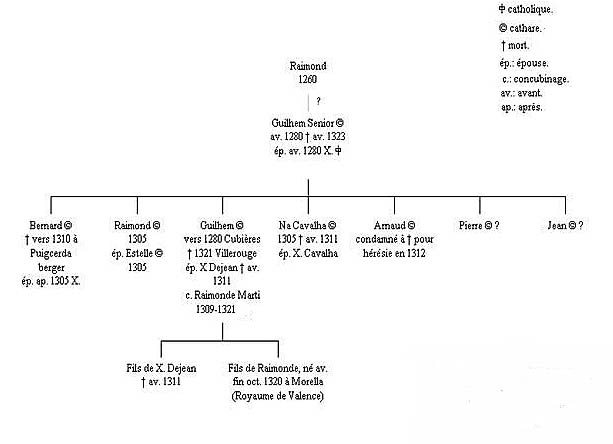 |
The House of Toulouse (
Tolosa)
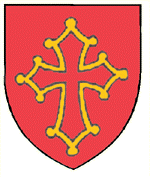 The family of Saint-Gilles
was one of the most powerful in Europe. As Counts
of Toulouse they held a huge area of land in the early Middle
Ages. Before the Cathar Crusade they enjoyed great prestige,
even within the Roman Church. They were much more than the
title of Count might suggest to modern ears. They were also
Dukes of Narbonne, Marquises of Provence and suzerain lords of other
territories, with some fifteen other, more conventional, counts
as their vassals.
The family of Saint-Gilles
was one of the most powerful in Europe. As Counts
of Toulouse they held a huge area of land in the early Middle
Ages. Before the Cathar Crusade they enjoyed great prestige,
even within the Roman Church. They were much more than the
title of Count might suggest to modern ears. They were also
Dukes of Narbonne, Marquises of Provence and suzerain lords of other
territories, with some fifteen other, more conventional, counts
as their vassals.
They were regarded as the equal of most kings and were related to the leading families of Europe, notably the Kings of England, France and Aragon. Their Courts were indistinguishable from royal courts.
The distinction between names and titles was not well developed in the middle ages, so the family may be called de St-Gilles or de Toulouse interchangeably. They came originally from the town of Saint-Gilles, an important centre where two pilgrimage routes to Compostella (the voie d'Arles and the voie Regordane) converged. In medieval times, Saint-Gilles was a major commercial centre and in its own right and the fourth most important pilgrimage site in Europe.
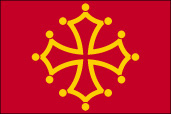 One
of the counts, Raymond
IV, had been the most prestigious leader of the First Crusade,
founding the
County of Tripoli in the Holy Land and becoming Count
Raymond I of Tripoli, with territories at both ends of the Mediterranean
Sea. He declined the crown of the new Latin Kingdom of
Jerusalem. His great grandson, Count
Raymond III of Tripoli, was present at the momentous battle
at the Horns of Hattin, where Saladin's victory signaled the beginning
of the end of Catholic states in the east. At the time of
the outbreak of the Crusade
against the Cathars of the Languedoc, the ruler was Count
Raymond VI. One of his wives was Jeanne
of England, which made Raymond son-in-law of Henry
II and Eleanor
of Aquitaine, and brother-in-law to
King Richard I (the Lionheart) and King
John of England. He was also related to the King
of France, and to the King
of Aragon. Raymond VI died in 1222 at a period when his
lands looked safe. The wars continued into another generation,
Raymond
VII (son of Raimond VI) fighting against Amaury
de Montfort, son of his Raymond VI's enemy, Simon
de Montfort.
One
of the counts, Raymond
IV, had been the most prestigious leader of the First Crusade,
founding the
County of Tripoli in the Holy Land and becoming Count
Raymond I of Tripoli, with territories at both ends of the Mediterranean
Sea. He declined the crown of the new Latin Kingdom of
Jerusalem. His great grandson, Count
Raymond III of Tripoli, was present at the momentous battle
at the Horns of Hattin, where Saladin's victory signaled the beginning
of the end of Catholic states in the east. At the time of
the outbreak of the Crusade
against the Cathars of the Languedoc, the ruler was Count
Raymond VI. One of his wives was Jeanne
of England, which made Raymond son-in-law of Henry
II and Eleanor
of Aquitaine, and brother-in-law to
King Richard I (the Lionheart) and King
John of England. He was also related to the King
of France, and to the King
of Aragon. Raymond VI died in 1222 at a period when his
lands looked safe. The wars continued into another generation,
Raymond
VII (son of Raimond VI) fighting against Amaury
de Montfort, son of his Raymond VI's enemy, Simon
de Montfort.
Many of the Counts were named Ramon, an Occitan name which is the same in modern Spanish, more familiar as Raymond in English and Raimond in French. Later members of the dynasty are often refered to in French literature as the Raimondines.
The Raimondines were arguably the most enlightened rulers in Europe until the advent of modern secular states. Somthing is known about the allies and the nobles of the counts, and also their relationships with their people, with the Jews and with Religious Dissidents. The price they paid at the hands of the Roman Church and the French Crusaders was public flogging, dispossession and ultimately the extinction of their noble House. Despite the best efforts of the Roman Church to demonise their memory and of successive French governments to efface all vestiges of their rule, there are still powerful links in the Languedoc to a clearly remembered golden age, before the territories of the Counts of Toulouse were annexed to France.
|
Raymond of Toulouse taking the oath to liberate Jerusalem bishop Adhemar of Le Puy (in red to left of Raymond IV of Toulouse in white) |
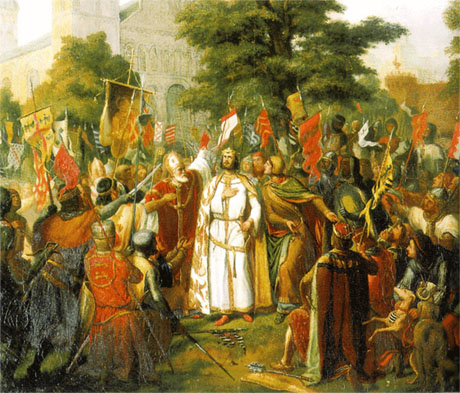 |
Click on the following link for more on individual The
Counts of Toulouse
Click on the following link for more on The
Cross of Toulouse, the heraldic device of the Counts of Toulouse
Click on the following link for more on
Occitan the language spoken in the lands of the Counts of Toulouse
Click on the following link for more on the Troubadours,
who made Occitan the first literary language of modern Europe
Click on the following link for more on
Occitania, "the country that never was"
Click on the following link for more on the lineage
of the Counts of Toulouse
Click on the following link for more on the
genealogy of the Counts of Toulouse
|
Raymond IV, Count of Toulouse |
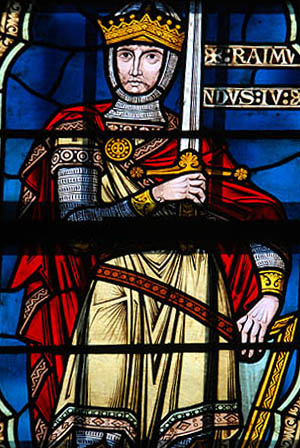 |
.jpg) |
 |
|
Raymond IV of Toulouse, painted by Merry-Joseph Blondel (1840s) |
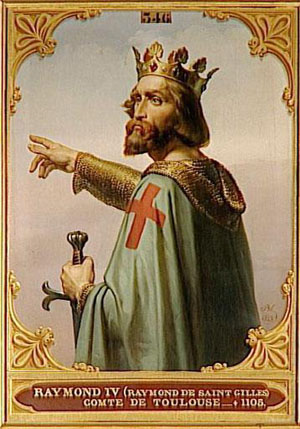 |
|
Raymond IV, window (detail) |
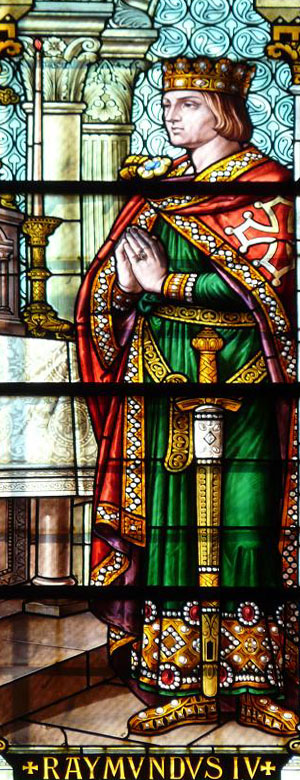 |
The Cross of Toulouse
Also called the Occitan Cross and, Erroneously, the Cathar Cross.
(
crotz di Contes de Tolosa, crotz occitana, crotz càtara)
This
device was the coat of arms of the family of St-Gilles, Counts
of Toulouse in the Middle Ages.
Wherever you go in the Languedoc, you will notice the Cross of Toulouse. You will find it incorporated into official arms of local government bodies, embroidered on flags, carved in stone, wrought in iron, printed on postcards, displayed in stained glass. You will find it worn as jewellery, sold as souvenirs to tourists, scrawled on walls as graffiti. You will even find it set in brass in the ground in public squares and visible in patterns of red and gold flowers.
Heraldry of the Cross of Toulouse
The "Occitan Cross"
The "Cathar Cross"
The significance of the Cross of Toulouse. .
|
 |
Heraldry of the Cross of Toulouse
 In
(English) heraldic terms the cross of Toulouse is described as "gules
a cross clechy pommety and voided or". In French Heraldic terms
as "de gueules, a la croix vidée, clechée, pommettée
et alaisée d'or". Both translate into lay language
as "on a red background, a yellow cross with pointy ends and its
centre cut out, and a bobble (pomette) on each of its 12 points.
The twelve pomettes may well have evolved from 12 rivets used to
fix a cross clechy onto a real military shield, reflected in the
version above right.
In
(English) heraldic terms the cross of Toulouse is described as "gules
a cross clechy pommety and voided or". In French Heraldic terms
as "de gueules, a la croix vidée, clechée, pommettée
et alaisée d'or". Both translate into lay language
as "on a red background, a yellow cross with pointy ends and its
centre cut out, and a bobble (pomette) on each of its 12 points.
The twelve pomettes may well have evolved from 12 rivets used to
fix a cross clechy onto a real military shield, reflected in the
version above right.
One medieval roll blazons the arms as "de goules a un croyz d'or pate et perse a une bordere d'or", which sounds like an inadequate attempt to describe the same arms.
The arms are so well known that even in English heraldry, the term "Cross of Toulouse" is used as a shorthand term that any herald will understand. Under heraldic convention the length of the arms of the cross may be varied according to artistic convenience, for example to fill a long shield.
 According
to tradition Raymond
IV (~1093-1095) adopted the cross during the First Crusade,
but it is known to have been used before the First Crusade. In 990
Guillame Taillefer, Count of Toulouse, married Emma, daughter and
heir of Roubaud, Count of Provence, bringing Provençal counties
as her dowry. In these lands the Counts vassals appear to have been
the first to adopt the cross. It was mentioned in 1080 at Marseille,
in connection with the Counts of Venasque. Their county, the Venaissin,
would soon after pass into the hands of the Count of Toulouse as
Marquis
of Provence.
According
to tradition Raymond
IV (~1093-1095) adopted the cross during the First Crusade,
but it is known to have been used before the First Crusade. In 990
Guillame Taillefer, Count of Toulouse, married Emma, daughter and
heir of Roubaud, Count of Provence, bringing Provençal counties
as her dowry. In these lands the Counts vassals appear to have been
the first to adopt the cross. It was mentioned in 1080 at Marseille,
in connection with the Counts of Venasque. Their county, the Venaissin,
would soon after pass into the hands of the Count of Toulouse as
Marquis
of Provence.
The cross appeared soon after on the banner of Raymond de Saint Gilles, Count of Toulouse, and when the family of St Gilles became Counts of Tripoli it flew over their possessions there too. It was arguably the only honourable flag ever flown on the Christian side. The most ancient cross in existence today is one decorating the keystone of a vault in the nave of the cathedral of St. Etienne in Toulouse, dated 1211.
 Some
believe the origin of the cross of Toulouse to be pre-Christian.
Its origin may have been a twelve-ray solar wheel, such as one found
in Saint-Michel-de-Lanes not far from Toulouse. The twelve discs
may have symbolised the twelve houses of the zodiac - as they do
in the large modern cross set into the square outside to Capitole
in Toulouse
(shown left). The cross is studded with metal bosses (shown right)
each decorated with examples of the cross of Toulouse as it developed
over the centuries.
Some
believe the origin of the cross of Toulouse to be pre-Christian.
Its origin may have been a twelve-ray solar wheel, such as one found
in Saint-Michel-de-Lanes not far from Toulouse. The twelve discs
may have symbolised the twelve houses of the zodiac - as they do
in the large modern cross set into the square outside to Capitole
in Toulouse
(shown left). The cross is studded with metal bosses (shown right)
each decorated with examples of the cross of Toulouse as it developed
over the centuries.
 The
arms of the town of Lloupia (shown right), preserve an ancient form
with the colours reversed. A remote origin of the cross is possible.
For example the Turfan cross, in Eastern Turkestan, closely resembles
the arms of Loupia. This form consists of a single continuous looped
line as shown on the left. It is possible that the design travelled
into Europe from the East following the same route that Cathar
teachings did. Similar crosses have been found in northern Italy
(Pisa and Venice), Provence (Forcalquier as well as Venasque) and
Spanish Catalonia (Santa Maria de l'Estany).
The
arms of the town of Lloupia (shown right), preserve an ancient form
with the colours reversed. A remote origin of the cross is possible.
For example the Turfan cross, in Eastern Turkestan, closely resembles
the arms of Loupia. This form consists of a single continuous looped
line as shown on the left. It is possible that the design travelled
into Europe from the East following the same route that Cathar
teachings did. Similar crosses have been found in northern Italy
(Pisa and Venice), Provence (Forcalquier as well as Venasque) and
Spanish Catalonia (Santa Maria de l'Estany).
The cross is sometimes referred to as an Occitan Cross and sometimes as a Cathar Cross. It is still a potent symbol throughout most of Occitania. Click on the following link for more on the significance of the Cross of Toulouse.
|
the cross shown here set into the ground at Toulouse is studded with metal plates like this. It is decorated with example of the cross of Toulouse shoing its historical development |
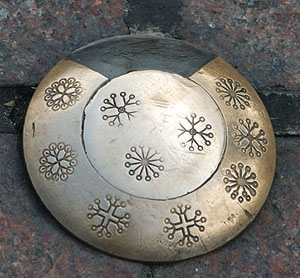 |
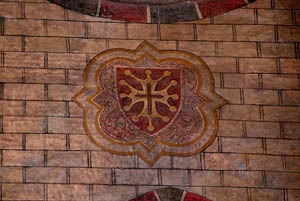 |
| stèle de Montferrand-d’Aude |
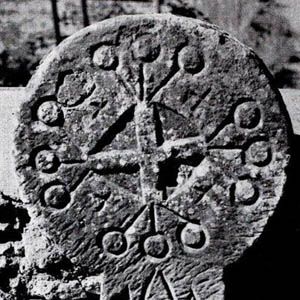 |
The Occitan Cross
The Cross of Toulouse still closely associated with the former territories
of the Counts
of Toulouse, and with its distinctive culture, including its
language, Occitan.
The first known written reference to the cross is in a 1173 document written by a Provençal notary. When the Counts of Toulouse acquired the Provence they added the cross to his arms. It eventually became the symbol of Languedoc resistance to the French invaders following the crusade against the Cathars of the Languedoc in the time of Raymond VI. In the contemporary Song of the Cathar Wars, laisse 109, written in Occitan, it is called la crotz ramondenca (The Raymondine Cross).
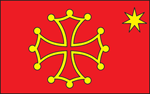
 The
Cross, or variants of it, is used as a badge of a small independence
movement, those who would like to Occitania become an independent
state, just as Catalans in the Roussillon and in Spain would like
to re-establish an independent Catalonia.
The
Cross, or variants of it, is used as a badge of a small independence
movement, those who would like to Occitania become an independent
state, just as Catalans in the Roussillon and in Spain would like
to re-establish an independent Catalonia.
Similarly it is used by those who would like to see the Occitan language revived.
| croix assyrienne or nestorienne (avec une inscription syriaque) |
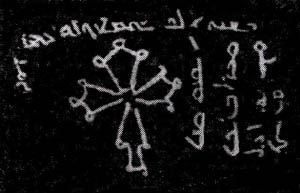 |
The "Cathar Cross"
The Cross of Toulouse is often referred to, especially by those catering for tourists, as the "Cathar Cross". There is no justification for this. The Cathars detested all representations of the Christian Cross. They regarded it as no more than an instrument of torture - and found worship of an instrument of torture as offensive as modern rationalists do.
 The
idea that Cathars might have adopted any form of cross is unsupported
by evidence, and is untenable given their beliefs. You can be certain
that anyone who talks to you about Cathar Crosses, or tries to sell
you one, knows nothing about the Cross of Toulouse, the Cathars,
or the history of the Languedoc.
The
idea that Cathars might have adopted any form of cross is unsupported
by evidence, and is untenable given their beliefs. You can be certain
that anyone who talks to you about Cathar Crosses, or tries to sell
you one, knows nothing about the Cross of Toulouse, the Cathars,
or the history of the Languedoc.
Although it is mistake to refer to the Toulouse Cross as a "Cathar Cross", by a coincidence it is in heraldic terms literally an "empty cross" - an idea that matches Cathar theology rather well, since the Cathars believed that Jesus was not crucified.
René Nelli, an expert in Catharism, has referred to a different cross - a human-shaped cross schematically represented by a Greek cross topped by an inverted V. You will find this on some monuments to Cathar victims of Catholic Crusaders and Catholic Inquisitors.
 There
is another meaning to the term Cathar Cross. Repentant first offenders
who admitted to having been Cathar heretics, and abjured their faith
when released on licence by the Inquisition
were required to:
There
is another meaning to the term Cathar Cross. Repentant first offenders
who admitted to having been Cathar heretics, and abjured their faith
when released on licence by the Inquisition
were required to:
"...carry from now on and forever two yellow crosses on all their clothes, except their shirts, and one arm shall be two palms long while the other transversal arm shall be a palm and a half long and each shall be three digits wide with one to be worn in front on the chest and the other between the shoulders."
Victims were required to renew the crosses if they became torn or destroyed by age. These yellow crosses, like the yellow badges of a different shape that the Catholic Church required Jews to wear, were badges of infamy - warnings to good Catholics to shun the wearers. These crosses were known in Occitan as "las debanadoras" - reels or winding machines. The idea seems to be that offenders could be "reeled in" by the Inquisition at any time. This was a serious concern since a second accusation meant a second conviction, and a second conviction meant death.
|
Not a Cathar Cross |
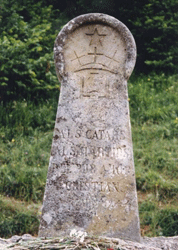
|
|
Not a Cathar Cross |
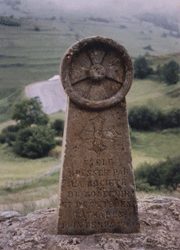 |
|
Not a Cathar Cross |
 |
Significance of the Cross of Toulouse
The Cross of Toulouse makes an elegant, well proportioned, yet simple design, and as such has been exploited shamelessly by the Tourist industry.
 Most
people who use the Cross of Toulouse probably never think about
why they use it. But it must be significant that it
is so widely used. In contrast, the official logo of
the Languedoc-Roussillon
is used by virtually no-one other than those sponsored by the regional
council.
Most
people who use the Cross of Toulouse probably never think about
why they use it. But it must be significant that it
is so widely used. In contrast, the official logo of
the Languedoc-Roussillon
is used by virtually no-one other than those sponsored by the regional
council.
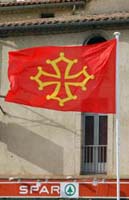
 Somewhere,
mixed in with the commercial exploitation at one extreme and frustrated
nationalism at the other is an abiding respect for and identification
with the Counts
of Toulouse, so widely loved by
their people and so egregiously treated by their worldly
enemies.
Somewhere,
mixed in with the commercial exploitation at one extreme and frustrated
nationalism at the other is an abiding respect for and identification
with the Counts
of Toulouse, so widely loved by
their people and so egregiously treated by their worldly
enemies.
You will find hints of this respect and identification everywhere in the ancient territories of the Counts of Toulouse, from the flags flown by pretty much everyone with a flagpole, to the most subtle acknowledgements. The cross of Toulouse features in the middle of the city's arms (shown right), while the mairie of Toulouse and the Midi-Pyrenees region both use the arms undifferenced. The Capitouls of Toulouse surmount the city arms not with a conventional civic mural crown, but with the coronet of their ancient suzerains.
Further Information on Cathars and Cathar Castles
|
If you want to cite this website in a book or academic paper, you will need the following information: Author: James McDonald MA, MSc.
If you want to link to this site please see How to link to www.cathar.info
For media enquiries please e-mail james@cathar.info
|



| CATHAR BELIEFS | CATHAR WARS | CATHOLIC CHURCH | CATHAR INQUISITION | CATHAR CASTLES | CATHAR ORIGINS | CATHAR LEGACY | CATHAR TOURS | CATHAR BOOKS | WHO's
WHO |
CATHAR TIMELINE | MORE INFO |
CATHAR GLOSSARY | CATHAR NEWS |
|
|

|
| Follow
@Cathar_Info
|
| Tweet
|
 |
| :::: Link to www.cathar.info ::: © C&MH 2010-2016 ::: contact@cathar.info ::: Advertising ::: |