|
|
|
|
|
|
|
|
|
|
|
HOME
CATHAR
BELIEFS
Basic
Tenets
Implications
Cathar
Believers
Cathar
Elect
Afterlife,
Heaven
& Hell
Other
Beliefs
Cathar
Ceremonies
Cathar
Prayer
The
Cathar Hierarchy
CATHAR
WARS
Albigensian Crusade
Who
led the Crusade ?
Crusader
Coats of Arms
Defender
Coats of arms
Medieval
Warfare
CATHOLIC
CHURCH
Cistercians
Dominicans
Franciscans
Cathars
on Catholics
Catholics
on Cathars
Catholic
Propaganda
"Kill
Them All ... "
Waldensians
Troubadours
CATHAR
INQUISITION
Inquisition
Inquisition
documents
CATHAR
CASTLES
Cathar
Castles
Cathar
Castle Photos
CATHAR
ORIGINS
Early
Gnostic Dualism
Manichaeans
CATHAR
LEGACY
Geopolitics
Historical
Studies
Popular
Culture
Catholic
Inheritance
Protestant
Inheritance
Cathar
Vindications
Do
Cathars still exist ?
CATHAR
TOURS
WHO's
WHO
The
Catholic Side
The
"Cathar" Side
Counts
of Toulouse
The
Cross of Toulouse
CATHAR
TIMELINE
Detailed
Chronology
MORE
INFORMATION
CATHAR
TERMINOLOGY
A
Cathar Glossary
|
Inquisition against the Cathars of the Languedoc
The Inquisition set up in the Languedoc was not the first Inquisition
set up by the Roman Church. Bishops' Inquisitions had
existed for centuries, but being local, never had the impact of
later Papal Inquisitions. The Inquisition which is the
subject of this page was the Medieval Inquisition, established informally
by Dominican
under Pope
Innocent III in the early thirteenth century and formalised
by later popes.
The more widely known Spanish
Inquisition was set up around two centuries later by their Catholic
Majesties Ferdinand (of Aragon) and Isabella (of Castile). In later
centuries another Papal
Inquisition would be created to exterminate Protestant ideas
in Southern Europe. Like the Spanish Inquisition, it would follow
the practices of the original medieval Inquisition in the Languedoc
- the one we are talking about here.
The express purpose of this original medieval Inquisition was to
discover and eliminate vestiges of Cathar
belief left in the wake of the Cathar
Crusades. During the crusades, ordinances had been
passed which imposed new penalties for heresy. After the death
of Innocent
III in 1216 Honorius sanctioned Dominic
Guzmán's new religious order, popularly known as the Dominicans
after Dominic. The Dominicans
in turn created the first formal Inquisition. In 1233 the
next pope, Gregory IX, charged the Dominican
Inquisition with the final solution: the absolute extirpation of
the Cathars. Soon the Franciscans
would join in too, but it is Dominic
Guzmán (St Dominic) and his followers who have left the legacy
of bitterness that endures in the Languedoc into the third millennium.
By the end of the fourteenth century Catharism had been virtually
extirpated. Before the Crusade the Languedoc, under the Counts
of Toulouse, had been the most civilised land in Europe.
People here had preferred simple asceticism to venality and corruption.
Learning had been highly valued. Literacy had been widespread,
and popular literature had developed earlier than anywhere else
in Europe. Religious
tolerance had been widely practised. Jews
enjoyed ordinary civil rights. The Languedoc had been the
home of courtly love, poetry, romance, chivalry and the troubadours.
All this was swept away by the Albigensian
Crusade and Dominic
Guzmán's Dominicans
and their Inquisition.
Procedures were developed over time, evolving from fairly amateur
attempts to establish guilt to a sophisticated mechanism that would
guarantee guilt. Initially welcomed by the Catholic community, the
Inquisition soon came to be widely hated throughout the Languedoc
by Jews, Cathars, Waldensians
and Catholics and alike - including local priests and bishops. Part
of the reason was that the Inquisition, with its papal backing,
was able to ignore the established power structure. It acted independently
of and often against the interests of local potentates, bishops,
lords and municipal councils alike. Inquisitors policed their own
activities and were answerable only the the pope himself.
Inquisitors were attacked when they appeared in public without
their armed guards. The Inquisitors' practice of digging up the
bodies of supposed heretics in cemeteries excited particular local
ire, and it was not unknown for church bells to be rung to celebrate
the murder of Inquisitors, as after the massacre at Avignonet
in 1242.
From contemporary documents we can trace the development of the
torture techniques developed by Dominican
Inquisitors. Here for example is an extract from an open letter
written around 1285 by the Consuls of Carcassonne
to Jean Galand, a Dominican
Inquisitor at Carcassonne.
Contrary the the practice and custom of your predecessors, you
have created a prison called "The Wall", which would
be better called "Hell". In it you have constructed
small cells to inflict pain and to mistreat people using various
types of torture. Some cells are so dark and airless that those
imprisoned there cannot tell whether it is night or day. They
permanently lack air and light. In other cells the miserable prisoners
remain in fetters - of either wood or metal - and are unable to
move. They excrete and urinate where they are, and cannot lie
down except on their backs on the cold earth ... In other places
in the prison they lack air and light and also food, except the
"bread of adversity, and the water of affliction" which
are provided only rarely. Some are placed on the chevelet; many
of them have lost the use of their limbs because of the severity
of the torture and are rendered entirely powerless ... Life
for them is an agony, and death a relief. Under these constraints
they affirm as true what is false, preferring to die once than
to be thus tortured multiple times ... they accuse not only
themselves but also others who are innocent, in order to escape
their suffering in any way ... those who so confess reveal afterwards
that what they have said to the Brother Inquisitors [Dominicans]
is not true, but false, and that they have confessed out of fear
of the peril of the moment. To some of those [witnesses] that
you cite you promise immunity so that they will more freely denounce
others without fear.
The original text is MS 626 BM Toulouse ff 546
v - 547v. This English translation by the webmaster. There is
a French translation in Jean-Marie Vidal, Un Inquisitor jugé
par ses victimes: Jean Galand et les Carcassonnaise, Paris,
1896, pp 39-43 and cited by Jean Duvernoy in Le Procès
de Bernard Délicieux 1319, Le Peregrinateur, Toulouse,
2001, p 8.
The bread and water quote is from the bible: Isaiah
30:20. From other sources we know that the bread was stale and
the water fetid - a diet that often resulted in death within weeks
or months.
The chevelet is an instrument of torture
These abuses and the complaints about them also occurred as Albi
and at Cordes
The procedure was that Inquisitors would announce their arrival
in a town in advance. Everyone was invited to attend and confess
their errors. When the Inquisitors arrived "volunteers"
were interviewed. If they confessed to relatively minor misdeeds,
were prepared to swear fidelity to the Catholic Church, and were
willing to provide useful information about others then they were
given a small penance and the matter was closed. Some of the consequences
of this practice were:
- It provided an opportunity for obliging Catholics to betray
friends and family, and a virtual obligation for everyone to do
so - failure to provide useful information was taken as lack of
genuine zeal and commitment to the One True Church.
- It provided a formal record of a first offence. This had a salutary
effect since a second offence carried the death penalty.
- It efficiently filtered out Cathar parfaits and other "heretics"
who were not willing to swear any oath, let alone one of fidelity
to the Catholic Church. Anyone who had not volunteered was immediately
suspected, and their failure to confess voluntarily was itself
evidence against them.
Repentant first offenders who admitted to having been Cathar heretics,
when released on licence by the Inquisition were required to:
"... Carry from now on and forever two yellow crosses on all
their clothes, except their shirts, and one arm shall be two palms
long while the other transversal arm shall be a palm and a half
long and each shall be three digits wide with one to be worn in
front on the chest and the other between the shoulders."
The dimensions are roughly 10 inches tall, 7 inches wide and
2 inches wide.
Victims were required to renew the crosses if they became torn
or destroyed by age. These yellow crosses, like the yellow badges
of a different shape that the Catholic Church required Jews to
wear, were badges of infamy - warnings to good Catholics to shun
the wearers. These crosses were known in Occitan as "las debanadoras"
- reels or winding machines. The idea seems to be that offenders
could be "reeled in" by the Inquisition at any time. This was
a serious concern since a second accusation meant a second conviction,
and a second conviction meant death.
From its beginning, the Papal Inquisition worked by ignoring
all rules of natural justice. Guilt was assumed from the
start. The accused had no right to see the evidence against
them, or their accusers. They were not always told what
the charges were against them. They had no right to legal
counsel, and if they were allowed a legal representative then
the representative risked being arrested for heresy as well. The
only sageguard was that accused persons had the right to name
their personal enemies so that the testimony of such people could
be discounted.
  People
were charged on the say-so of hostile neighbours, known enemies
and professional informers who were paid on commission. False
accusations, if exposed, were excused if they were the result of
"zeal for the Faith". Guilty verdicts were assured - especially
since, in addition to their punishment, half of a guilty person's
property was seized by the Church. The Dominicans
soon hit on the idea of digging up and trying dead people, so that
they could seize property from their heirs. People
were charged on the say-so of hostile neighbours, known enemies
and professional informers who were paid on commission. False
accusations, if exposed, were excused if they were the result of
"zeal for the Faith". Guilty verdicts were assured - especially
since, in addition to their punishment, half of a guilty person's
property was seized by the Church. The Dominicans
soon hit on the idea of digging up and trying dead people, so that
they could seize property from their heirs.
Techniques of obtaining confessions included psychological methods:
threats of procedures against other family members, promises of
leniency in exchange for a confession, trick questions, sleep deprivation,
indefinite imprisonment in a cold dark cell on a diet of bread and
water. At Carcassonne,
the Inquisition walled people up. Those sentenced to the wall in
its stricter form - there were two levels - had little chance of
survival for very long. Strict immuration was in effect an alternative
form of death sentence. In the course of time the Inquisition would
develop a wide range of even more ghastly techniques to break, maim
and kill people.
Torture became a favourite method of extracting confessions for
offences both real and fabricated. Its use was explicitly
sanctioned by Pope Innocent IV in 1252 in his bull ad
extirpanda though it had been practised from the earliest
days. Inquisitors and their assistants were permitted to absolve
one another for applying torture. Instruments of torture,
like crusaders' weapons, were routinely blessed with holy water.
Torture was applied to obtain whatever confessions were required,
and sometimes just to punish people that the Church authorities
did not like - people could be and were tortured even after they
had confessed.
From time to time attempts were made to regulate procedures in
response to complaints from municipal councils. In theory, only
one session of torture was permitted, but this restraint could be
ignored - repeated torture was regarded as as the continuation of
a single session, or the rule was regarded as applying separately
to each charge, so that all the Inquisitors needed to do was generate
as many charges as they needed. Other nominal constraints on the
shedding of blood, endangering life, causing permanent disability
and torturing minors were routinely ignored - no one was in a position
to enforce them, and mutual absolution seems to have been available
on request.
Together, these techniques were responsible for the first effective
police state in Europe, where the only thoughts and actions permitted
were those approved of by the Roman Church, where no-one could be
trusted, and where duty to the totalitarian authority took precedence
over all other duties, whether those duties were to one's sovereign,
family, friends, religious beliefs or conscience.
Many of the techniques developed by the Medieval Inquisition were
picked up and used by later totalitarian regimes and police states.
Among them are the creation of racial and religious ghettos; the
forcible wearing of "badges of shame"; formalised propaganda
and forgery; spying; seizure of property, threats, false promises,
intimidation and torture; and disregard for what has long been regarded
as natural justice.
It is difficult to find any technique of modern totalitarianism
that was not pioneered by the Medieval Inquisition, right down to
the good cop / bad cop routine; physical restraint; the separation
of families; sexual humiliation; the use of agents provocateurs
and listening tubes; false promises of leniency; and softening up
new victims using psychological techniques such as leaving them
for weeks, cold and hungry, isolated in cells within hearing distance
of the torture chamber. Even water boarding was used.
Inquisitors even charged people for the equipment used to execute
members of their families - just as the very worst twenty-first
century totalitarian states do.
Jacques Fournier,
Bishop of Pamiers.
The old Episcopal Inquisition continued
in parallel with the new Papal Inquisition, so co-operative bishops
were able to work hand-in-hand with papal Inquisitors. One notable
example was Jacques
Fournier, Bishop of Pamiers.
Jacques Fournier a Cistercian
monk became Abbot of Fontfroide
Abbey. In 1317 he became Bishop of Pamiers. He undertook a rigorous
hunt for Cathar believers, which won him praise from Catholic authorities,
but alienated local people. He was an exceptional Inquisitor.
Uniquely "Monsignor Jacques" was interested in what had
really happened, not just in obtaining convictions. He kept detailed
records of his interrogations and managed to have them preserved
to provide a treasure trove for historians. He made a name for himself
by his skill as an Inquisitor during the period 1318-1325. He conducted
a campaign against the last remaining Cathar believers in the village
of Montaillou,
as well as others who questioned the Catholic faith.
He personally supervised almost all of his operations,
only occasionally using torture to extract information. The bulk
of his interrogations relied on his verbal skill at drawing out
information and encouraging people to unwittingly condemn themselves
and their friends. He conducted 578 interrogations in the 370 days
his Inquisition was in operation.
The Fournier Register is a set of records
from the Inquisition run by Jacques
Fournier between 1318 and 1325. He interrogated hundreds
of suspects and had transcripts recorded of each interrogation.
He demanded a great deal of detail from those appearing before him.
Most of those he interrogated were local peasants and the Fournier
register is one of the most detailed records of life among medieval
peasants. The records have been the focus of scholars, most notably
Emmanuel Le Roy Ladurie whose pioneering work of microhistory Montaillou
is based on the material in the register. Thanks to his records,
we know more about life in the tiny Pyrenean village Montaillou
than we know about life in London or Paris in the early fourteenth
century.
Prior to Bishop Jacques
Fournier the local authorities had done little to pursue
so-called heretics, and the region was one of the last areas of
Europe to be home to a significant number of adherents to the Cathar
religion, a full century after the French Crusade against the Cathars
of the Languedoc.
The severest sentence was to be burnt at the stake,
but this was rare, with this Episcopal Inquisition only sentencing
five heretics to this fate. More common was to be imprisoned for
a time or to be forced to wear a yellow cross on one's back. Other
punishment's included forced pilgrimages and confiscation of property.
Unlike the Papal Inquisitors, Jacques
Fournier was prepared to weigh the evidence objectively
and release those against whom there was no evidence of deviation
from Catholic orthodoxy.
Fournier's record was assembled in three stages:
- During the inquisition itself a scribe would
make quick notes in short form to record the conversation.
- These would then be expanded into full minutes,
which were then presented to the accused for review and alterations
in case of errors.
- Finally a final version would be recorded.
The process involved translating the dialogue
from the local Occitan
language to the Latin of the Church.
In 1326, on the successful rooting out of what
were believed to be the last Cathar adherents in the area, he was
made Bishop of Mirepoix in the Ariège. A year later, in 1327,
he was made a cardinal. He succeeded Pope John XXII (1316–34)
as Pope in 1334, being elected on the first conclave ballot. His
election as pope accounts for the fact that even a small proportion
of his records survived into modern times since they were transferred
to the Papal Archives.
Click on the following link for more on Montaillou

Click on the following link for more on Jacques
Fournier
You can also read some transcripts of Fournier's
trials, translated into English:
Bernard Delicieux
Pretty much the only Catholic churchman to have emerged from the
whole of the Cathar period with any integrity (as measured by modern
secular standards) was a Franciscan
friar called Bernard Delicieux.
Delicieux came from Montpellier, not then part of France.
He noted with some justification that there was no way of establishing
one's innocence: "... if St. Peter and St. Paul were accused
of 'adoring' heretics and were prosecuted after the fashion of
the Inquisition, there would be no defence open for them."
Delicieux was involved in the case of Castel Fabre, a unique and
revealing case in which a man was found not-guilty by the Inquisition.
It is revealing in that the only reason that a defence could be
mounted was that another arm of the Church stood to lose if a guilty
verdict were returned. The facts of the case were that the Dominicans
were trying to disinherit Castel's heirs on the grounds that he
had been a Cathar - unlikely since he had been buried in a convent.
The Franciscans
had evidence that he had left his worldly goods to them - again
suggesting that he had not been a Cathar at all. If he was guilty
then the Dominicans
would get the goods. If he were innocent the Franciscans
would get them. These unusual circumstances provided a unique opportunity
for a genuine trial based on evidence - itself an interesting fact
in that it showed that the Church new full well what a properly
conducted trial looked like.
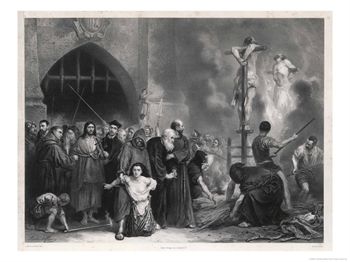
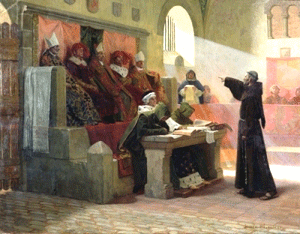
Bernard famously created such popular pressure against the Inquisition
and their hated Wall, that the king's agents were eventually obliged
to free its wretched prisoners. The scene, painted much later, by
Jean-Paul
Laurens (1838 – 1921) is depicted on the right, and may
be seen at the Musée des Beaux arts in Carcassonne
(just off the Square Gambetta).
Bernard was unpopular with the Dominican
Inquisitors whose absolute power he temporarily threatened. He was
implicated in a plot to return the Languedoc to the Aragonese rulers
in the shape of Ferrand, the King of Majorca. Jaume of Aragon, aware
of the plot, revealed it to Phlippe le Bel, King of France. The
rebels were executed and Bernard ended up incarcerated in the Wall,
sentenced to perpetual imprisonment. He was later delivered to the
Pope, Clément V , who kept him prisoner in Avignon. In 1310
he was released and went to Béziers
but a new pope John XXII had him re-arrested in 1317. Judged at
Castelnaudary
in 1319, he was "put to the question" (ie tortured). He
died in prison the following year.
Streets are named after him in Montpellier and Toulouse.
|
The "Logis de l'inquisition" -
The house of the Inquisition in Carcassonne
|
 |
|
 |
| |
| |
| |
|
Jean-Paul Laurens (1838-1921)
The Agitator of Languedoc, 1882
oil on canvas ( 115 cm c 150 cm)
Musée Des Augustins, Toulouse, France
|
 |
| |
|
Jean-Paul Laurens (1838-1921)
La Délivrance Des emmurés de Carcassonne, 1879
oil on canvas ( 115 cm c 150 cm)
Musée Des Beaux Arts, Carcassonne, France
|
 |
| |
|
Imprisoned
|
 |
| |
|
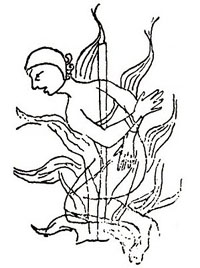
Around 12 50 Alphonse de Poitiers wrote to
Pope Innocent IV asking him to issue a bull against heresy.
This document is known in the form of a draft, on the back
of which is a sketch showing a man being burned at the stake.
|
|
This image has become famous. It is used
to illustrate many books, and on Cathar monuments, as at Les
Casses. It is a cleaned up version of the sketch on the back
of the document mentioned above.
|
 |
|
The document itself (copy shown below) is
rarely mentioned, though it may have had important repercussions.
The document is undated but must have been drafted after 1249
when Alphonse took the title Count of Toulouse. Pope Innocent's
bull Ad
extirpanda, was issued on May 15, 1252, authorising
the use of torture for eliciting confessions from heretics.
Ad
extirpanda applied specifically to regions of what
is now northern Italy, but it possible that it is based on
the text of another bull, now lost, issued in response to
Alphonse's request.
|
| |
|
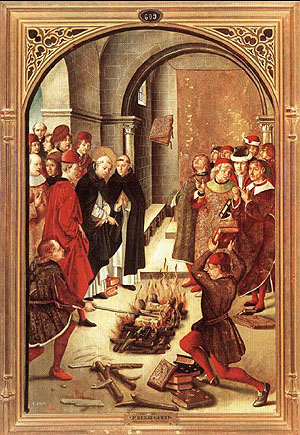
This detail of a painting commissioned by
Dominicans
shows Dominic
Guzmán judging "heretics" who are about
to be burned at the stake. For many centuries Dominicans
were proud to claim Saint Dominic as founder of the Inquisition,
but in recent years, since the Inquisition became unpopular
even in Catholic circles, a great deal of effort has gone
into trying to establish that Dominic
Guzmán had nothing to do with the Inquisition.
|
 |
| |
|
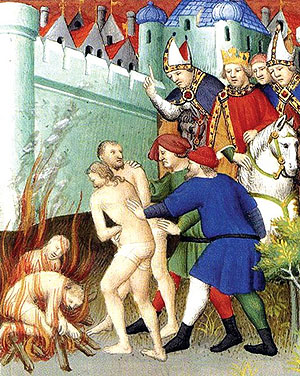
Bishops supervise the burning of "heretics"
|
 |
| |
|
|
 |
| |
|
Conrad of Marburg, detail of a 13th century
church window, Elisabethkirche Marburg
|
 |
| |
Some Useful References
- Jean Louis Biget, Autour de Bernard Délicieux.
Franciscains et société en Languedoc entre
1295 et 1330, in « Mouvements Franciscains
et société française. XIIIe-XXe siècle ».
André Vauchez dir. Paris. Beauchesne, 1984.
- Jean Duvernoy (trad.), Le procès de Bernard
Délicieux – 1319, Toulouse 2001, éd.
Le Pérégrinateur
- Bernard Hauréau, Bernard Délicieux et
l'Inquisition albigeoise, 1300-1320, préface
et traduction Des pièces justificatives de Jean Duvernoy
(reprint de l'édition Hachette de 1877), Loubatières,
Toulouse, 1992. ISBN 2-86266-175-9
- M. Jouve, Vie hérétique de Bernard Délicieux,
1931
|
| |
|
Peter Martyr
|

|
|
|
|
|
|
|
|
How The Inquisition developed in later Times
Back in In 1184 Pope Lucius III and the Emperor Frederick had formulated
a programme for the repression of heretics. This document, Ad
abolendum, is sometimes known as the charter of the Inquisition,
because it set the tone for future developments. The Fourth Lateran
Council in 1215 had ordered all bishops to hold an annual inquisition,
if there was a suspicion of heresy in their See. But these Episcopal
inquisitions were found to be inadequate for the task .
The Inquisition against the Cathars of the Languedoc proved a turning
point. Now the Church had a weapon that demonstrably worked. It
could be replicated and used against others. Over the centuries
to come there would be a number of Inquisitions. They have been
directed against pagans and supposed witches, dissenting sects,
Cathars, Muslims, Jews and members of other religions. They have
also been directed against freethinkers, apostates, atheists and
blasphemers.
|
|
Figure on the Basilica at Carcassonne
Heresy was often represented as a form of
wilful blindness
|
|
 |
|
|
|
The Medieval Inquisition - Pope Gregory IX
A roving papal Inquisition had been set up in 1231 by Pope Gregory
IX. He extended existing legislation against heretics and introduced
the death penalty for them – indeed for anyone who dissented
from his views. Initially intended to be temporary, this Inquisition
was used to extirpate surviving Cathars in the Languedoc. Anyone
accused or ‘defamed’ was treated as guilty, and no one
once defamed got off without some punishment. After 1227 Inquisitorial
commissions were granted only to the friars, usually to the Dominicans.
The Inquisition was now the ‘Dominican
Inquisition’. Dominic
Guzmán’s threats of slavery and death for the citizens
of the Languedoc were fulfilled for a second time. First the massacres,
now the Inquisition.
The Bishop of Toulouse marked the canonisation of Dominic
Guzmán on his first Saint’s Day (4 th August 1234)
by burning a woman for her Cathar beliefs. She had confessed to
him as she lay sick in bed with a fever. She was carried to a field,
still on her sickbed, and consigned to the flames without even a
show trial.
All of the legal apparatus of the Inquisition was developed during
this period. Elsewhere, courts followed at least the basic rules
of justice: the accused knew their accusers, they were allowed legal
representation, in some places judgement was delivered by a jury
composed of peers of the accused. The old bishops’ Inquisitions
had been public hearings, but these papal inquisitions were different:
now secret hearings took place before clerical judges and prosecutors.
Guilt was assumed from the start. There were no juries, and no legal
representation for the accused. There was no habeas corpus;
no disclosure of any evidence against the accused, and no appeal.
Inquisitors were allowed to excuse each other for breaches of the
rules – which meant that in effect there were no rules. There
were secret depositions and anonymous accusations, torture and unlimited
detention in appalling conditions for those who failed to confess.
Dead people were tried along with the living. When found guilty
their children were disinherited. At least half the estate generally
went to the Church – so that the Church had a direct material
interest in a guilty verdict. Children and grandchildren of those
found guilty were all debarred from any secular office .
Gregory IX’s immediate successor died before assuming the
reins of office, but the next pope, Innocent IV, made the Inquisition
into a permanent institution. In 1252 he issued a bull Ad
extirpanda, which explicitly authorised the use of torture,
seizure of goods and execution, all on minimal evidence. Torture
was to be administered by the secular authority, but when this proved
impractical the Inquisitors were allowed to administer it themselves
(and to absolve each other for doing so). Thereafter it was an exceptional
man, woman or child who could not quickly be convinced of his or
her heresy
In theory torture could be applied only once, and could not
be such as to draw blood, to cause permanent mutilation or to kill.
Boys under the age of 14 and girls under 12 were excused. In practice
there was no one to enforce any of these safeguards, and they were
all ignored. The accused were imprisoned, often for many months,
before being examined. They were often kept in solitary confinement,
in unsanitary conditions, in a dark dungeon, and without adequate
heating, food or water. This was deliberate, and designed to ensure
that most of the accused would already have broken by the time of
the first examination. Only the strongest characters were able to
face a tribunal of hooded figures who claimed to have heard witnesses
and seen incriminating evidence. Most of the accused were prepared
to admit anything, even though they did not know what the accusations
were. Those who failed to admit their crimes were taken to the torture
chamber and shown the instruments of torture. This too was designed
to terrify and break them – the dark chamber, the horrifying
instruments, the torturer-executioner dressed and hooded in black.
If they still failed to admit their guilt they were then subjected
to torture: men, women and children alike. Some people were tortured
for years before confessing. Only the most exceptional could resist.
Every day they risked being tortured to death.
Tortures varied from time to time and place to place, but the following
represent the more popular options. Victims were stripped and bound.
The cords were tied around the body and limbs in such a way that
they could be tightened, by a windlass if necessary, until they
acted like multiple tourniquets. By attaching the cords to a pulley
the victim could be hoisted off the ground for hours, then dropped.
Whether the victim was pulled up short before the weight touched
the floor, or allowed to fall to the floor, the pain was acute.
This was the torture of the pulley, also known as squassation
and the strappado. John Howard, the prison reformer, found this
still in use in Rome in the second half of the eighteenth century.
The rack was a favourite for dislocating limbs. Again, the victim
could be flogged, bathed in scalding water with lime, and have their
eyes removed with purpose designed eye-gougers. Fingernails were
pulled out. Grésillons (thumbscrews) were applied to thumbs
and big toes until the bones were crushed. The victim was forced
to sit on a spiked iron chair that could be heated by a fire underneath
until it glowed red-hot. Branding irons and red-hot pincers were
also used. The victim’s feet could be placed in a wooden frame
called a boot. Wedges were then hammered in until the bones shattered,
and the ‘blood and marrow spouted forth in great abundance’.
Alternatively the feet could be held over an open fire, and literally
roasted until the bones fell out; or they could be placed in huge
leather boots into which boiling water was poured, or in metal boots
into which molten lead was poured. Since the holy proceedings were
conducted for the greater glory of God the instruments of torture
were sprinkled with holy water.
Whole families were accused. Family members would often be induced
to incriminate each other in order to minimise the suffering of
their loved ones. Minor heretics who confessed might escape with
light sentences, whereas denial invited trouble. The Inquisitor
Conrad of Marburg burned every victim who claimed to be innocent.
Hearings of the Inquisition denied every aspect of natural justice,
and became ever more prejudiced as time went on. They were held
in secret, generally conducted by men whose identities were concealed.
In the Papal States and elsewhere, Dominicans
acted as both judges and prosecutors. By papal command they were
forbidden to show mercy. There was no appeal. The evidence of embittered
husbands and wives, children, servants and persons heretical, excommunicated,
perjured and criminal could be used, secretly and without their
having to face the accused, their charges being communicated to
the victim only in summary form if at all.
No genuine defence could be sustained. For example, if a husband
provided an alibi, saying that his wife had been asleep in his arms
when she was alleged to have been attending a witches’ sabbat,
it would be explained to him that a demon had adopted the form of
his wife while she was away. The husband had been duped. There was
no way for him to prove otherwise. Spies were employed with the
incentive of payment by results. Perjury was pardoned if it was
the outcome of ‘zeal for the faith’ – i.e. supporting
the prosecution. Loyalties were over-ridden so that obedience to
a superior was forbidden if it hindered the inquiry, and those who
helped the Inquisitors were granted the same indulgences as pilgrims
to the Holy Land. Any advocates acting for and any witnesses giving
evidence on behalf of a suspect laid themselves open to charges
of abetting heresy. No one was ever acquitted, a released person
always being liable to re-arrest and a condemned person liable to
a revised sentence with no retrial, at the discretion of the Inquisitor.
In theory torture could be inflicted only once, but in practice
it was repeated as often as necessary on the pretext that it was
a single occurrence, with intervals between the sessions. Confessions
were virtually guaranteed unless the victim died under torture.
Then came the sentence, and execution of the sentence:
...The obdurate and relapsed were taken outside the church
and handed to the magistrates with a recommendation to mercy and
instruction that no blood be shed. The supreme hypocrisy of this
was that if the magistrate did not burn the victims on the following
day, he was himself liable to be charged with abetting heresy
(Christie-Murray, A History of Heresy, p 109) .
Almost everyone fell within their jurisdiction. People were executed
for failing to fast during Lent, for homosexuality, fornication,
explaining scientific discoveries, and even for professional acting.
In order that no blood be shed, the favoured methods of execution
did not involve the cutting of flesh. So it was that burning was
popular, the stake having been inherited from Roman law. The estates
of those found guilty were forfeit, after the deduction of expenses.
Expenses included the costs of the investigation, torture, trial,
imprisonment and execution. The accused bore it all, including wine
for the guards, meals for the judges, and travel expenses for the
torturer. Victims were even charged for the ropes to bind them and
the tar and wood to burn them. Generally, after paying these expenses,
half of the balance of the estate went to the Inquisitors and half
to the Pope, or a temporal lord. This proved such an efficient way
of raising money that it became popular to try the dead as well
as the living. Bones were dug up and burned, even after many years
in the grave. As in trials of the living, there were no acquittals,
and the heretic’s property was forfeit. In practice this meant
that the heirs of the deceased were dispossessed of their inheritances
.
 |
|
|
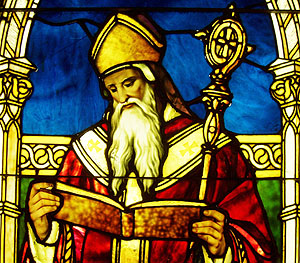
St
Augustine of Hippo - an ex Manichaean
Sometimes called the "Father of the Inquisition"
|
 |
| |
|
St
Augustine of Hippo, an ex Manichaean,
trampling other Manichaeans
underfoot
|
 |
| |
|
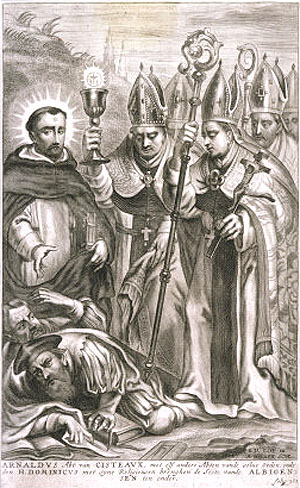
Dominic
Guzmán(with a halo), Arnaud
Amaury, and other Cistercian
abbots crush helpless Cathars underfoot - a sanitised version
of the persecution of the Cathars
|
|
|
| |
|
Victims were stripped and bound. Cords were
tied around the body and limbs in such a way that they could
be tightened, by a windlass if necessary, until they acted
like multiple tourniquets. By attaching the cords to a pulley
the victim could be hoisted off the ground for hours, then
dropped. Whether the victim was pulled up short before the
weight touched the floor, or allowed to fall to the floor,
the pain was acute. This was the torture of the pulley, also
known as squassation }. It was also called the strappado.
John Howard, the prison reformer, found this still in use
in Rome in the second half of the eighteenth century.
|
 |
| |
| |
 |
| |
| |
 |
| |
 |
| |
|
|
|
The Knights Templar
The trial of the Knights Templar demonstrates how unjust the Inquisition
could be. The charges of heresy against them were almost certainly
fabricated. No real evidence was ever produced to support the accusations.
The best that could be managed was hearsay evidence such as that
of a priest (William de la Forde) who had heard from another priest
(Patrick de Ripon) that a Templar had once told him, under the inviolable
seal of confession, about some rather improbable goings on.
Inquisitors obtained the most damning evidence through the use
of torture. In countries where torture was not permitted, the Templars
denied the charges, however badly they were otherwise treated and
however long they were imprisoned. As soon as torture was applied
the required confessions materialised. Inquisitors refused to attach
their seals to depositions unless they included confessions, so
that only one side of the case appeared in official records. In
France, where torture was applied freely, there were many confessions,
and also many deaths under torture. Accused persons who retracted
their confessions faced death at the stake as relapsed heretics
.
|
Quote from J. Michelet (ed.), Patrologiae
Cursus Completus, Series Latinae, 221 vols. (Paris,
1844-64), vol. 1, PP 31-32; translated by Barber, The
Trial of the Templars, p 124.
|
|
Under torture, the Templar Grand Master himself, Jacques
de Molay, confessed – though it is likely that his
confession was fabricated or at least added to, since he
was dumbfounded when it was read out to him in public. When
he tried to mount a defence on behalf of the Templar Order,
he was told that "in cases of heresy and the faith
it was necessary to proceed simply, summarily, and without
the noise of advocates and the form of judges". Since
all of the Order’s assets had been seized there was
in any case no way for him to mount an effective defence.
Even by asking to do so he invited death at the stake, as
a number of churchmen pointed out at the time.
|
When no English Templars could be induced to confess, the Pope
insisted that torture be applied. He was shocked to discover that
the common Law of England prohibited torture and insisted that his
law "God's Law" be applied and torture inflicted. When
the Archbishop of Mainz delivered a verdict favourable to the Templars
at a provincial council, the Pope simply annulled it. When it looked
as though the Templars in Cyprus might be acquitted, the Pope ordered
a new trial backed by torture. When the fate of the Templars was
considered at the Council of Vienne late in 1311 the cardinals had
‘a long dispute’ as to whether a defence should be heard
at all. In the event no defence was heard and the Pope enforced
the King of France’s demand that the Order be suppressed.
|
Templar assets were divided up between Church and State,
and interest in the fates of individual Templars immediately
subsided. Jacques de Molay retracted his confession knowing
what the consequences would be, and was roasted alive, slowly,
over a smokeless fire on 18 th March 1314. A document recently
re-discovered (The Chinon Parchment) reveals that the Pope
knew the Templars to be innocent of the charges against them.
|
|
|
The Chinon Parchment was published by
Étienne Baluze during the 1600s, in Vitae Paparum
Avenionensis ("Lives of the Popes of Avignon").
Dr Barbara Frale discovered that in it Pope Clement
V secretly absolved the last Grand Master Jacques de
Molay, and the rest of leadership of the Knights Templars,
in 1308, from charges brought against them by the Medieval
Inquisition. The parchment is dated Chinon, 1308 August
17th - 20th. The Vatican keeps an authentic copy with
reference number Archivum Arcis Armarium D 218, the
original having the number D 217.
|
|
The activities of the Medieval Inquisition were so terrible that
the memory of them has survived throughout Europe to the present
day. Some Christians acknowledge that this body was one of the most
sinister that the world has ever known, and now attribute its work
to satanic forces.
|
Knights Templars being burned alive
Illustration, anonymous Chronicle, From the Creation of
the World until 1384. Bibliothèque Municipale,
Besançon, France.
|
 |
| |
|
|
Detail of a miniature of the burning
of Jacques de Molay (the Grand Master of the Templars) and
Geoffroi de Charney.
From the Chroniques de France ou de St Denis, BL Royal MS
20 C vii f. 48r
(In fact they were roasted slowly, rather than burned like
this)
|
 |
| |
| |
|
In 1310, 54 Templars were burned outside
Paris.
Manuscript Image from J. Riley-Smith (ed.), The Oxford
Illustrated History of The Crusades
(Oxford University Press: Oxford, 2001), p.244
|
 |
| |
|
|
|
The Spanish Inquisition
The Medieval Inquisition was established in Barcelona in 1233.
Five years later its authority was extended to Castile, Leon and
Navarre. This was essentially an extension of the Inquisition established
to extirpate the remnants of Catharism. Over 200 years later another
inquisition was to appear : the Spanish Inquisition. Their
Roman Catholic Majesties, Ferdinand and Isabella, established it
in 1479, with the explicit sanction of Pope Sixtus IV, who in 1483
also confirmed the Dominican
friar Thomas de Torquemada as Grand Inquisitor for Aragon and Castile.
The Inquisition was initially directed against Jewish and Muslim
converts who were suspected of returning to their own religion,
and thus being guilty of apostasy. (Many had converted to Christianity
only under threat of death.)
The process was much the same as that of the Medieval Inquisition,
and indeed was deliberately modelled on it. It too was manned mainly
by Dominicans.
They copied the methods of arrest, trial, punishment, staffing,
and procedure, even down to the blessing of the instruments of torture.
There were a few differences from the Medieval Inquisition, for
example there were cases where people were able to mount a defence
and were acquitted. Better records were kept. Some Inquisitors seem
to have been relatively enlightened and were suspicious of accusations
motivated by the self-interest of accusers. Prisons seem to have
been better than most ecclesiastical prisons – there are cases
of people committing minor heresies in order to get themselves transferred
from ecclesiastical prisons to those of the Inquisition. On the
other hand, this may say more about ecclesiastical prisons than
Inquisition prisons, for even in the latter many died before their
cases were heard. In the early days the accused were able to appoint
their own defence counsel, but by the mid-sixteenth century this
had changed. If advocates were permitted they had to be abogados
de los presos, officials of the Inquisition, dependent upon
the Inquisitors for their jobs. It is fair to assume, as their clients
did, that these court officials were aware of their employers’
expectations and of the dangers of doing their jobs too well .
|
It was widely accepted that the Inquisition existed only
to rob people, as they openly affirmed (Kamen, The Spanish
Inquisition, p 150). Both rich and poor knew that it
was the rich who were most at risk. The fact that the Inquisition
funded itself from the property it confiscated meant that
in effect it burned people on commission. Individual Inquisitors
also funded themselves, acquiring great wealth during their
careers. Some Inquisitors were known to have fabricated evidence
in order to extort money from their victims, but even when
discovered they received no punishment. Similarly their staff
of helpers, called familiars, were free to commit
crimes without fear of punishment by the secular courts. After
1518 this was formalised. Familiars enjoyed immunity from
prosecution similar to benefit of clergy or modern diplomatic
immunity. This provided another cause of popular scandal,
along with their exemption from taxation .
|
|
|
"Some Inquisitors. ..": A good
example is the Inquisitor Diego Rodriguez Lucero, who
fabricated evidence, extorted a fortune and killed hundreds
to conceal his crimes. He might well have continued
his career indefinitely had he not overstepped the mark
by arresting the Archbishop of Granada and torturing
his relatives to obtain evidence against him. See Kamen,
The Spanish Inquisition, PP 75-7
|
|
The activities of the Inquisitors were resented by all sections
of society, and the papacy was obliged to interfere from time to
time, although the Inquisitors were powerful enough to ignore it
on many occasions. Pope Sixtus IV issued a bull on 18 th April 1482
protesting that
in Aragon, Valencia, Mallorca and Catalonia the Inquisition has
for some time been moved not by zeal for the faith and the salvation
of souls, but by lust for wealth, and that many true and faithful
Christians, on the testimony of enemies, rivals, slaves and other
lower and even less proper persons, have without any legitimate
proof been thrust into secular prisons, tortured and condemned as
relapsed heretics, deprived of their goods and property and handed
over to the secular arm to be executed, to the peril of souls, setting
a pernicious example, and causing disgust to many.
When someone was arrested all of his or her property was seized.
This was then sold off as required to pay for the upkeep of the
person arrested. This might go on for years until the property was
all sold off. The families of the accused were not supported, so
they also suffered hardships. In some cases the children of rich
parents starved in the streets. Others survived by begging. The
King, Ferdinand, intervened from time to time, and later, in 1561,
provision was made to support dependents– although the effect
was to use up the sequestered assets that much faster.
The accused were invited to confess their crimes but not told what
these crimes were. Sometimes it was difficult to guess, as any of
the following were considered serious crimes: changing bedding on
a Friday, not eating pork, dressing in certain ways, wearing earrings,
speaking in foreign languages, owning foreign books, casual swearing,
criticising a priest, or failing to show due reverence to the Inquisition.
Three methods of torture were popular, the garrucha, the
toca and the potro. The garrucha was
the strappado under another name. The toca was a water
torture - copied by Us forces in the early twenty-first century.
A linen strip was forced down the throat of the accused and water
poured down it until the stomach was distended. The potro
was a form of rack combined with tourniquets.
Surviving records of these torture sessions make harrowing reading.
As the torture progressed the victims were soon ready to admit to
anything. They would admit to having done whatever they were accused
of. But since they did not know the specifics of the accusation
they could not admit to them item by item. More torture was applied.
They admitted to whatever their accusers had said, but again they
could not be specific because they did not know what their accusers
had said. More torture was applied. They begged for clues. They
begged for mercy. They were told to confess. They confessed to crimes,
real or invented, apparently whatever they could think of. They
asked what it was the Inquisitors wanted and offered to confess
to it whatever it was – still not good enough. More torture
was applied. And so it went on, sometimes until they went mad. Sometimes
they died under tortured. Many died in prison. Others committed
suicide. Of the survivors some were disabled for life.
The lucky ones got off with penance, whipping or banishment. Others
were condemned to slow deaths in prison or in the galleys. As the
writer George Wryly Scott noted in his book A History of Torture:
Of all the punishments which the Inquisition inflicted in the
name of God, for sheer long-continued cruelty, nothing ever rivalled
the treatment of the galley-slaves, who were flogged very nearly
every day during the period they laboured at the oars…It
was a fate worse than death. For, as everyone knew, it meant a
life of the most terrible hardship man could possibly endure and
yet continue to live; it almost inevitably entailed death long
before the sentence was completed. It meant, in the majority of
instances, that the victim was gradually whipped to death.
Others were condemned to public execution, but this was rarely
a simple matter of dispatching the victim. Even those who confessed
immediately were tortured. Execution was not the sentence
– it was an additional sentence. At the end of the
trial a public ceremony was held called an Auto-da-fé
(Portuguese for Act of Faith). The victim was dressed in
a penitential tunic ( san benito) painted with a design.
Impenitents wore tunics painted with pictures of their wearers burning
in Hell with devils fanning the flames. On their heads they wore
3-foot-long pointed pasteboard caps (corozas), also painted.
Around their necks they wore nooses, and in their hands they carried
candles. Anyone judged likely to speak out against the Inquisition
was gagged. After a procession came a Mass and sermon, in which
the Inquisition was praised and heresy condemned. The sentences
were read aloud and then carried out. As usual the secular authorities
were obliged to burn victims on the Church’s behalf on the
grounds that ecclesia non novit sanguinem – the Church
does not shed blood. Burning generally took place on Sundays or
festivals in order to attract the largest possible audience. Participation
was a meritorious act – so for example any persons who helped
collect firewood would earn a remission of their sins.
A slow roasting was considered preferable to quick incineration.
Victims were tied high up on their stakes, partly to give the crowds
of faithful a good view, partly to prolong the agony. Sometimes
there was further torture before the fire was lit. For example Protestants
who refused to recant had burning sprigs of gorse thrust into their
faces until they were burned black. The whole event was a popular
festival for the devout, who enjoyed the spectacle and ridiculed
the victims in their death agonies. The events were closely linked
to royal spectacles. The king was obliged by his coronation oath
to attend these mass burnings. Such burnings were even held to help
celebrate royal marriages .
Children and grandchildren of the condemned were prohibited from
becoming priests, judges or magistrates, lawyers, notaries, accountants,
physicians, surgeons, or even shopkeepers. They could not become
mayors or hold other public offices. Some penalties passed from
generation to generation without limit. Under statutes of limpieza
de sangre, the descendants of heretics, like those of Jews
and Moors, suffered civil disabilities because of their ‘tainted
blood’. San benitos worn by heretics were hung up
in local churches as an eternal badge of shame so that no one should
forget their heretical ancestors.
The Spanish Inquisition continued its work for centuries, and exported
its practices to the New World. The Portuguese exported similar
practices to their colonies, not only to the New World but also
east to countries like Goa. The fact that few of the indigenous
people of the New World could be induced to convert should have
meant that there was little recidivism, and therefore little heresy.
In fact many hundreds of heresy trials were conducted in South America
.
|
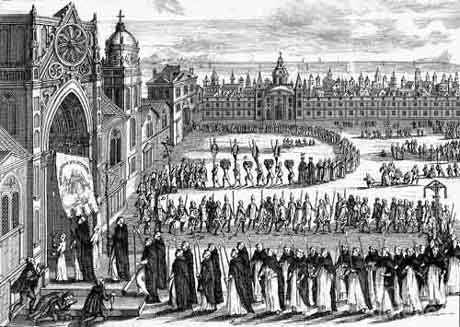
A procession by the inquisition in Goa -
Dominicans in the lead, victims in sanbenitos behind. From
Picart's 'The Ceremonies and Religious Customs of the Idolatrous
Nations' (English version, London, 1733-38)
|
 |
The Spanish Inquisition continued to execute its victims into the
nineteenth century. When the French army invaded Spain in 1808 the
Dominicans
in Madrid denied that they had torture chambers in their building.
The soldiers searched and found that they did. The chambers were
full of naked prisoners, many of them insane. Similar discoveries
were made throughout the country.
While it existed, the Spanish Inquisition was regarded with horror,
even by Roman Catholics from other countries who witnessed its activities.
It was abolished by Joseph Bonaparte in 1808, but it was reintroduced
by Ferdinand VII in 1814, and finally ended by government decree
on 15 th July 1834 .
|
|
|
|
The Roman Inquisition
The Roman Inquisition, more correctly the Congregation of the
Inquisition, was set up in 1542 by Pope Paul III to help eradicate
Protestantism from Italy. It was composed of cardinals, one of whom
had proposed its establishment in the first place. He later became
Pope himself, taking the name Paul IV. A keen opponent of the free
exchange of ideas, he enjoys the distinction of having put even
his own writings on the Index.
Procedures of the Roman Inquisition were no more just than those
of earlier inquisitions, and executions became more common than
in Spain. Freethinkers and scientists were added to the existing
categories of victim for torture and execution. It was this inquisition
that was responsible for burning the foremost philosopher of the
Italian Renaissance, Giordano Bruno, in 1600; and for inducing the
foremost scientist, Galileo, to recant under the threat of torture
.
Book burning was as popular as elsewhere, but political repression
added a new dimension. This persecution too continued for centuries,
until the papacy became too far out of step with the rest of Western
Christendom. Eventually the Church decided to change its ways, or
at least give the appearance of changing them. Pope Pius VII purported
to forbid the use of torture in 1816, although in practice it continued
to be used for decades to come. Public burnings became something
of an embarrassment too. The answer was not to abandon executions
but to carry them out more discreetly. Pius IX, in an edict of 1856,
sanctioned ‘secret execution’. In the Papal States things
had changed little since the Middle Ages – it was for example
still a crime to eat meat on a feast day. Political trials were
conducted by priests, whose power was absolute. Again, the accused
were not permitted legal representation, nor were they allowed to
face their accusers. All this came to an end only in 1870, when
the Papal States were seized. The last prisoners of the Inquisition
were released , and the Pope became a self-confined prisoner in
his own palace.
In 1908 the Holy, Catholic and Apostolic Inquisition changed
its name to the Holy Office. In 1967 it changed it again,
this time to the Congregation for the Doctrine of the Faith.
It still functions from a large building near the sacristy of St
Peter’s in Rome. Since 1870 its dungeons have been converted
into offices. Despite the name change, there is no apparent embarrassment
about its history. On the contrary it still conducts heresy trials
according to rules that breach what are elsewhere regarded as elementary
rules of natural justice .
Despite the methodical destruction of Church torture chambers in
modern times there is still evidence of their existence –
not only medieval records but the testimony of early penal reformers
like John Howard (1726–1790). Museums throughout Europe display
instruments of torture carefully designed to inflict the maximum
of pain over prolonged periods without shedding blood (a Papal requirement).
Because so many records have been lost, no one knows how many men,
women and children were tortured or burned to death over the centuries
by the various inquisitions. Similarly undetermined is the number
of families dispossessed, children orphaned, communities destroyed.
All we can say with certainty is that the pain and suffering that
was caused is incalculable. Even sources sympathetic to the Roman
Church have accepted estimates in excess of nine million.
One irony is that the Medieval, Spanish and Roman Inquisitions
would all have burned Jesus as a persistent heretic if he had appeared
before them. They might each have done so on different grounds:
for example for advocating absolute poverty, for practising Judaism,
and for criticising St Peter.
|
|
Execution of Mariana de Carabajal at Mexico.
Illustration from El Libro Rojo, 1870.
Ten members of Mariana de Carabajal's family were tried for
practicing Judaism, and burned at the stake. Mariana (who
lost her reason) was tried and put to death at an auto-da-fé
held in Mexico City on March 25, 1601
|
 |
| |
| |
 |
| |
|
|
|
The Inquisition worked by ignoring all rules of natural justice.
Guilt was assumed from the start. The accused had no right
to see the evidence against them, or their accusers. They
were not even told what the charges were against them. They
had no right to legal counsel, and if exceptionally they were allowed
a legal representative then the representative risked being arrested
for heresy as well.
People were charged on the say-so of hostile neighbours, known
enemies and professional informers who were paid on commission.
False accusations, if exposed, were excused if they were the result
of "zeal for the Faith". Guilty verdicts were assured - especially
since, in addition to their punishment, half of a guilty person's
property was seized by the Church. (Dominicans
soon hit on the idea of digging up and trying dead people, so that
they could retrospectively seize their property).
Techniques of obtaining confessions included threats of procedures
against other family members, promises of leniency in exchange for
a confession, trick questions, sleep deprivation, indefinite imprisonment
in a cold dark cell on a diet of bread and water, and of course
a wide range of even more ghastly techniques. Torture was
a favourite method of extracting confessions for offences both real
and fabricated. Its use was explicitly sanctioned by Pope
Innocent IV in 1252 in his bull ad extirpanda. Inquisitors
and their assistants were permitted to absolve one another for applying
torture. Instruments of torture, like crusaders' weapons,
were routinely blessed with holy water.
Torture was applied liberally to obtain whatever confessions were
required, and sometimes just to punish people that the Church authorities
did not like. Together, these techniques were responsible
for the first police state in Europe, where the only thoughts and
actions permitted were those approved of by the Roman Church, where
no-one could be trusted, and where duty to the totalitarian authority
took precedence over all other duties, whether those duties were
to one's chosen sovereign, family, friends, beliefs, conscience,
or even to the truth.
|
A Pear of Anguish, or "Pope's Pear"
- Closed and open
|
  |
|
|
|
|
Bernard Délicieux and Jean-Paul Laurens
Bernard Délicieux, a Franciscan friar who stood up against
the excesses of Dominican Inquisitors in the 1300s.
| |
| |
|
Jean-Paul Laurens, Freeing of the Imprisoned
of Carcassone, 1879.
La délivrance des emmurés de
Carcassonne. Jean-Paul Laurens, 1879, Oil on canvas, 14 feet
1 inch x 11 feet 5 inches. Musée Des Beaux-Arts, Carcassone,
France.
|
|

|
| |
|
Jean-Paul Laurens, The Agitator of Languedoc,
1887. Oil on canvas, 45 1/4 x 59. Musée Des Augustins,
Toulouse.
The Agitator of Languedoc depicts
Bernard Délicieux facing his judges.
|
 |
| |
|
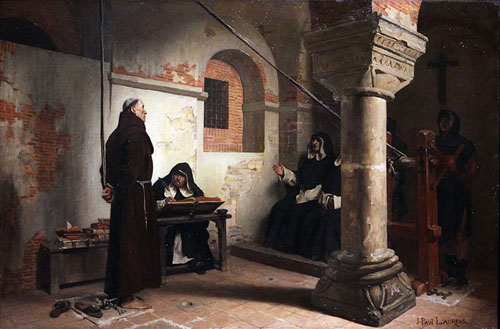
Jean-Paul Laurens, L'Interrogatoire, 1881
Dominican Inquisitors prepare to torture
Bernard Délicieux using the strappado
When the winch is turned Délicieux will be hoisted
off the floor by his hands which have been tied behind his
back. If this is not sufficient then he will be allowed to
drop then pulled up quickly, dislocating his shoulders. If
that does not work, ever heavier weights will be attached
to his feet and the process repeated until the required result
is obtained.
|
 |
| |
|
Jean-Paul Laurens, After the Interrogation,
1882. Oil on canvas, 32 1/8 x 48. Private collection.
This is from another sequence by Jean-Paul Laurens (so the
victim is not Bernard Délicieux )
|
 |
| |
|
Jean-Paul Laurens, Le pape et l'inquisiteur,
1882. Oil on canvas, 44 1/2 x 52 7/8. Musée Des Beaux-arts,
Bordeaux.
The Pope and the Inquisitor shows Pope Sixtus
IV with Torquemada, who is examining the Papal Bull making
him Inquisitor General of Castilla and Aragon in 1483.
|
 |
| |
|
|
|
Jean-Paul Laurens, The Walls of the Holy
Office (1883) depicting the role of the Pope’s hidden
adviser;
Jean-Paul Laurens, The Great Inquisitor in
the Time of the Catholic Kings (1886) depicting the decision
to persecute Jews in the Spanish kingdom
|
| |
|
Jean-Paul Laurens, The Men of Holy Office,
1889. Oil on canvas, 57 1/2 x 79 1/2. Musée de Beaujeau,
Moulins.
Showing the effectiveness of repression in
the Roman Catholic Church-State in this portrayal of Inquisitors
examining the files of those whose lives are in the balance
(These are Dominicans in their summer outfits)
|
 |
|
|
|
|
Catholic & Inquisition Documents
Including Inquisition Depositions
Canon
Four of the Council of Tours (1163)
Canon
Three of the Fourth Lateran Council (1215)
An
Extract from the Chronicle of Ralph, abbot of Coggershall concerning
the discovery of a Cathar in Rheims
Bernard
Gui,
Extract from the Inquisitors' Manual [1307-1323], Practica inquisitionis
heretice pravitatis on the Waldensians
Bernard
GUI,
Extract from the Inquisitors' Manual [1307-1323], Practica inquisitionis
heretice pravitatis on the Beguines
Bernard
GUI,
Extract from the Inquisitors' Manual [1307-1323], Practica inquisitionis
heretice pravitatis on the Albigensians (Cathars)
Caesarius of
Heisterbach: Medieval Heresies from Dialogue on Miracles, V
, Discussion of Waldensians, Albigenses, and "intellectual
heretics" at Paris.
Angelo Clareno, a
Spiritual Franciscan: On Torture ,
early 14th Cent.
Medieval Sourcebook, Primary Documents Jacques
Fournier, Bishop of Pamiers 1318-1325: The Inquisition
Record. [At SJSU] English translation by Nancy P. Stork of selected
confessions by Cathar heretics and Jews to Bishop Jacques
Fournier and the Inquisition at Pamiers.
- Béatrice
de Planissolles (noblewoman, Chatelaine de Montaillou,
later husband of Barthélemy
Amilhac, suspected of Cathar beliefs)
- Barthélemy
Amilhac (priest and husband of Béatrice
de Planissolles suspected of Cathar beliefs)
- Grazide
Lizier (widow of Pierre Lizier of Montaillou (and the local
priest's concubine) suspected of Cathar beliefs)
- Agnes
Francou (member of the sect of the Poor of Lyons - A Waldensian
who refused to swear an oath)
- Aude
Fauré, Wife of Guillaume Fauré, of Merviele:
Confession to doubting the doctrine of transubstantiation
- Guillemette
d'Ornolac, Widow of Bernard Benet d'Ornolac: Confession to
doubting the doctrine of the immortal soul.
- Arnaud
Gelis, also called Botheler "The Drunkard" of Mas-Saint-Antonin:
Confession to communicating with the dead
- Baruch
of Germany: Interrogation of a Jew who was forced to convert
to Roman Catholicism, but remained a practising Jew
- Huguette
de Vienne, wife of Jean Marinier or Jean de Vienne: Interrogation
of a Waldensian who refused to recant.
- Jacqueline
d'en Carot: Interrogation of a woman who doubted the doctrine
of the resurrection of the dead.
- Navarre
Bru, widow of Pons Bru of Pamiers: Confession of having talked
to Arnaud
Gelis about her dead husband.
|
|
"The cardinals dallied with their duty
until 18 March 1314, when, on a scaffold in front of Notre
Dame, Jacques de Molay, Templar Grand Master, Geoffroi de
Charney, Master of Normandy, Hugues de Peraud, Visitor of
France, and Godefroi de Gonneville, Master of Aquitaine, were
brought forth from the jail in which for nearly seven years
they had lain, to receive the sentence agreed upon by the
cardinals, in conjunction with the Archbishop of Sens and
some other prelates whom they had called in. Considering the
offences which the culprits had confessed and confirmed, the
penance imposed was in accordance with rule—that of perpetual
imprisonment. The affair was supposed to be concluded when,
to the dismay of the prelates and wonderment of the assembled
crowd, de Molay and Geoffroi de Charney arose. They had been
guilty, they said, not of the crimes imputed to them, but
of basely betraying their Order to save their own lives. It
was pure and holy; the charges were fictitious and the confessions
false. Hastily the cardinals delivered them to the Prevot
of Paris, and retired to deliberate on this unexpected contingency,
but they were saved all trouble. When the news was carried
to Philippe he was furious. A short consultation with his
council only was required. The canons pronounced that a relapsed
heretic was to be burned without a hearing; the facts were
notorious and no formal judgment by the papal commission need
be waited for. That same day, by sunset, a pile was erected
on a small island in the Seine, the Isle Des Juifs, near the
palace garden. There de Molay and de Charney were slowly burned
to death, refusing all offers of pardon for retraction, and
bearing their torment with a composure which won for them
the reputation of martyrs among the people, who reverently
collected their ashes as relics."
(Henry Charles Lea, A History of the Inquisition
of the Middle Ages Vol. III, NY: Hamper & Bros, Franklin
Sq. 1888, p. 325)
|
 |
| |
|
|
|
|
Alphonse's draft letter is held in the French
National Archives, in a dossier called "Grands documents
de l'histoire de France; Florilège", No
notice 00000192, Fonds MUS, Cote AE/II/257 (Cote origine J428/1):
described as "Projet de texte rédigé pour
Alphonse de Poitiers, comte de Toulouse, afin d'obtenir du
pape Innocent IV une bulle sur les poursuites contre les hérétiques.
Au verso figure le dessin d'un hérétique livré
aux flammes. Document non daté, en latin."
The bull ceded to the State a portion of
the property confiscated from convicted heretics. The State
was obliged to take on the responsibility for carrying out
the penalty (since the Church insisted that churchmen should
not shed blood). The relevant portion of the bull read: "
|
 |
|
|
|
Further Information on Cathars and Cathar Castles
|
|
|
|
|
|
|
If you want to cite this website in a book
or academic paper, you will need the following information:
Author: James McDonald MA, MSc.
Title: Cathars and Cathar Beliefs in the Languedoc
url: http://www.cathar.info
Date last modified: 8 February 2017
If you want to link to this site please see
How
to link to www.cathar.info
For media enquiries please e-mail james@cathar.info
|
|
|
|
|
|
|
|
|
|
|
 |
|
|
|
 |
|
|
|
|
|
|
|
|
|
|
|
|
|
|